
The Dancing Diva | Lorraine Comanor
Originally published May 10, 2025
We may spend our whole life climbing the ladder of success, only to find when we get to the top that our ladder is leaning against the wrong wall.
Attributed to Thomas Merton
The year my father died my mother morphed from an artist into a dancing diva. A former student at the Boston Museum School of Fine Arts and Harvard, she’d abandoned her brushes at the start of my skating career, recently picking them up again to capture the National Guard firing on the Kent State students. The subject was an unexpected departure from her portraits and still lifes, because she wasn’t a political person. The drama of the 1970 event evidently caught her imagination, perhaps brought her back to my days of competing on the world stage.
Three years later, a decade after I’d hung up my blades, when I returned to Boston to finish my anesthesia residency, I found her hard at work. “It’s going to be my best painting yet,” she said, showing me a series of preliminary sketches along with a developing canvas. Today I can still visualize the triangle of menacing guards descending on the unarmed crowd, feel an energy absent in some of her older paintings, and thinking, “Mom’s coming into her own.”
But, two and half months after my return, my father had a middle-of-the-night, fatal heart attack and rather than waking me – I was across town– before my long day at the Brigham, Mother called the police. They’d come immediately and, although there was nothing to be done, had been so kind that she felt guilty about her Kent State project and days later destroyed both the sketches and the main canvas.
Something about her explanation didn’t ring true, but I didn’t challenge her. Shortly thereafter, despite never having shown an interest, she took up ballroom dancing, claiming she’d become a hermit if she stayed in her studio. Not one to do something less than 110 %, she packed up her brushes and started a daily trek to the dance studio.
Perhaps I shouldn’t have been surprised, because as a child she’d wanted to star in the Ringling Brothers Circus. If my skating had been that circus, I could understand her not accepting my quitting after winning the national championships, her anger at the German philosopher, under whose roof I lived during my Swiss training days, who had encouraged my exploring life outside the rink. Still, I’d felt badly about her abandoning her painting – she’d been drawing since she was a little girl and was a recognized artist– but occupied with work and family, I didn’t try to persuade her that painting and dancing weren’t mutually exclusive. Having been pushed to return to the ice after retiring, I knew that if your heart wasn’t in what you were doing, it didn’t come out well.
Mother’s obsession with dancing wasn’t initially obvious, but then my knowledge of her life was limited to what she told me on the phone, as six months after my father’s death, I’d moved back to California to start a practice. Yet, by the time she relocated to Florida two and a half years later, the dancing bug had taken firm hold. She raved about her new teacher, Jack, one the of two partners in their thirties who ran the Boca Raton studio, but I often found her upset after a lesson, describing criticism far harsher than what I’d received from my most disparaging skating coach. So, when Jack’s partner, John, also tired of Jack’s caustic words, told Mother she was beautiful, that he could make her a star, the two teamed up.
John convinced sixty-three-year-old Mom that dancing stars needed to make an entrance. She couldn’t come to the studio in New England matron outfits. Mom started shopping for more fashionable clothes, painting her fingernails, getting pedicures for open-toed heels. At John’s insistence, frugal Mom stopped pumping her own gas. Dancing divas didn’t pump gas. They got full service. She had to work on her image. Which apparently included a makeover of her plain Jane daughter. Only I balked. I was fine with pumping my own gas, okay with minimal make up that didn’t smear inside my O.R. mask. More a child of the woods than of the shows, I’d made a radical departure from the stage, trading costumes for scrubs, hiding behind the ether screen in hat and mask, joining the invisible profession of anesthesia.
Perhaps when Mom insisted on full service and started talking about Sonja Heine-style entrances, I should have understood she was ready to give up a behind-the-scenes role and was serious about becoming a star. Even submitting to a second face lift when she’d suffered a cardiac arrest during the first. Even taking amphetamines to go from a size twelve to a size two and ending up with a four-unit GI bleed. Gone was the mother who’d once applauded grandkids in the Christmas pageant, joined us caroling, hunting for a Yule log. In her place was a dancing diva.
Initially, she’d aspired to international ballroom, travelling to Blackpool to watch the competitions, but John persuaded her to switch to his specialty, theater arts. Initially afraid of the lifts, under his tutelage, she gradually became confident. Only four years older than I, John could make her fly like a swan, then shower her with lavish compliments and little kisses, none of which had been part of my reserved New England father’s armamentarium. My father thought highly of my mother, but he didn’t offer the praise she craved and that John provided.
Overnight John became a permanent fixture in Mom’s life, always along on every family visit. Hoping to build her name in the dance world, she also brought him to major competitions for young, top-level dancers, where, if they couldn’t compete in a Pro-Am division, John often arranged for them to do an exhibition. Afterwards he never missed an opportunity to tell everyone how beautiful she was, how the crowd loved her, how she always brought the house down. He convinced her to set up a dance corporation, develop a web site. When he had Mother securely in his realm, he introduced his friend Shane, suggesting that Shane’s dramatic sword dances would enhance their productions, help garner accolades she’d never imagined in her forties and fifties chairing Phi Beta Kappa at Harvard.
So, Mom ignored her attorney sister Doris’s concerns about this son of a thirteen-year-old Seminole and a German army major who had panic attacks, issues with alcohol and money management, and a male partner. He’s outgrown being gay, she argued. She bought John a little house, and, later, lied about his age to move him into her retirement complex, so he was readily on hand to help her with another show. Wanting him to feel masculine, able to pay the bill at a restaurant, she put his name on her credit card. And finding him always short of cash, my previously prudent mother started paying his bills. “He’s an artist,” she’d say, “Money goes through his fingers like water.”
Between our visits, I would listen to her on the phone, marveling at her energy, but squirming, as she bragged how she and John had brought the house down yet again. While I didn’t miss the present-at-every- practice skating mother she’d once been, our conversations often left me feeling I’d come up short, that I’d failed to redeem myself after leaving skating too early. I had to wonder had I gone beyond national champion, not opted out before the next Olympics, would she, at sixty plus, have stuck to her own art instead aspiring to dance on the world stage?
Eventually she moved away from competing herself, complaining of nasty politics, but also probably realizing that, although dancers might be older than skaters, age was catching up to her. However, sponsoring competitions and producing galas allowed her to remain in the spotlight. She put together and financed “Ballroom Fever,” a show well reviewed in the New York Times, but ultimately too expensive to take on the road. She went to skating competitions, touting her dancing with judges and commentators, before producing an extravaganza in Athens, to beg the Greek gods to admit dancing to the Olympics. A fortune in costumes, stage sets, air fares, legal fees, salaries for dancers, Shane and John. A listing in the Ballroom Dancers’ Hall of Fame after a $50,000 donation to the American Ballroom Society. A dance professorship following another large bequest to a local university. The latter two discovered after her death. I didn’t begrudge her spending money for pleasure, although I worried about her going through her inheritance for stardom, abandoning her former intellectual world for the dance universe. Was she reliving what she missed about my skating? Was I just now understanding how important having a child star had been to her? But as her new career made her happy and she and John appeared good friends, who was I to question either?
Three months after suffering a mild stroke at ninety-one, she and John were in London putting on a show when her sister Doris was diagnosed with advanced metastatic cancer and sent home with hospice. Repeatedly I left messages at their hotel, but Mother didn’t return the call for several days. “You need to come immediately. Doris is going fast,” I told her, offering to make reservations for both of them at the Brookline Holiday Inn, where I was staying, the closest hotel to my aunt. But John wanted the Harvard Club across the Charles. He couldn’t stay in a Holiday Inn, because what if you died in a Holiday Inn? What would people say?
The two arrived in the middle of the family death vigil, as Doris’s lungs were rapidly filling with fluid. When her breathing became so labored as to require morphine, Mother said to John, “You need to take me back to the hotel to get the video of our London show. Doris will want to see it.”
Doris died that evening and six months later, Mother had a fatal stroke. John didn’t think to call me at home and later went to the wrong airport to pick me up. By the time I got to the hospital, it was too late for a last conversation.
During a break from her bedside vigil, her neighbor described a dinner scene, later confirmed by Mother’s doctor, from a few days before. In the middle of a financial discussion, Mother told John that no more money would be going to Shane. Angered, a couple of drinks on board, John lunged at her, bending her arm backwards, toppling the table. Eventually she was rescued by the waiter and some octogenarian diners.
After her death, going through her credit card statements, I found a charge for motorcycle parts made two hours after her stroke. John didn’t have a motorcycle, but Shane did. John brought him uninvited to her funeral dinner, seating him across from me. I tried not to think about any of it, as I closed her apartment, carefully packing up her art.
When the truck with her possessions arrived in California, I went through her drawings and canvases, to decide which to hang, but also in the hopes of finding a Kent State sketch that she’d missed when she’d destroyed the lot. Never having bought the “kind police’ or ‘fear of becoming a hermit’ excuse for her abandoning her painting, I thought a drawing might provide a further clue to the direction she’d taken, one that had brought her such pleasure at such a cost. But no luck; she’d purged every last one.
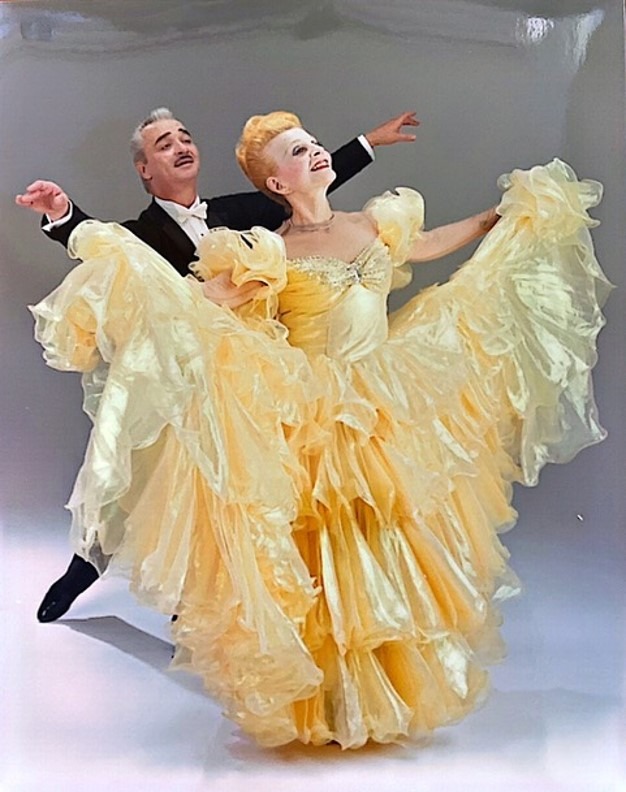
She had, however, assembled what she labelled her legacy, not her paintings and sculptures, but a collection of photos and videos from her dancing years. A seated series of her crowned holding a scepter. A myriad of dramatic poses with John, all in exquisite gowns, including one with Shane brandishing his sword that reminded me of Darth Vader as the lead National guard bearing down on the Kent State students. Perhaps she was trying to capture the excitement she missed at my world championships, pick up where I’d left off, even go further.
My later milestones had lacked the drama of my skating life. For most of them — including the arrival of her first grandson — there’d been a dance conflict. Within hours of his birth, she’d pressed me to come straight from the hospital to the hotel where she and John were giving an exhibition. Which, I did, baby in tow. For all but one of her grandchildren’s graduations, there’d been a show. She couldn’t make it to the National Library of Medicine’s opening exhibit of notable women physicians since the Civil War. So, I hadn’t gone to my own reception.
Perusing the photos she’d assembled, I began to understand that a child who preferred the woods to the ice rink, an adult who donned scrubs instead of gowns, was the wrong daughter for a mother who craved the spotlight. I boxed up her collection along with my skating pictures and newspaper articles, and shelved them in the garage. Searching for a better remembrance of Mother, I discovered a small group of photos that are now mounted in my bedroom. They’re from what I call the interim years, that short period between the end of my skating and the start of her dancing when we were an ordinary family, singing Christmas carols, hunting Yule logs, the pursuit of stardom, momentarily suspended.
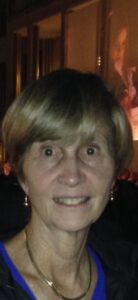
Lorraine Hanlon Comanor is a former U.S. figure skating champion, U.S. team member, and board-certified anesthesiologist. A graduate of Harvard University ( BA), Stanford Medical School (M.D.), and Bennington Writing Seminars (MFA), she lives in Carmel Valley, California. She is a co-holder of a medical patent and author-coauthor of 35 medical publications and her personal essays ( 2 notables in Best American Essays and 3 nominated for the Pushcart Prize) have appeared in the New England Review, Boulevard, New Letters, Little Patuxtent Review, Consequence, Joyland, LitMag, The Rumpus, and Newsweek, among 13 others.