
Originally published December 6, 2024
I’m sixteen and sitting on a Polish charter bus, staring at the itinerary my Tel Aviv high school teachers have passed around. We’re coming down from the exhilaration of being on a plane with our classmates, all the way from Israel, on what we anticipate will be a life-changing experience: A four-day field trip to the Nazi camps in Poland.
Raised on the Holocaust from an early age, part of me expects to be met with swastika-lined streets, shuttered Jewish shops, broken glass. Maybe even a few bodies piled on street corners. Instead, I look out the bus window and see cobblestones and quaint town squares, outdoor cafés. I imagine that our Jewishness is written all over our faces, and for a moment I feel extreme unease whizzing through the streets of Warsaw, no matter that we are on a bus and not a cattle train.
“Auschwitz in the morning, shopping in the afternoon,” I say to myself, reading the itinerary. Each of our four days has us at a different camp until the afternoon, when the teachers have scheduled a variety of shopping excursions: an outdoor mall in Warsaw, the old Krakow Market, the picturesque ski town of Zakopane. We even get dinner at McDonalds.
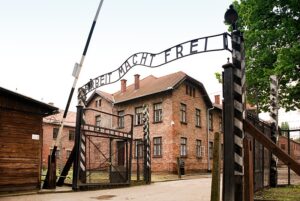
As we step off the bus and approach the camp the next day, we discover that Auschwitz has a gift shop. Do you think they sell ice cream? we joke sarcastically …and soap, someone whispers, taking it a bit too far. We shudder, remembering the stories of all the unfathomable things the Germans made with the Jewish remains. There are books and postcards—scenes of pastoral lush green grass, where once stood a death camp—and we all know but decide not to say out loud why the grass is so healthy, why the green is so green.
Our tour guide leads us through the still-standing barracks, shows us where the officers lived in big brick buildings, and points to where Mengele conducted his human medical experiments. We peek into a gas chamber and are told to look at the walls carefully: Do you see the scratches? Those are from the nails of people being gassed, trying to escape. Next on our tour is the crematorium, with its brick ovens, long enough to burn two bodies at a time. Our guide describes how the gassed bodies were dragged into this room, stripped of any remaining valuables (hair, gold teeth, anything precious enough to be hidden in body cavities) before being burned in the ovens. His tone is matter of fact, but I can see tears welling up in the teachers’ eyes. It’s hard to breathe.
The itinerary deliberately seeks to pace the experience by unleashing us on the Polish markets for the second half of each day. We gladly cooperate, desperately needing some relief, and turn our attention to big teenage decision-making: what color of Doc Martens are we going to buy from the merchants at the Warsaw market, and are they fake or originals? And does it even matter? We breathe in crisp foreign air and try to hide our Israeli accents, falling asleep at the end of the day in a daze of emotions we shove deep down so we can get up and trek to the next destination of horror in the morning.
The Majdanek camp welcomes us with more exhibits of Jewish remnants. First, we are led into a barrack, the walls of which are lined with metal boxes filled with shoes. So many shoes, so many so small, all covered in layers of dust, having sat here in cages for decades. I focus my gaze on a pair of red mary janes that would fit a five-year-old girl. Before I can feel anything, we’re off to another exhibit of pots and pans, suitcases, jewelry, prosthetics––all behind glass. We walk through the camp in a silence unusual for a group of teens, and finally reach a monument where we stand in an even quieter quiet, trying to make sense of the hell we’ve been walking through. Everything we have lived and breathed through books, movies, grandparents coming into our school with numbers tattooed on their arms, has now come to life, in all its deathliness.
Let our fate be a warning to you. These are the words engraved on a low dome molded from the ashes of Jews killed in the camp. We stand and stare in silence, having suddenly lost the desensitization that had allowed us to indulge in shopping and dining all week after touring the camps, to share Holocaust jokes under our breath. Let our fate be a warning to you. There’s a power in seeing these words displayed outside of Israel, in the very place so many were murdered.
And in some strange way, there’s a sense of pride emerging within us––perhaps even some redemption in seeing these words here, in blood-soiled Poland, where the message is louder than ever: Never again.
***
Only a couple years after the trip to Poland, my fellow highschoolers and I were drafted into the Israeli Defense forces, as are all eighteen-year-olds in Israel. Most see it as a natural part of life, the equivalent of going to college in the United States. For some, getting into an elite force is like getting into Harvard. It’s the social norm, as is the conviction that without a military, Israel will be wiped from the map.
But just a few days into bootcamp, I knew there was no way I could serve for the next two years: Besides the ideological conflict within––I had not a single militaristic bone in my body–– I was a teenager who couldn’t accept being forced to be part of something I didn’t believe in. Being raised by my pro-peace activist mother, and surrounded by peers who rejected the mandatory draft to the army, I also realized that I’d not want to raise children who would have to serve, and decided to move to the US, where my American father lived, and where I had spent some of my childhood.
During my first few years back in San Francisco, my accent steadily became more American, and my politics moved even further to the left. The physical distance from my homeland emboldened my sense of entitlement to criticize the Israeli occupation of Palestine, but I knew this was a privileged stance because, unlike most Israelis, I had a choice. I was an American citizen and didn’t have to live there and try to live a semblance of a normal life while blocking out daily threats. Didn’t have to endure the cognitive dissonance of believing in making peace with an enemy that continued to inflict so much pain on my people, of holding onto the belief that most Palestinians want peace despite their years of oppression.
It was mostly because I liked children and knew Hebrew that I soon became a Jewish educator in reform and liberal synagogues. There was nothing religious about the way I was raised, but in America I was seen as an expert on all things Jewish: I could read Torah, knew the holidays, was fluent in Hebrew. And I could, of course, teach The Holocaust.
And so there I was, a 21-year-old secular Israeli-American, tasked with the responsibility of introducing fourth graders to The Holocaust. My Israeli cynicism couldn’t help but mock the way these kids had been coddled and protected from what I had been exposed to at a far younger age.They were the lucky Jews who’d never experienced bomb shelter drills at school, or suspicious packages to beware of on every street corner. Who never had to think about suicide bombers on the bus to school. The ones who got to wait until they were “old enough” to learn about the six million—and even then, got a watered-down version.
And then a realization: Most of my Hebrew school students wouldn’t even be considered Jewish by most of the Israeli orthodox Jews my friends and I would pass by on the streets of Tel Aviv, us in revealing tank tops on scorching summer days, them in old Jewish Eastern European attire: black suits, long sleeves, and top hats. Some of my students had a Jewish father but not a Jewish mother (Judaism is matrilineal); some even had two parents of the same sex (strictly forbidden in orthodox Judaism), or unmarried parents who’d gladly serve shrimp at a Bar Mitzvah. But we’d all be Jews in Hitler’s eyes, payos or no payos. Pork or no pork. God, or no god.
It was in America that I heard new versions of the ancient prayers—versions that rejected the notion of the Jews being the chosen people. I was surrounded by Jews who didn’t feel they could blindly support the State of Israel and its policies. Suddenly it dawned on me that being Jewish was not the same as being Israeli, and that an Israeli is only one type of Jew; one of the newer iterations. In Israel, I had grown up with a clear message that I didn’t have to be religious to be a Jew; now it was sinking in that I didn’t have to be Israeli, either.
I spent a couple of decades settling into this reality, identifying, if asked, as a secular American-Israeli Jew, always feeling the need to clarify that I am against the occupation of Palestine. I held onto my leftist politics as I fumbled my way through an anemic, amorphous version of Judaism, telling myself there was no real need to define something so multifaceted.
Then came October 7th, with its lack of differentiation: Jews are Jews are Jews, Israelis are Israelis are Israelis. Jews hid in closets again, in attics. Babies were tucked away in dresser drawers as their parents were slaughtered in the same room. And for a precious few moments the world, for the most part, stood in shock at the events. Nothing like this since the Holocaust, people were saying. We stand with Israel. Grasping both the gravity and opportunity of this moment, I could see in my mind’s eye all of Israel standing up and turning towards the rest of the world with a plea to come not only to its rescue, but to the rescue of all the innocent Palestinians who would be the next victims in this endless cycle.
But as expected, Israel dived head first into war, ruthlessly retaliating, and I paused. I put my life on hold. I wanted to detach myself from Israel and its atrocities. From a nation of people suffering from deep-seated, generational PTSD—the grandchildren of Holocaust survivors—unleashing the war machine, yet again. I watch with the rest of the world as my high school classmates and their now grown sons and daughters fight Hamas, all while taking up the fight of our ancestors in Europe. Never again shall we be lambs led to slaughter. Never again.
***
In the early 1940s, when my father was a young boy living in Burbank, California, his father received a letter from Europe. It was from another Goldner, begging for help, for sponsorship, for anything that might get his family out of Europe during the rise of Nazi occupation.
My grandfather did not respond, and his son—my father—carried the guilt of that inaction through his life like a badge of shame, though he never admitted this to me. He didn’t have to; I could see his gray eyes grow wide as a child’s, lined with terror, as he retold me again and again this snippet from his childhood. It was a confession of wrongdoing, one that needed repairing.
So instead of admitting to a guilt that wasn’t his in the first place, he became a Holocaust expert and collector. His shelves were packed with books on Hitler, Eichmann, the Reich, many versions of Anne Frank’s diary. An Auschwitz coffee table book. He made a documentary about a Holocaust survivor and showed me “The Eternal Jew,” a Nazi propaganda film when I was too young to understand why Jews were equated with rats, why noses and skulls were measured, chilling German narration in the background. I was so scared of the Holocaust that when showering, I’d imagine that gas would flow out at me instead of water. To this day I can’t stare her in the eye––Anne Frank, with her tilted head smiling sweetly at me from the spine of a book.
Now that my father has passed, his Holocaust book collection fills my garage: a place already filled to the brim with too much I can’t let go of. So, the books gather dust, an unsolved problem.
One day, my neighbor Lynn walks by our open garage door and sees the stacks. Embarrassed, I say: “These are my father’s books. All these piles of boxes.” She asks if I can donate them somewhere.
“They’re all about the Holocaust,” I explain. “Nobody wants them.”
“Well…” Lynn hesitates. “Maybe you should hold onto them. There seem to be more and more people denying that it happened.”
I stare at her blankly, unable to respond. For the first time since October 7th, I feel my Jewishness is seen as a simple truth, based in a reality far beyond politics. Beyond Jewish affiliation, beyond beliefs. Identity. I am suddenly back at the dome of ashes in Poland, enveloped in those words again: May our fate be a warning to you. And what I felt as a teenager as I stood and stared at the engraving was washing over me now––that strange mix of validation and acknowledgment. But Lynn’s words convey an even bigger truth, something that I hadn’t been able to articulate in my ever-growing unease around my identity, especially since October 7th: Diminishing these historic atrocities risks losing their lessons for humanity as a whole. It risks forgetting that we all have a part in ensuring nobody else inflicts similar horrors again. Onto anyone.
Standing among my father’s books, in the company of Anne Frank, Eichmann, Himmler, Hitler, Auschwitz with its gas chambers and gift shop, I now hear this ancestral cry directed at me—at all Jews and Israelis—to heed the warning on that dome as we look at Israel’s own actions. May our fate be a warning to you is a mirror turned on ourselves. It is a call to extend never again where it is hardest, scariest. Where it may feel like we could risk losing the very thing we’ve been fighting for as a people in hope that we can regain our humanity.

Naomi Anne Goldner is a San Francisco-based writer. She holds an MFA in Fiction from San Francisco State University, and her work has been performed, published and anthologized in various journals and publications including The Hill, Variant Lit, Entropy Magazine, Quiet Lightning, The Festival Review, Qu Literary, and the Smart Set to name a few. Founder of WordSpaceStudios Literary Arts Center, and editor-in-chief of Chariot Press Journal, she’s excited to find a home for her first novel.
