
Empty Nest | Shea Burchill
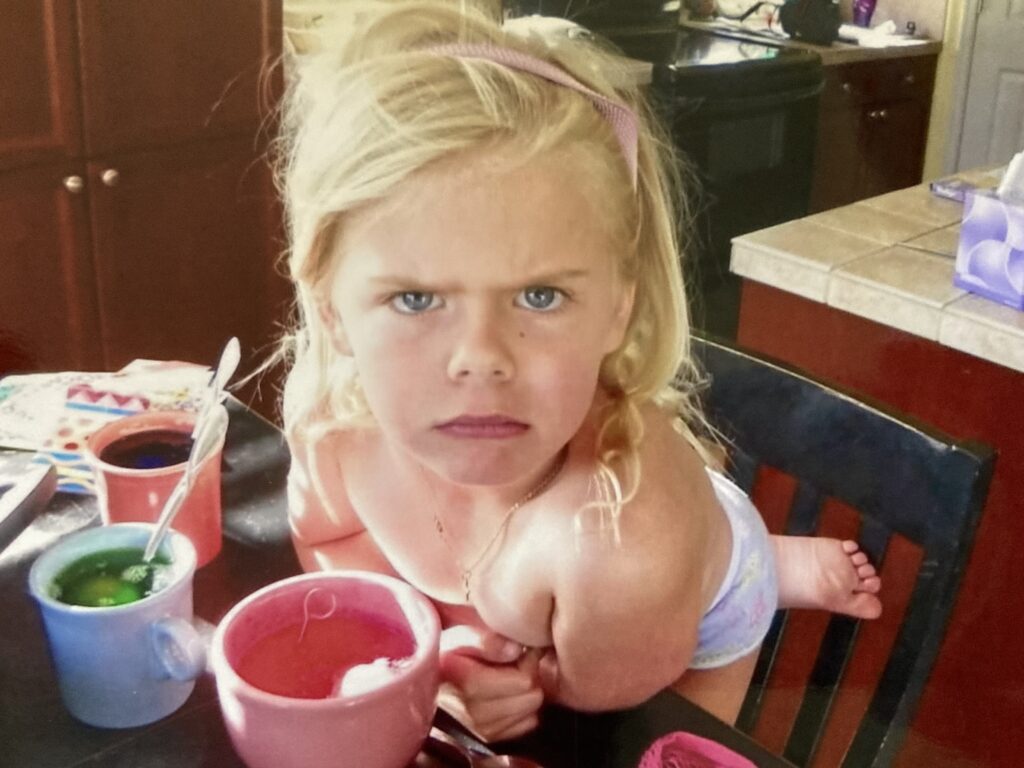
The Frowner by Shea Burchill
My youngest is set to go to college in England in just a few days, a circumstance I wouldn’t have bet on when I was peeling her physically off my leg at her preschool drop-off 15 years ago. Back then, Sawyer experienced every parting from me as though it would be forever; she clung to me with a prehensile strength that belied her tiny stature. And it didn’t really get better as the school year wore on. Every day I would hope for some improvement, but even on the days when she would chatter brightly to me on the car ride over, as we approached the gray steel door to her classroom she would once again begin to cry big wet tears down her shiny red cheeks. She couldn’t be convinced that I would be back soon. At the time, I craved just a few minutes for myself; time to get a few chores done or to work so I wouldn’t have to return emails or write pleadings late into the night. So even though I never harbored any illusions that preschool was some huge and important educational step, I still gave her a hug, pried her off me, handed her to the paraprofessional specifically designated to the task of restraining her while I left, turned my back, and walked away.
Sawyer was a mystery to me back then: she had emerged from me with a full head of hair so dark it looked black. By the end of her second summer it had turned a pale, platinum blond, but her eyebrows stayed that same dark brown, and most days they framed a very serious and persistent frown. It was a striking contrast to her older sister, Finn, who always seemed to have a soft, dimpled, Mona Lisa smile on her face.
My early mistake was to assume that I could parent them both the same way. I was 31; still at an age where I thought I had life mostly figured out. Finn had settled down into a careful, agreeable, joyful two-year-old after a hellish first three months of colic and breastfeeding troubles (where most nights at around 3 a.m. I honestly questioned if I was going to survive). Whether it was tumbling class, swimming, fire ants or fireworks, Finn took in the world with awe, enthusiasm and an unflappable peaceful presence. She napped on-time and regularly. She ate what I put on her tray and wore whatever outfit I pulled down from the hangers for her. I had no idea what people were talking about when they referenced the “terrible twos.”
But from the start, Sawyer was so different. Having learned that trying to get her older sister to sleep in a crib was a staked road to insanity, I let Sawyer sleep beside me in the big bed from the start, all fears of SIDS be-damned. Most nights, I barely woke up for her to breastfeed; I just rolled over like a puppy-mill Labrador and let her feed against me until her dark lashes slowly lowered over her cornflower blue eyes again and her little lips popped open in a perfect “o”. It was quiet, warm and soft. We were both safe.
If it had been up to her, she would probably be sleeping there beside me still. But sadly, it just wasn’t. When she was six months old, I found out my husband had been unfaithful. December 7, 2006, was my own personal Pearl Harbor Day. Everything I had trusted, known and believed in ended in the time it took to read a text. I had a two-year-old and an infant. I was a sleep-deprived wraith of myself. Like craft slime, my skin, muscles and fat had been stretched too far, and I was a stranger in my own body–still slowly trying to find my way back to my original form. I worked part time and didn’t earn enough to pay our two mortgages on my own. I didn’t know what to do or even where to begin to know what to do.
Shortly thereafter, an early winter snowstorm broke like a wave over the Indian Peaks, and we got almost two feet of snow. The rainbow-colored C9 Christmas lights we had hung on the bushes out front struggled valiantly to shine through the layers and layers of white, fluffy accumulation, but everything was cold and dark, and it felt like it always would be.
For me, as a mother, there has always been a demarcation—a disconnect between what I know in my bones I should do, and what I am capable of doing. I love my kids more than anyone else on this planet, and not by just a little bit. But showing them that love, caring for them with the grace, patience and care that is their birthright has been complicated and impeded by my own fears, insecurities and needs. For a period during that black December, my milk dried up from the stress which was problematic because Sawyer only breastfed. Her hunger and outrage was immediate and inconsolable. My inability to respond appropriately (with milk) felt apt and in-keeping with everything else that was going on; I felt scared, entirely helpless and without answers. When she would fix me with her red-faced gimlet stare as I tried to immediately introduce her to formula and cereal, exhausted, frustrated and sad beyond words, I was tempted to tell her, like I had begun telling myself over and over, “Yes, I KNOW this sucks. But welcome to the real world.”
We had transitioned her to her crib shortly before the news hit, and I had been dutifully waking two or three times a night to the sound of her tinny cries through the baby monitor and going to soothe her. But after everything fell apart, on the nights when I could get both girls to bed early and I finally had two minutes strung together to try to think about what I should do, to try to fit the jagged pieces of my life’s puzzle together, to make sense of what had happened, or more usually, to just close my eyes and sink into a thought-free oblivion that I craved with every atom of my body, I dreaded the sounds of her waking. Her whimpers were like a trumpet sounding reveille to a wounded and bloody soldier. But then I discovered the “off” switch on the baby monitor. Magically, with a push of a button, her crying stopped. Logically, I knew it was wrong, and my stomach churned at the idea of her alone in her dark room, not understanding why I wasn’t coming, waiting for me and waiting for me. But still I couldn’t bring myself to go.
And after a few nights…she stopped crying. At some point during those long shadowy hours, she found her thumb, and a lavender stuffed bear that had been tied to her crib railing who she would later come to call “Baby.” At six months old, she was not saying words yet, but she still managed, during those snow-muffled, tragic days leading up to Christmas to convey to me through grunts, pointing and her emphatic eyebrow glowers, that she wanted the bear to be untied from the crib. From that point on, if Sawyer wasn’t eating or sleeping, she usually had her thumb in her mouth and Baby nestled in the crook of her arm.
My husband and I moved on from the infidelity. We picked our way down a broken-glass path of anger and hurt to emerge, years later, on the other side. And Sawyer moved on from nighttime waking and breastfeeding to other childhood joys and challenges, but my heart ached when I looked into her eyes for any length of time. I could see in their depths a comprehension of that abandonment; an understanding of what had happened that went well beyond her age. I knew without question that she’d learned the lesson I so desperately did not want to teach her: that all love is imperfect and unreliable.
Because she always had a thumb in her mouth, Sawyer was really hard to understand. Not just when she spoke around it, which she did often, but also because she sucked it so much for so long that it impacted how her teeth came in and how she used her tongue. She would stumble up to me, her fine blond hair ratted from sleeping, eyes wide and eager, and squeak out a sentence excitedly, expectantly. When I would stare down at her–obviously not understanding– her dark brows would lower in anger, she would grip Baby tighter to her chest and her thumb would immediately return to her mouth. Often, Finn would translate for Sawyer. She seemed to understand her on a telepathic level (I could not imagine it was any easier for her to understand Sawyer’s actual words than it was for me). But still, there were communication breakdowns. Because her sister was so accommodating, because I could not understand Sawyer, and because I was so busy, and sad and overwhelmed, I usually tried to buffalo her into compliance. But she was not one to be bullied, and she would routinely resist with loud defiance and tears.
I had always known I was nonbinary; but when Sawyer was a baby, I was so deep in the closet I couldn’t see my own hand in front of my face for all the darkness and denial. So, for a person who struggled their entire childhood frustrated with being made to wear frilly dresses and other female drag, I was surprisingly tone-deaf when it came to Sawyer and clothes. She knew before she had words what she liked and what she didn’t. But I remained conveniently oblivious—blankly grabbing questionably matched tops and bottoms and swooshing them over her flaxen-haired head and up over her tiny toddler butt despite her squawks of protest.
It took me an embarrassingly long time to understand that was why she was angry each morning. Or maybe I did know, and I thought she should learn to embrace conformity quickly, just as I had to. Because even after I started comprehending that she wanted to decide what she wore each day, we battled. Fearing the old ladies at Target who would shame me with, “but it’s so cold outside!” I forced her to wear jackets although I knew it made her irate (she didn’t want her iconic fashion to be covered up). Some of her style choices: when she was two, she wore her Tigger Halloween costume every day for six months. In kindergarten, she opted to wear her fleece nightgowns instead of actual clothes. For a period, although she showed no interest in airplanes, she curiously wore an old leather pilot’s helmet everywhere we went. Thereafter, just as inexplicably, my husband and I spent an entire Christmas shopping season going from mall to mall trying in vain to find high heels for four-year-olds.
But it was more than just fashion autonomy. Yes, she hated certain socks, but the lightbulb that went off in my brain when I finally understood it was because the seams would twist and feel uncomfortable in her shoes was like waking up from a 30-year-dream and embracing the child that I had been. I sucked my thumb, too. I had a bear stuffy I took everywhere with me, too. I never wanted to sled or ski—I hated how the snow would seep in from the crack between the mittens and the coat and sear my skin, how my toes were always cold in my cheap Payless snow boots; Sawyer did, too. I hated loud noises and bright lights; so did she. Large groups of people made me nervous and shy; she burst into tears the first time I tried to take her to the public swimming pool after she saw all the splashing kids and chaos. I only ever wanted my mom to hold me…so did she.
Slowly, slowly, I stopped cramming her into clothes she objected to. I tried to stop caring what other mothers thought and started trying to listen to what she wanted. Her first soccer game, she began hysterically weeping when we pulled up to the fields, teaming with tiny toddler soccer players, their red, yellow and blue jerseys making them look like schools of fish flashing from one side of a green ocean to another. She sat in my lap the entire game, her warm back counting a steady rhythm against my chest, her thumb in her mouth… just watching. The coach and the other parents seemed, in retrospect, inordinately disturbed by her lack of participation in what was, at the end of the day, just a bunch of three-year-olds trotting, en masse, beside a ball. They kept coming up and chirping at me shrilly, “doesn’t she want to play?” I had to take deep breaths, meet their eyes with a firmness that has never been natural to me, and trust that backing Sawyer up, literally and figuratively, was the right thing to do.
In the end, the key to understanding her was not so hard, after all. One morning when her sister was at school, I had a work deadline to meet. I plunked Sawyer down in front of the TV to watch a movie about a lost dog. I worked with one ear trained to the next room, where I heard the familiar plot unfolding. But then midway through drafting my motion, she began sobbing so loudly and so inconsolably that I raced from my office, certain she’d fallen from the sofa arm where she liked to perch and broken a leg. In fact, she was sad beyond measure for the lost dog in the movie, and no amount of assuring her it would turn out okay could soothe her. She had the same reaction after we stumbled into the Denver Natural History Museum’s wildlife halls or dared to venture into a Bass Pro Shop—she was devasted by the stuffed and mounted animals, grieving their unnecessary deaths and the voyeuristic displays in a way somehow the rest of us managed to rationalize. Sawyer’s heart was blue-whale-big, and it ached for animals and children harmed by the stupidity, cruelty and injustices of the world. She knew all adults (most especially me, starting from that first cold December) could do better, and when we fell short, she was furious and heartbroken.
I have dozens of photo albums and so many photos of Sawyer. In many of them, she’s smiling—her nose scrunched up, her opal teeth flashing, her eyes twinkling like a wood sprite. But also, there are many of her glaring at the camera: at the Hollywood Walk of Stars, at the beach, in the mountains, on Broadway, at birthday parties; so, so many soccer games. I love those photos, too. I might love them even more because most of those frowns were well-earned. Maybe one or two were misplaced or misdirected, but so often if Sawyer was scowling, it was because I was asking too much of her, or because I was not protecting her, protecting her sister, not helping a small squirrel, or bird, or dog. It was because I was living life at a distance—trying to stay hidden and apart from its pain and responsibility—and was instead asking her to pose for a picture, to pretend at happy-family. She never stopped expecting more from me, never stopped wanting me to take that short walk to her room those first December nights.
When she was little, we read a book about owls all snuggled together in the big bed. Thumb in mouth, she stiffened beside me when I read a paragraph that said that if there is not enough food, owl parents will throw the weakest owl from the nest to die. There was that scowl, that outrage over nature’s brutality. At the time, I thought her upset and horror over that fact seemed disproportionate. Adrift in one of thousands of chaotic nights like it, caring for young children, working, staying closeted and navigating the rough waves of my relationship with my husband, it was easy to discount her intelligence, her comprehension of the empty nest’s metaphor. But in response, Sawyer must have decided staring up at the Day-Glo stars on the ceiling of her room, that being amazing at everything might bring me down the dark hallway of her past. Over and over, she kept trying to prove that she was not the weakest fledgling.
After Finn started school full-time, Sawyer became my little errand buddy. I would drive around with her to the grocery store, to the dry cleaners, to school drop-offs and pick-ups. Thumb in her mouth and often wearing a tiara and/or evening gown gloves, she would solemnly gaze out the tinted windows of our minivan, listening intently to Taylor Swift’s lyrics with me as the miles and days and years unfolded without me really paying attention.
Sawyer’s early school years were hard, even after she stopped clinging to me at drop offs. On the best of days, school was full of difficult personalities and challenging stimuli for her, and on the worst, she shouldered our society’s failures like an oversized backpack full of rocks that she wasn’t allowed to take off. Her cousin was born two months after her. They grew up together; went to the same elementary school together. Atticus is autistic, and although he struggled early on to communicate with most people, he and Sawyer always seemed to understand each other. She knew, more than the rest of us, what it was like to feel so constantly unheard. She was patient and kind with him but never patronizing. One day, after (what should be an NRA-sponsored) “active shooter” practice, her teacher took me aside after school to let me know that Sawyer had been very upset during the drill and that it had been hard to calm her down. When he asked her why, she had gulped out between sobs that she was scared because Atticus was bigger than her and she didn’t know how she would be able to find him quickly and carry him out. There was no sugar-coating or soft-landing I could give her—Sawyer was nobody’s fool; she would’ve recognized my equivocating or minimizing immediately. But scared and small as she was, and though she realized at age eight that her life, and her cousin’s, and her friends’, and her teachers’ lives were all at risk, she still kept marching into school each day after that day.
Those elementary years she would frequently tell me, though, with a sparkle in her eye and a jagged-tooth crooked smile, “You should take me out of school today.” She loved to play hooky with me. And every once in a while, I would email the attendance clerk that Sawyer was “sick.” Then we’d go to Target in the middle of the morning to buy things we didn’t need. We’d get Pizza Hut breadsticks and turn our tongues blue with the ICEEs at the food kiosk, then go back home to watch Tom & Jerry or Looney Tunes. But I took for granted those requests. Took for granted that she wanted to spend time just with me; that I was her favorite person. Busy and tired myself, always juggling part-time lawyering with full-time caregiving, it was so easy back then to prioritize the teachers’ understandable paranoia about her attendance impacting reading and math (and therefore standardized testing) over hours and minutes with my kid that were always, always slowly ticking down.
When she started middle school—when I stopped needing to physically attend to meal prep and laundry, homework and teaching her and her sister how-to-human…I began to take full breaths again. I emerged from the middle of a fourteen-year tornado where everything had been magical and full of love and wonder, but also stressful, blurry and chaotic—where I couldn’t follow a thought to completion because it would be whipped away in the wind as soon as it left a synapse. Now, with her sister driving and Sawyer pouring her own cereal, time was gifted back to me. And with it, the genderqueer realization that I had been keeping locked away in an Insta Pot deep inside my soul reached its maximum cooking temperature and began its inevitable pressure-filled release.
It was terrifying. I grew up in the 80s in a conservative-Colorado-farm-town turned conservative-Colorado-suburb. Swimming every day in a lukewarm paddling pool filled with the toxic green sludge of homo- and trans-phobia, I had slammed shut my own closet door in justifiable fear and self-loathing at 13. The idea of being honest—with my family and friends (and also with myself)—after a lifetime of play-acting, seemed like climbing Everest without oxygen—something that could be, in theory, accomplished, but not really by someone like me.
But in acknowledging it, I cracked what had been to that point an unbreakable code with a queer enigma machine—suddenly all the confusion, all the pain from my earliest memories-on, was translated. I now had a vocabulary to describe why I had always experienced the world, my relationships, and my life with my nose and hands pressed hard up against the glass—looking in from the outside. Even though I was so scared of what it all meant, of what would happen, and how it all would end, that language of authenticity couldn’t be ignored or shoved back inside the padded room of my heart. Furtively, I began writing, putting the Real Me down in a Word Doc…but carefully saving it under “untitled.” I told my therapist, confident I could still take the secret to my grave because of therapeutic privilege. With great trepidation, but without comment, I stopped using a purse, stopped wearing heels to court; began slowly shedding feminine artifices that had itched and burned my skin from before I could remember.
Sawyer was evolving, too. She broached adolescence right as my mother began a breast cancer tailspin and my father-in-law began showing early signs of dementia. And although I wasn’t out, my inner chaos was probably hard to miss—sometimes I thought you could actually see it rolling under my skin like a giant rogue, subcutaneous beetle. Given all that, and loving as big and unguarded as she did, intuiting other’s pain as much as she did, she had to come up with coping strategies, whether they made any sense or not.
After she got the stomach flu in sixth grade, she became obsessed with avoiding the chaos and lack of bodily control that vomiting entailed. Her bedroom became a sterile lab: a clean room. She stripped off her “outside” clothes before she entered, and (inexplicably) the only other living beings allowed inside were the dogs and the cat. I never had to worry about Sawyer being on her cell at school—for several years there, she didn’t take it out of her room. When she finally did, she carted it around everywhere in a plastic Ziploc. She asked for a UV phone sanitizer for Christmas.
Homework had to be done immediately after school and only straight A’s would do. Once the weakest player on her soccer team, she spent hours kicking the ball against a concrete step off our porch and running long, grassy hills until she became a force of nature in the backfield. Lithe and lightening quick forwards would ricochet off her ribboned thighs like scythed grains of wheat, and her passes were epic bending torpedoes downfield. She prayed for everyone she knew each night in a format that could not be deviated from or misspoken. In her mind, failing at these incantations meant life or death for the people she loved.
If she was disappointed or disillusioned when, ultimately, none of her control mechanisms stopped the COVID pandemic, or her grandparents from dying, or the angst that wafted off me like bad perfume, she didn’t admit it and she didn’t let up—she only increased her efforts. She was driven—obsessed with playing college soccer, and fingernails-chewed-to-the-quick-anxious: about games, grades, boys, friends and so many other things I’m sure she didn’t give breath to. That frown was ever-present on our long car rides to distant travel team practices and in the early morning blue light as she fed half her bagel to our dogs before school. But, having learned image-control like every American girl does (from Instagram), she smiled brightly and often in public—her long blond hair framing Viking cheekbones, the tip of her tongue lightly balanced behind her bright white teeth—so much so that people called her “Sunshine.”
Despite her crippling worry, or maybe because of it, she loved to laugh. She watched every season of Friends from start to end at least four times through so that the jokes became familiar and expected—a practiced hand run through the fur of an old dog. It soothed us both when the first music notes to the intro would come on in the background in the mornings while she got ready for school. She was delighted by jesters and class clowns. Not bold enough to be one herself, she still loved to banter with them when the teacher wasn’t looking, and though she was never cruel or biting, she was hilarious herself. Coaches, teachers, younger kids, friends, animals and strangers on the street—they were all drawn to her like she was her own invisible but irrefutable death star tractor beam.
I loved her laugh; loved her heart-breaker smile. I didn’t want to add my mid-life- awakening-rock to her pack. I had wanted to wait until she graduated high school to come out, but by the summer before her senior year, the truth had saturated my pores; it was dripping out of me. I knew that the tense, sometimes muffled, sometimes loud conversations I was having with her father behind closed doors were like morse code distress taps for her and her sister, and so ultimately, I agreed with him that it was best to tell them both.
My kids grew up in the Boulder County of the early and mid-aughts, with rainbow flags in classrooms and classmates who transitioned from one semester to the next. They navigated pronouns as though it was their second language. But being cool with queerness in general is a different bowl of soup from being ok with your mom telling you she’s nonbinary right as you’re trying to figure out who to go to Homecoming with. And so much harder when she comes out in the midst of Trump’s $215-million-dollar anti-trans political campaign; when the country (and lots of people you know), are observably, vocally, pivoting toward hate. Sawyer was always prone to more worry than the next kid, and now I had opened a new universe of concern for her. Beyond an understandable apprehension about how my appearance and my identity would impact her high school social standing, she was also terrified when I started going to protests, or really, any time we would go out in public with my ponytail gone, my hair short and shaved. She wanted to keep me safe in a time when any relative safety for trans people was crumbling into a vast ocean of bigotry.
I had lived my life as a white, cis-het woman. I had enjoyed privilege and safety hard to quantify. Now, every time I left the house, I felt conspicuous and targeted. It was hard to find an answer for her when she asked me in confusion and maybe a little exasperation, “If you’re so scared, why are you choosing to look this way now?” It was hard to explain adequately how the door had been blown free, the hinges torn loose, the frame shattered and that the Real Me who stepped through steadfastly refused to go back inside. I hated feeling afraid all the time, I hated that she had to be afraid for me all the time. I couldn’t blame her for being exhausted with me, for wanting some space to breathe and process. But opening that vault where I’d cowered for 50 years and learning to exist honestly was not without a different, intense insecurity and a new, soul-threatening fear of losing the people I loved most. It was hard not to be hurt. It was hard not to grasp.
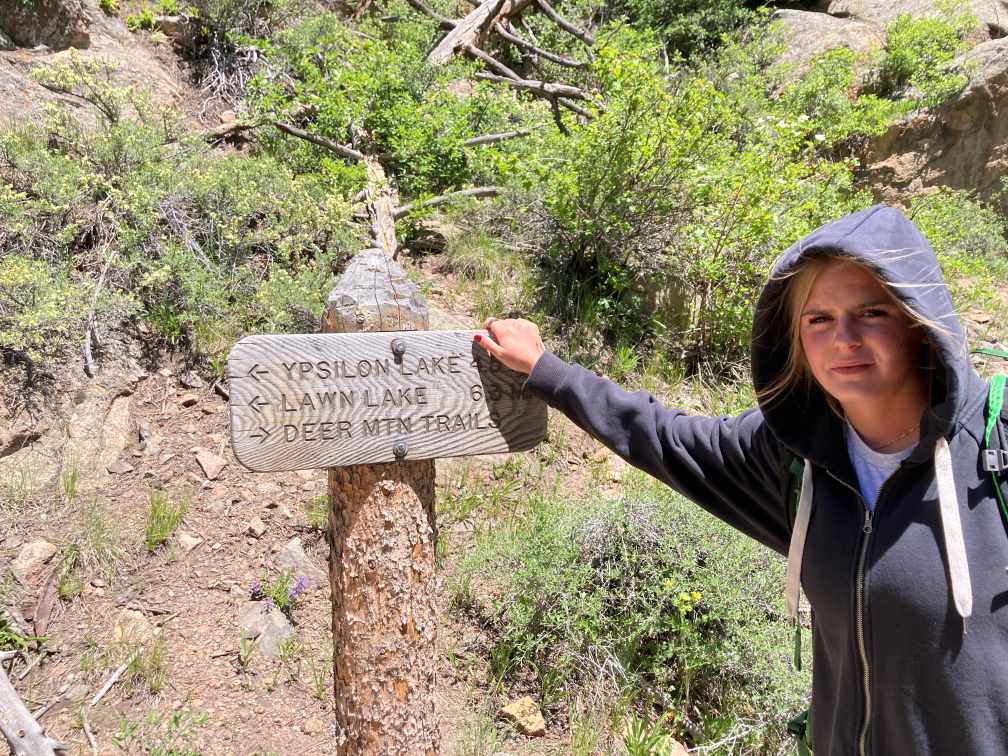
One early morning in the midst of it all, I cajoled her into hiking to Lawn Lake with me. Sawyer was an unenthusiastic hiker on her best days, the more so for out-and-back hikes—she didn’t want to see the same things twice. Her days of longing to spend time with me were long past, replaced by teenage priorities like scrolling IG or plans with friends. But out of guilt, and loyalty, and love, she reluctantly agreed. When we got to the trailhead, though, she stuffed her air pods in and set a relentless pace 10 feet ahead of me with her soccer-girl lungs and legs.
Lawn Lake was damned back in 1903 (along with a few other high mountain lakes in what is now Rocky Mountain National Park) by a bunch of Front Range farmers, eager to claim more water for irrigation. It was an earthen dam that fell into disrepair over the years, in part because it was so hard to reach. When it failed on July 15, 1982, the lake’s waters exploded through the canyon at a rate of 18,000 cubic feet per second. The lake emptied in about 30 minutes. The deluge gouged a deep and wide wound through the gorge–and though the river is a soft echo of what it would’ve been that day, the lake a fraction of its former size–the scar is still very visible today. It surrounds you as you walk: massive boulders thrown downstream for miles, exposed tree roots and earth carved like modeling clay—compelling evidence of the power and strength of nature withheld for so long by something men made.
As we were cresting the last rise nearing the lake, exhausted and having hardly said three sentences to each other for hours, something dark and large appeared on the trail ahead. So big that my mind couldn’t compute that it was real, although my eyes caught the small muscle movements and twitches that automatically meant it was alive and very much existing in the world. Sawyer saw it, too, and stopped dead on the path in front of me. A male moose.
We live in Colorado. There’s wildlife, sure. But we don’t encounter it very often. So, although I’d read trail signs before about what to do if you come upon a black bear, or a coyote, or a moose, I hadn’t committed anything to memory. I grew up watching Rocky and Bullwinkle—moose, with their improbable antlers and their ridiculous dewlaps always seemed like silly cartoons-come-to-life to me. But that is not the in-person experience. I was immediately terrified and desperate to have Sawyer safe. I told her quietly to get behind me. She slowly started walking backwards, but he had seen us, too, and started trotting quickly (more quickly than an animal that size has a right to) down the well-worn corridor right at her. She reached me just as he was approaching us both and I did the only thing I could think to do—I shoved her off the path and then followed behind her into a bunch of gray-trunked, disheveled pine trees.
Huffing audibly, he stomped right on by us down the trail and out of sight, satisfied (like so many male bullies in the world are) with making two females a fraction of his size leap out of his way because he could. It’s not a classic hero tale–I am not claiming I saved her life, or that I risked mine. Other than his claim to the path, he didn’t seem particularly agitated or angry. He was probably just late for a meet-up with a gray squirrel somewhere. But he did give me the gift of clarity; a precious few seconds of knowing my own soul. Because it was evident to me in those moments with absolute certainty that although I was so scared, and helpless, and without answers…still, I would’ve tried anyway. That had he meant more serious business, I would have covered her body with mine. That had he intended to take a life, he would’ve had to end mine before he got hers.
In the end, there was no big reveal, no drama, no scandal. And also, no answers to be found, other than continuing to live together as a family; continuing to love each other. We shuffled through her last year at home quietly, carefully. Being honest and kind with each other when we could, doing our best to apologize when we couldn’t, and letting the rest of the world think what it would. If there was talk behind her back or mine, I never learned of it. And on a dewy May morning this spring, with Longs Peak robbed of its snow and looming dark blue behind her, she stood in her burgundy cap and gown on the make-shift podium erected over the midfield line of her high school soccer pitch—her long hair blowing in the cool breeze—and accepted her diploma.
Which brings us to this September, and a moment that was hard to believe in those early years would ever really come: she is leaving for college. Not just down the road at CU, not a few hours away in Gunnison or Grand Junction, not just a short flight away on one coast or the other. She is leaving for England to play soccer (sorry, “football”), an entire Atlantic Ocean away. And I am so happy for her; I am. Because loving her makes me want to be the best version of myself—brave, selfless, supportive and encouraging. I am happy for her. I want everything good for her: I want her to have an expansive life, full of adventure, love, and lots of incredible people and experiences. But I am also so sad to be losing my little buddy; sad to be separated from my favorite person by time and space in a very straightforward Newtonian way.
And maybe a little scared, also, that her frown is my touchstone, my sacred object, my skeleton key. That without its immediate censure, I will not be the human I ought to be. Being Sawyer’s mom (for all my faults), was the best job I ever had, and I don’t quite know who I am without her in the room down the hall. Yes, I failed her early on. And yes, I’ve failed her any number of ways since then. But trying to love her the way she deserves to be loved has made me a better person. I so desperately want to keep being that person.
I know that Sawyer will always be my daughter, and that she will keep needing me in different, smaller ways. But it’s hard for different and smaller not to feel like distance. That distance has been growing inevitably, slowly, every day since the day she was born. When she was little it was so slight it couldn’t really be measured. But each year the momentum gathered, the speed increased, and the trajectory arced her further and further away. It is, I am assured, how things are supposed to be. It is astonishing; I am bewildered that this is where we are when those memories of the early days of preschool are still so sharp and clear.
But next week, after we’ve put the sheets on her bed and unpacked her clothes; when we’ve bought her shower shoes and a laundry bag, when we’ve met her flat-mates and maybe taken them all out to dinner, it will be time to say goodbye. That’s when it will be my turn. My turn to take a deep breath against the throbbing in my own heart, the ache that won’t let my lungs take a full breath. Time to step back, to hug her for a few minutes, but not too long. Time to tell her with a voice that doesn’t tremble to be brave, to have fun…when all I really want to do is grab onto her leg and not let go. Then it will be time to turn and walk away.

Sawyer by Shea Burchill
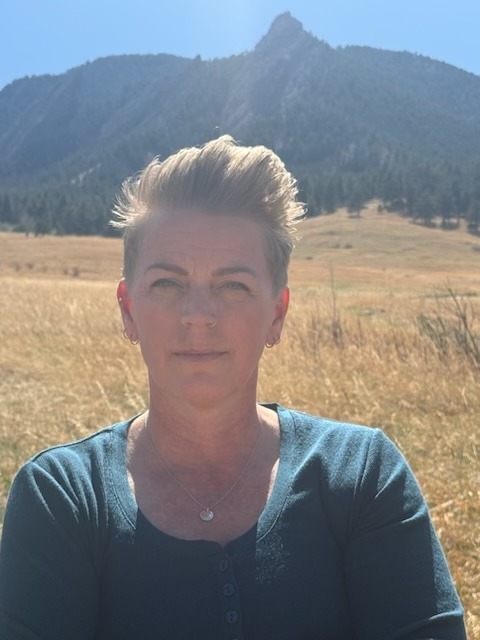
Shea Burchill (she/her) is a writer, essayist and divorce lawyer who lives on the Front Range of Colorado with her husband and three dogs. She has two adult daughters. Shea is the 2025 Fourth Genre Michael Steinberg Memorial Essay Contest Winner and was a finalist for the 2025 Missouri Review Jeffrey E. Smith Editor’s Prize in Nonfiction and the 2025 Reed Magazine Gabriele Rico Challenge for Nonfiction. Her writing has also appeared in Reed Magazine and Marrow Magazine.