

Changing Minds | Kristi Ferguson
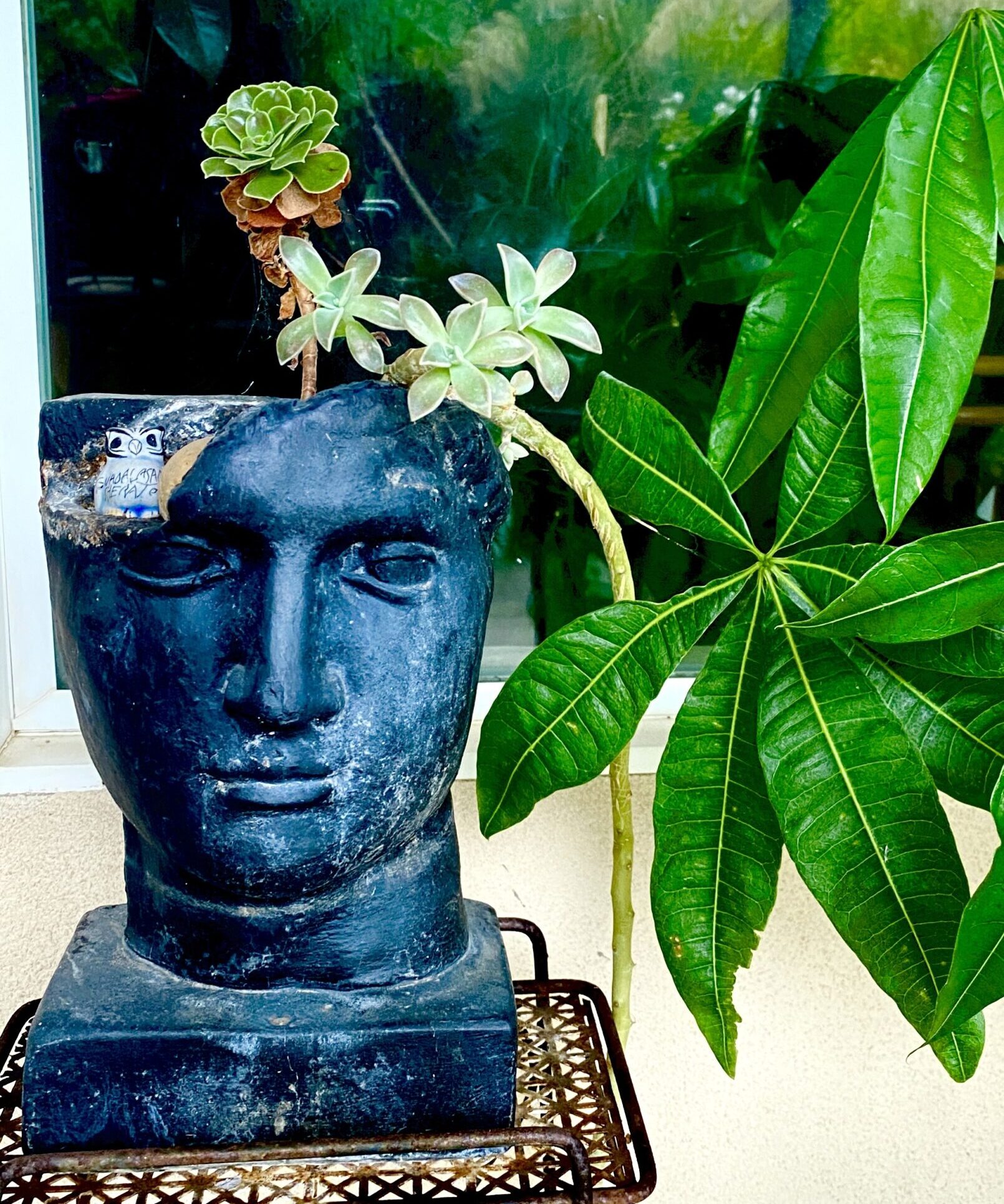
Open Mind by Sharon K. McClain
I don’t remember exactly when I began planning my nervous breakdown. It was perhaps seven years after I first arrived in the United States with a two-month-old passport, $200 in cash, and $800 in debt to the brother who bought my plane ticket. If so, it would have been the summer of 2016, after my second year of graduate school, when, months shy of my twenty-sixth birthday, I began telling my fiancé that I would schedule a breakdown after my degree.
The first person to tell me I had anxiety was a therapist in college. I was twenty-one, a sophomore. My appointment was on a stormy day, and I could hear the rain beat at the waiting room window as I thought of all the things I would rather be doing, all the homework I needed to complete, the tests I should have been preparing for, the texts I should have been reading. When my name was called, I walked down the hall past the general practitioner’s office where I usually went. I was seeing a therapist only because I’d started having break-through bleeding during in-class exams—my period arriving off-schedule, with no warning, while I worked out formulas in my behavioral statistics class. The college physician, in addition to upping the dose of my birth control pills, had insisted I visit one of the therapists.
At my destination, I sat on a cushy chair too comfortable for a doctor’s office. On an azure couch across from me sat the therapist, eyes kind and a beneficent half smile on her face. Her dark brown hair almost reached her waist, and she wore a flowered dress that was too long and too loose and too bright.
My therapist said I had anxiety. I was tempted to believe her. There seemed an alluring simplicity to the idea that there was something intractably wrong with the chemicals in my brain that could be fixed by the SSRI pills she insisted the college physician would prescribe me. But I was a psychology major. I had, by the time I stepped into the therapist’s office, been exposed to Rosenhan’s “thud” study casting doubt on psychiatric diagnosis, to Slater’s concerns about the easy distribution of psychotropics and the downplaying of their side effects, and to Loftus’s field-shattering findings on the unreliability of memory, from her “lost in the mall” demonstration of its malleability to the failures of eye-witness testimony. Which is to say I had developed a skeptical view of psychoanalysis, psychotropics, the criteria of the Diagnostic and Statistical Manual of Mental Disorders that is used by psychiatrists and psychologists, and of any mental diagnoses that rely solely on memory and self-report.
Therefore, when on my third visit, my therapist settled on anxiety, after first proposing that I had depression, then PTSD, her diagnosis didn’t faze me. When she recommended I alter my neurochemistry with a pill, I politely but firmly declined.
#
I was raised in missionary communes where belief was a prerequisite for parental care, for physical safety, for a place to live, for love, warmth, food, shelter. When I lost my belief at fourteen, I did all I could to hide that it was gone. During our brief sessions, my therapist posited that these years of hiding—of certainty that discovery would mean expulsion, homelessness, disaster—kept me constantly on edge.
Three visits with the therapist were enough for me to confess the more provocative anomalies of my upbringing in an insular religious community that most people would call a cult. I did not see her long enough to report its mundanities. We did not discuss the precarity of being raised by adults who were volunteer evangelists “living by faith,” nor my involvement, from a young age, in annual singing troupes in which children’s affectionate hugs and capacity to smile while belting out Christmas songs was tied to the generosity of their audience, and thus their parents’ ability to cover the rent of their multi-family home.
My therapist questioned me about physical and sexual abuse. I didn’t think to mention that thirteen was the age when I was first tasked with selling CDs at gas stations, counting earnings every hour of the day, deducing whether I’d take enough home. I never went hungry until my first year in America—I’d always lived in communes that received carloads full of expired goods. And I never knew the cost of our rent, only that it was desperately needed until my father said that it wasn’t, and then fundraising all but ceased until money was inevitably needed again. I spent hours as a teenager dissecting the absurdity of this financial strategy as I rode in a crammed car between restaurants where I and other women and girls sold CDs while my father led a band in playing music. When I started working stoplights, I developed crude theories of probability, tracking the number of cars I approached before one would give me a handful of coins for a magazine.
In college, my worries centered on grades; any subpar performance in my academics sent me whirling down a panicked spiral. A low score on a quiz meant I’d fail the class, meant I’d fail out of school, meant I’d fail at life and become unmoored, destitute. I never discussed it, but I believed failure might make me go back to the missionary group that was my old life. Some nights I dreamt I was back. I’d wake in the dark and reach for my glasses, study the outlines of the furniture in my dorm room to convince myself I was only dreaming. Before I had left, I’d known so many people who had gone, then rejoined, and I—thousands of miles away—at last understood them, which, in itself, frightened me.
I agreed with my therapist’s observation but not her conclusion. I saw how my anxious thinking delivered me to freedom; it had kept me safe until I could orchestrate a proper escape. In college, it was driving me toward what I wanted—strong study habits, stellar academics, future stability, the secular life that had been out of my reach. With every fear I worked harder, every worry resulted in a plan, a list, a strategy for success. In the therapist’s explanation, I recognized that my mind, my life, was propelled by the engine of anxiety, and I loved it. I could not, I realized, live without it.
#
The college therapist was not the first person to want me to change my mind in a specific, substantive way. My earliest memories are crowded with my mother’s displeasure with the way my mind worked. In the dark, my child-eyes saw demons in light fixtures. Objects on desks became faces, ugly and twisted. When I slept, I had nightmares about subjects my mother said should not concern me—gunpoint robberies, kidnappings, shootings.
During the day, when I was not afraid, my child-lips complained too often. My mother prayed for me to change, led me in prayer asking for lasting change. She took the verse, “out of the abundance of the heart, the mouth speaketh” literally. One of my books illustrated this phrase with a picture of a child spewing symbols of bad words that traveled up from a black-inked heart, and I thought of that picture when my mother answered my whining with desperate alarm, saying, “I’m worried about what your heart is like.” Of course, by my heart, she meant my mind.
Both my mother and therapist misunderstood. My mind had always been my safe place. Even as a child, when I was told that the mind can be dangerous, that thinking trends toward evil, when I was pushed to exert control over every thought, I found that my mind was a thrilling refuge. I was taught that my mind was a means through which I could hear from Jesus and spirits, both from heaven and hell. I was instructed to keep my channel pure, so the messages I received would be from the right side. At twelve, when I felt lonely and misunderstood, I summoned a whole cadre of spirit helpers, men and women, young and old, who all adored me, advised me, told me I was special, beautiful, wonderous, when I felt I held none of those traits. I say this to explain that my mind, for a very long time, has been a place that loves and cares for me, that protects me from others and from myself.
#
Thoughts, I knew from my psychology classes, lead to emotions and to behavior. This rang true to the messaging of my childhood, which targeted thoughts as precursors to feelings and actions. I was told what proper and improper thoughts were, urged to think the right ones so I could contort my mind into the shapes my cloistered world found appealing: happiness, gratitude, contented acceptance. Those were not the feelings that saved me from my childhood, and they would not, I was sure, be the impulses that ferried me into a safe adulthood. In the therapist’s diagnoses and SSRIs, I saw flashbacks of the prayers and reading lists I’d escaped, the visions of named demons that were said to whisper the doubt and ingratitude that fueled those who longed for a life different from the one to which they’d been born.
In the therapist’s office, I was uncertain of my own welfare, but I was certain I would not accept anyone else’s perception of my mind as fact. I did not want the therapist’s diagnoses or her cure any more than I wanted the demons or prayers of my childhood.
#
While I was skeptical of the diagnostic or interventional side of psychology—clinical psychology, therapy—I remained fascinated by the study of the mind as an entity. After college, I attended graduate school in cognitive psychology, an area devoted to the study of the mental processes of “ordinary” minds (as opposed to those of mentally ill, or “abnormal” minds). I specialized in judgment and decision-making with a focus on quantitative methods, testing statistical approaches for finding how the mind works without asking people how their minds work. Humans have a poor understanding of their own minds—I read many studies telling me so, confirming a suspicion planted by my childhood.
My roommate studied clinical psychology. She wanted to be a therapist. From her, and from seminars we attended, I learned about mindfulness. I learned about the raisin exercise. Hold a raisin, feel its ridges, examine it, really see it, smell it, taste it, swallow, follow. I learned that some studies argue mindfulness might even be more effective than cognitive-behavioral therapy.
In my undergraduate courses, cognitive-behavioral therapy was often contrasted with psychoanalysis. Psychoanalysis is the therapy of Freud. It is unconsciousness, lying on couches, an authority figure mining your mind and “recovering memories” no one can corroborate. The grayscale image of a white-bearded Freud in my intro psychology book, his apparent obsession with sex, his making of meaning from dreams, recalled—to me—the founder of the group I’d been raised in whose sexual fantasies, psychological theories, and interpretations of dreams I’d been steeped in for nearly two decades. Psychoanalysis seemed all pseudo-intellectual, fabrication passed off as science, and when my empirically minded textbooks and professors told me its validity was doubtful, I readily agreed.
Cognitive-behavioral therapy disregards Freud’s unconscious. It is the marriage of thinking and action. It is the therapy of intention, of planning, of goals and completion through individual rationality and effort. I was, in theory if not in practice, a great admirer of cognitive-behavioral therapy. I despised psychoanalysis. Mindfulness struck me as somewhere between the two. It involved some action but seemed overly reliant on mysterious ritual and ultimately focused on correcting the unconscious. Despite the ardor of its supporters, I sided with its skeptics.
“So, get people to stop stressing out and they’ll stop being stressed, is that it?” I scrunched my face at my roommate’s explanation, rolled my eyes when she agreed, “Basically, yeah.”
I found the whole premise of mindfulness a laughable tautology. It was not made for people like me. People who wrap themselves in their fears, in their worries and stresses and feel they are safe, not despite, but because.
If, in the therapist’s office in undergraduate college, I suspected anxiety might be my saving grace, in graduate school I was certain. My mind did not seem to work nearly as quickly or smoothly as other minds did, but it worked all the time. Every day, every moment, my mind pushed me toward worry and work and the two brought me success. My grades outshone those of my classmates. My thesis progressed while others lost their footing, lost their place in our program. I had a plan for my future, a trajectory. I thought ahead while my friends were adrift. They did not need plans. They had employed parents who called them, who paid their rent, who offered them cars, encouragement, options. I had none of these things. I had myself and my fears and my plans through those fears and that was enough. It had to be.
#
When I first joked to my fiancé, Alex, that I was looking forward to graduating as then, perhaps, I could carve out some time for my nervous breakdown, I was two years into graduate school. I was perpetually exhausted, run ragged, yet no more than when I was in undergraduate, no more than I had been for all my adulthood, and even before. In graduate school, I was better off, with more money and prospects than I had ever had, or believed I could have.
When I rank my graduate experience (which I do), I place it at the 90th, perhaps even 95th percentile. That is, I believe my time in a PhD program was better than that of 90 to 95 percent of people who undertake PhD programs. I consider myself lucky in many ways. Unlike my lab mate, who was forced for years to focus on a single study that went nowhere, the research program my advisor happened to assign me was fruitful, it yielded results interesting enough to be published. I kept up my grades. I did not mind grading, I did not mind teaching, I even enjoyed it. My graduate stipend was enough to live on with roommates whom I got along with. On the side, I babysat for a frazzled but kind Korean single mother, a tenure-track astrophysicist. Her two beautiful children were well-behaved. Those extra hours of labor made me eligible for food stamps and Medicaid, so I managed (most months) to secure groceries, birth control, and basic healthcare.
Most important of all to a PhD program, my advisor and I got along. I asked her straightforward questions about my work and my progress toward my degree, and she gave me, for the most part, straightforward answers. She was pragmatic and helpful; she wanted me to succeed. Also, I had a more attainable ambition than most of my classmates, many of whom vaguely wished to be university professors. I had planned, from the onset, to go into industry, which meant my job pool was much wider, my post-graduate salary prospects much higher. I directed my research toward this goal, I learned skills I knew would translate to jobs, I kept my studies as practical as I could, made my experiments applicable to the real world. I pursued summer internships, knowing they would increase my chances of starting a career outside academia, and my advisor, though she disapproved, did not inhibit me. She even wrote my letters of recommendation. I had, on the whole, a perfect experience in school. And yet.
The year I proposed my dissertation I could not stop thinking about walking into traffic. There was no reason in particular, not any one thing. It was just that with a false step, at just the right time, I would not have to revise my journal submission or pass my comprehensive exams or reply to my advisor’s six emails. At least not for a few days, for a week. Maybe not ever.
I was fairly certain I would not walk into traffic. But the thought that I could became a comfort to me. An idea I held in my hand every day, clutched to my chest when I slept, that made getting out of bed each morning a manageable prospect. It might have stayed just that forever, but I periodically visited my fiancé and my fiancé owned guns. Reluctantly, before winter break, I asked Alex to maybe store his guns somewhere new during my visit. Not because I really wanted to be dead, but just to be safe, because I could not stop thinking of walking into traffic.
#
Around this time, a friend loaned me Jonathan Haidt’s The Happiness Hypothesis. I glimpsed myself in Haidt’s image of his own neurosis, a person genetically biased toward pessimism, predisposed to anxious, sorrowful emotions.
I was not really surprised at the solutions Haidt points to, three methods through which those who automatically steer toward the abyss might change their minds. Two—meditation and cognitive-behavioral therapy—are taxing, requiring effort and time. The last one—SSRIs—is easy in theory but in practice takes insurance, experimentation, adjustment. Even when SSRIs work, they may elicit a host of side effects. Haidt experiences several, but the one that causes him to give up the charmed rose-colored perspective that the pills grant him is a new disability to recall names and facts he knows well. In undergraduate, I’d heard of other side effects. Multiple friends had taken the college therapist’s prescription and felt, on SRRIs, their own dizzying array of suicidal ideation. Even when SSRIs work well, ultimately, they require a consistency which to me sounded like dependence.
After I asked Alex to hide his guns, he suggested I speak to a therapist, but I could not imagine taking a regular hour away from my studies. I already had too little time, already felt far behind, having started my undergraduate studies two years later than most students, I was rushing to finish my final degree a year ahead of when I turned thirty. Even if I could have found the time, I was uncertain I could find a therapist who would take my Medicaid; by my fourth year of graduate school no dentist in my college town would take it anymore. Around this time, a Rite Aid pharmacist answered my protest at their refusal to accept my state insurance for birth control pills with the explanation that Ohio Medicaid had not paid them for filling prescriptions in over three years. I am not sure it is possible to determine how much these factors influenced my position, but I decided it was not my mind that needed to change, it was my environment.
In graduate school my dissertation, like most dissertations, had an esoteric focus. Mine centered on a particular approach to judgment and decision making, a method of dissecting the mind with numbers and correlational lines. One of the method’s precepts is that you cannot properly characterize human judgment without intimately understanding the ecology in which it occurs. You cannot understand the validity of allowing your judgment to be informed by a cue without understanding its validity in the actual task environment. For instance, if you notice the sidewalks are wet, no one would fault you for thinking it’s raining, but that is because we understand that wet sidewalks are highly correlated with falling rain. To put it another way, walking into traffic might be a valid response to too many emails, if it is in fact true that emails would cease if you were hit by a bus.
In my last year of graduate studies, I drove three hundred miles away from my university, changed the environment of my PhD research. I moved in with Alex who had hidden his guns and convinced me it would be all right to leave my program, my stipend, my babysitting job, my body of research, the courses I would have taught and graded. He supported me, paid my bills, bought my food, put me on his health insurance plan while in our bedroom, on the living room floor, on the porch, in the kitchen, I worked on my dissertation full time. In this way too, I was lucky in my graduate experience. Through this, the end, my degree, turned tangible. The emails from my advisor didn’t bother me so much, traveling as they did from many hours away. My urge to walk into traffic abated.
Still, there had been a toll. When I secured a job offer, I scheduled it to start two months after my graduation date. I laughed again to Alex and my friends: two months. Two months designated for my scheduled nervous breakdown.
#
I have six siblings and we all look alike. Photocopy faces, expressions that match, voices and wide-open laughs that mirror each other, regardless of age and gender. We are not close, or rather we go in and out of clusters of closeness. Clusters of confidence, clusters of estrangement. Among seven siblings it is possible to sustain friendships and enmities at the same time.
In the spring of 2019, I graduated. I planned to settle into my version of a nervous breakdown. Two months with no labor, no stress. Visiting friends. Doing nothing. One week after my graduation I was instead driving eight hours with a sense of dread. Something had happened to one of my siblings, who I will call C. C had not slept in days. C was not doing well. When I saw them, I was not sure what to expect. I thought the bewilderment I saw in C’s face when I walked in the door was the hallmark of their condition, but I was wrong.
I imagine if I were to model C’s mind at that time, I would find that it was taking information from the environment, drawing knowledge from that information, but the ecological validity between the information used and the judgment made would be low. It was as though C had glanced out the window at wet sidewalks and said, “Look out, it is raining acid today.” It was if they were receiving an email and thinking, “The best way out is to get hit by a bus.”
#
My sibling’s thinking in psychosis reminded me most of my most anxious nights, except theirs wouldn’t stop. Not when C was sedated in the emergency room, not when they were committed to a psychiatric ward for a week. Not even when they emerged on a litany of prescription drugs, face blank, inexpressive, “drowning,” C would tell me of that time, a year later when their medication had been properly adjusted and they were inching closer to their old self.
I learned that our mother experienced a similar event in her early twenties, also fresh off a stint of hallucinogens and on a steady diet of weed. I read Surviving Schizophrenia by E. Fuller Torrey and learned that psychiatrists disagree on how to define schizophrenia, disagree on its exact causes, and if its sufferers can ever completely recover.
#
There was no time for my nervous breakdown. I gradually accepted that I would not have it. I was angry at C for breaking during my time to shatter, even while I feared for them, even while I admitted my conception of breakdown never involved psychosis.
It was under the pressure of helping C that I started to meditate, to try to silence my mind for a few minutes each day. In the time I was meant to be meditating, my materialist convictions temporarily lapsed. I imagined all humans were in training to become part of all things, but that we could not because we can’t help but respond to the clamor of the world, the information around us, when a fully-connected being—a deity, as anyone knows, must be silent. Aware of the prayers, of the hopes, of the pain, of the noise, yet unmoved by it all. I craved this indifference, but only for moments. I wanted to feel peace beyond all the noise, and I didn’t. I longed to travel to a realm of silence, but I did not want to live there.
Even witnessing my sibling’s mind in chaos, I could not wish for a quiet internal life. Living in the shadow of the psychotic mind, whispering in the dark of our bedroom at night, my fiancé challenged me to change.
“Remember before this they were always anxious,” he said of my sibling. “You’re anxious like that too, about everything.” Alex had, since we first met in my freshman psychology class, shown concern for my preoccupied mind. Now he was afraid of what it might do. How it might break.
I understood his fear. I too, worried a thinking disease lay in my genome. Gaps in thought, silence, sometimes seemed less terrifying than what I saw with C. Their mind seemed to labor ceaselessly, drawing everything in. A break in the sidewalk, the sound of a horn, a man on the corner with a radio on, a car moving too slow, to C everything was infused with meaning. Apophenia, this phenomenon is called, the making of patterns where there are none. The seeing of faces in furniture, of grids in tree branches, of threat in the step and the casual greeting of a stranger.
#
Three years after obtaining my PhD, I was working my second six-figure job. I was paid by the hour—a contract arrangement I pursued in an attempt to reclaim some of my time, to force myself into a reasonable work-life balance. I had succeeded. Somewhat. Some nights I got lost in repairing code, in preparing reports, presentations, in examining data. Some days I was up till two am, then awake again at six, after a night dreaming of formulas. After too many such days, I’d grow angry at myself. While I worked, I listened to music about life and love and meaning and wept. I wanted to spend my time with Alex, now my husband. I wanted to relax, but I couldn’t. I didn’t find relaxing enjoyable.
Alex told me he accepted that I was a workaholic, but he wished that it made me happy. Still, he loves me for who I am, so he says, even if that person is someone perpetually driven, with a mind tending towards worry and angst, always chasing something out of reach, always afraid the scaffold she’s built is too frail. But he reminded me I promised I would take a break. He wanted me to take a year off after graduate school and I refused, but now, three years of my work had helped us pay off his nearly one-hundred-thousand dollars in student loan debt, and the mortgage for the family property on which his aging relatives lived. I had, since arriving in the U.S., helped two younger siblings and my oldest sister’s family of four establish themselves in America. I almost felt safe enough to breathe. I squirreled away months’ worth of paychecks—protection, security—and agreed, I would take some time off.
For the third time I told friends—and now coworkers too—that I was finally taking some time for my nervous breakdown. My husband did not like when I said this, but I said it anyway, in part because I felt ready at last, to fall to pieces. I quit my job thirteen years to the month after I arrived in the United States. For the first time in thirteen years—and longer still, for the first time in memory—I had no goal I was reaching for, no fear of failing, no imminent collapse. Thirteen years of anxious worry and work—five spent in a PhD program that made me want to walk in front of a bus—bought me this relief. Some better, smarter, more capable or flexible person than me would have found it some easier way. I could not.
My husband insisted that I relax during some of my time, and I tried. Truly, I tried. I slept late, I read, I tired myself of watching TV, I got coffee with friends and tried to just sit, in stillness. Yet I could not sit for long. I had plans, aspirations I pushed aside in my quest for security that pounded my brain. Urgency filled me again—this moment, right now—is my only escape, the only brief spell that I have for my true ambitions.
There are many ways for a mind to work. I learned this again and again in my studies, how there is so much variation within what we call “normal,” so much we cannot capture, cannot name. Yet go to a psychiatrist, to a therapist, you will get a name, a label. Isn’t this what we need? What we want? To name an ill so it can be healed? I see it all around me. Social media posts about autism and ADHD flooded with identification, with self-diagnosing sufferers. Hundreds. Thousands. I too, linger over these posts. Though I do not want pills or a label, I wonder what they might do for me. I want to understand the inner workings of my mind. I would like to chart a map of how everyone thinks and find myself among them, to be able to point to a spot, the dot that is me, and say: here, here I am.
#
Three months into my break, my husband noted I was back to working sixteen-hour days and I told him, “But this time I love it,” and I did. I’d accepted that some quiet, sometimes, can be a good thing. So long as it is not permanent. So long as I could turn it off, at my own will. I’d meditate ten minutes in the morning. I’d run two miles, or six, or ten. I’d set myself moments of steadiness, quiet. Times when I pushed thought to the periphery and held, not for very long, just to see what it was like.
I could not abandon my anxious thoughts. They had been with me always, my best-known enemies, my closest friends. They had imagined me, built me, set me in motion. I could not imagine myself without them, could not picture the person I would become, someone else, not the self that I love, not the person I have wanted and worked and tried so hard to be.
I knew I could not sustain the pace of my mind, and yet I still wanted it. I wanted the rush of thought, the infinite possibilities it presents, the gnawing feel at my skin that I must move, must try, must always be striving and striving. When I was exhausted, depleted, then I wanted calm, but I also still wanted to hunger. Ultimately, I still believed in myself, in my mind, that if it was urging me forward, there was somewhere to go.
#
This winter, six months into my break, I started seeing a new therapist. I went looking for strategies for calming my mind just enough to enjoy my life, just enough to keep its rate of movement as fast as I can, for as long as I can. My therapist wanted to know a lot about my childhood, and I told her. I was still skeptical of psychoanalysis, but I was comfortable talking. From the new therapist’s brown couch, I told her about my first therapist, that one long ago who diagnosed me with depression, then PTSD, then anxiety, all in three sessions. I felt validated when she agreed that was quite a lot, in quite a short time. After five months of weekly visits, the new therapist gave me no diagnosis.
Two friends from my school days, now therapists, told me that insurance in nearly every U.S. state requires that a therapist diagnose their patients after the very first session. Medical insurance requires an illness, even if, as they both agree, a one-hour session is generally insufficient for an accurate diagnosis. From this I deduced that my therapist must have diagnosed me with something, some mental disorder from the revised fifth edition of the Diagnostic and Statistical Manual of Mental Disorders. I was tempted to ask her. My therapist friends told me even when they don’t tell a patient their diagnosis, they put it in notes. They informed me too that patients have a right to their notes whenever they ask. I was tempted to ask.
Part of me wanted to know what my therapist put in her notes, wanted to know what she thought of my mind. If she’d written “anxiety,” or “depression,” or “PTSD,” or perhaps something new. The larger part of me though, didn’t care what she thought. A small part of me was curious, but for the most part, I was happy with my mind, happy with the precarious balance I’d carved and on which I teetered. Happy enough anyway, not to care for a verdict from anyone else.
#
At night, when the list started, I turned to my phone and opened an app named “Tasks.” I pulled up a list I’d labeled “Tomorrow” and added a few entries. I clicked on another titled “Infinite List” and typed in a half-dozen more. I put down my phone, closed my eyes, and told my mind to rest. I imagined the crush of the ocean. Rain beat on the window behind my head. I concentrated on my breathing. I sang in a whisper to my mind, like I would to a child, “Rest, darling. Rest.” Tomorrow, I knew, I would crave its rush, its millions of thoughts, dreams, and attempts, would want to hear them culminate into a relentless drum I could set my feet to. But now I turned my body toward my husband beside me, pressed into the warmth of his skin, tried to match my breath to the rise and fall of his ribs.

Kristi Ferguson is a researcher and writer. Originally from Brazil, she currently lives in Arlington, Virginia, with her partner and child. Her writing has appeared in Bellevue Literary Review, Litro Magazine, JMWW, and elsewhere. She is an alumna of the Kenyon Review Writers Workshop as well as the Sewanee Writers’ Conference, where she was a 2025 nonfiction scholar. Find more of her writing at kristiferguson.com.