

Riding With Pancho Villa| James Luna
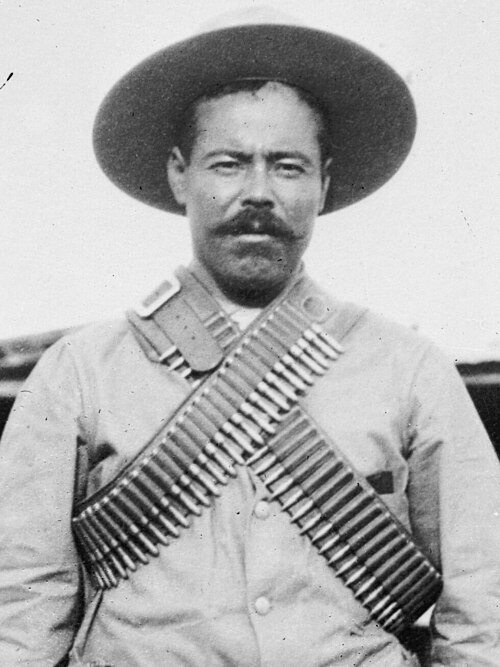
Pancho Villa, Wikipedia
Two weeks ago, you spat in a tube and sent it through the mail. Today, an email tells you to download the app to get your DNA analysis results. The results? Mexico. You expected that since both maternal and paternal grandparents left Jalisco for Colton, California, more than 100 years ago. Or was it Zacatecas? Either way, thirty-seven percent Mexican? Ok. You knew with your light skin that any indigenous blood was diluted by the Spanish invasion. Forty-eight percent Iberian Peninsula? That makes sense, güero. However, some details are unexpected: one percent Welsh? No wonder Mom swooned over Tom Jones. You send screen shots to your siblings and go about your day.
A month later, you get a notification. Your DNA results have been updated. Oops. You’re only 34% Mexican. And Wales is not on the list anymore. It’s been replaced by Cornwall and Northern Ireland. No wonder you like Guinness, though your brothers still go for Miller Lite.
The changing numbers make you nervous, uncertain, and disconnected. This science doesn’t settle anything. Where does your family come from? Mom and Dad’s birth certificates say their parents were born in Mexico. That brings some certainty. You make tamales every Christmas. Beans and rice are your go-to sides. You grow jalapeño and serrano chiles in your garden.
White co-workers ask, “Where’s your family from?” One even asked if you’d ever been in a gang. You’re not part of white America.
Yet you had to learn Spanish in high school. The teachers you work with who are first-generation correct your Spanish when you speak. Each time you shop at Cardenas Market for piloncillo and pan dulce, the homeys give you the side eye. You moved away from the West Side of San Bernardino where you grew up. You watch football, not fútbol. Don’t forget about your taste for Guinness. You stick out as a foreigner in two cultures.
The question “Where do you come from?” doesn’t express your disquiet. You want something DNA analysis can’t give. The answers will take time, a different kind of time, a different pace, one most Americans have forgotten: people talking time. And a good appetite. Research means talking to your abuela, your abuela’s tías and your godparents. It means getting away from your cookie-cutter suburban home, driving through the old neighborhood, and having a sit-down with relatives. Get over the “I’m afraid to drive there, let alone park” mentality. Drop your ultra-fast internet speed impatience, take a breath, and get in the car. You know the way. Remember the liquor store? It’s still there. The panadería and taco stand have been replaced by a strip mall with a discount shoe store, a pizzeria and a store where you can pay your car registration, send money internationally and get your eyebrows threaded at one time.
The old street is narrower than you remember. It could be more cars line the curb than when you and your brothers played football in the street. Just park your Tesla, ask the Sombra de San Pedro to protect it from wayward Impalas, and knock on the door. Understand that it will take you about 30 minutes to actually sit down, because that’s about how long it takes to greet everybody. Abuela or tía or your nina will meet you at the threshold with an “Ay, it’s been so long!” You’ll have to deal with the guilt because she’s right. You’ve ignored this part of your family. Give her a strong hug. She loves you. Then you’ll be ushered past ancient uncles whose wrinkled faces seem lined with the roads they have travelled. You’ll be trampled by a whirlwind of grandchildren who will smile, point, and laugh at you all the same time. Your presence will be considered by serious, silent, mustachioed men who exude the air of judgment. But don’t head for the chicken exit, which literally exists as a rubber flap cut from the kitchen door. Your patience will be rewarded.
First, greet everyone. Use your Spanish if your pronunciation has improved. Don’t try it if it hasn’t. Poor Spanish will elicit swift and terrible laughter, and your outsider status will be cemented like a patio. Take your lumps since you’ve been away for ages. After the derision, you will be seated and asked if you’re hungry. Don’t bother answering; you’re going to be fed. If it’s before noon, you’ll get pan dulce. Check the bag; it could be yesterday’s pan dulce. Grease stains mark bread that’s at least a day old. In this case, ask for coffee so you can dunk the cuerno into submission. Maybe you’ll get lucky and there’ll be fresh menudo. Get ready for the dish that makes the Campbell’s kids pee in their pants with envy: tripe and hominy in a spicy soup. Just get over the “yuck” factor you’ve had all your life and taste it. However, if your luck has run out, you will be served leftovers from breakfast: cold papas and eggs warmed and served in a tortilla. No matter what you see on the plate, don’t hesitate. Remember: you’re on a mission.
Visiting in the afternoon will mean that half of the clan is taking a nap. Late afternoon might be your best bet; Grandma’s fired up the placa and is making fresh tortillas. Sit down, shut up, and eat, because you’re not going to get that taste anywhere else: a warm, perfectly round tortilla dripping with melted margarine (which we still call it “butter”). Have a few.
Soon, your second cousin will arrive from work with a cube of beer. Yeah, those geometric wonders: cans of beer in cardboard cubes, the apotheosis of ergonomic engineering. Honeybee architecture can’t match Budweiser and Miller for form and function. Just drink one. If you refuse, you erect a wall between you and the family. No one, from Grandma to the newest newborn will speak to you if you decline a cervecita.
While wiping whatever form of hydrogenated oil, fat, grease or manteca from your cheeks, you’ll notice photographs on a shelf, each sitting on a doily that Grandma crocheted. Fuzzy, out-of-focus photos in color, others in black and white, wedding pictures, soldiers in uniform, chubby babies in white baptismal garments all looking toward you but not at you. Faces filled with hope and love, reminders of the vicissitudes of joy.
Slowly, Grandma will pull one photograph from behind the rest: a small 4 by 6 in a tarnished frame. Within the picture, a small man in a dark suit with a high collar stands to the left of a chair. In the chair sits a woman in a white blouse and dark skirt. She holds a round-faced baby who wears a bonnet and white clothes. No one, of course, is smiling. Early photographs took time to capture, so the subjects had to sit still, and it’s easier to maintain a serious face for 30 seconds than to hold a smile that long. Another reason nobody smiled in pictures before the 1950s is that life was miserable for everyone, rich or poor, throughout most of human history.
Grandma will use her apron to wipe the dusty glass on the frame and announce, “This is my ––.” The appellation could be great-grandmother, grandmother’s aunt, second-cousin’s best friend’s godmother, any female familial relation. You should understand that though we gave the word “macho” to the American vernacular, we remain a distinctly matriarchal culture. You might, as in my wife’s family, hear, “This is my great-grandmother. She married her first stepcousin, so her mother-in-law was her aunt, and she ended up being a godmother to her brother’s first son who married my tío’s sister. Imagine! Such a small world.” Sure is, Grandma, when everyone lives on the same rancho.
Then comes one of the three predictable lines: “Abuelita was 100% Aztec Indian!”
Hold the phone! I am a direct descendant of this person. I have results of my DNA by region. None of my DNA is Mexica (Grandma still uses the invader’s name). How does Grandma know that her grandma was 100% Aztec?
Be prepared. She might throw out predictable line #2: “See the man, my great-grandfather? His ancestors came over with Cortes. with Hernán Cortes!” And they’ll say, “Hernán,” not “Hernando,” to make sure you know that they were homeys. Don’t tell them that he called himself “Hernando.” It’s time to do some elementary math. The caravels Cortes used were about 40 feet long and held a crew of 60. With 11 ships, there were a little over 500 soldiers in his “expedition.” Even with repeated surnames, there’s still a good chance that someone with your last name was there. However, on the Noche Triste, about 400 of his men died. Many drowned when they fell off the causeways. They were loaded down with too much stolen gold to be able to swim. 500 minus 400. Could 100 surnames account for every Mexican from Yuma, Arizona, to Modesto, California? It’s possible, but, come on! No one who claims a relative in the invasion actually names the guy who was with Cortés, do they? Of course not.
Confounding the divergent points of view is the lack of records about Mexican genealogy. Americans love their documents and have maintained them well since 1607 when Jamestown was founded. In spite of Revolution, Civil War, and World Wars, Americans can pretty much search though archives of information on their families. Census documents, voting registrations, military records and police reports are readily available for anyone wanting the low-down on grandpa or great grandma. Latinx can’t claim much on this. From the time the Spanish burned Mexica (“Aztec”) codices using kindling from the Inquisition to the destruction of civil records in the Revolution of 1910, threading the documents of Latino history has been challenging, hot and painful.
Back to your quest: That same Grandma who swore the old lady in the tarnished frame was Aztec will pull another photo and announce predictable line #3: “That’s my great-uncle on my mother’s side. You know, he rode with Pancho Villa.”
I guarantee you—I swear to you—that you will hear this sentence in every Mexican home in America. Middle class, dirt poor, illegal, legal, first generation, 12th generation, Chicago, San Antonio, Boise, you’ll hear it. Everyone’s great-grand-someone rode with Pancho Villa.
Imagine if they were all telling the truth? Put all those pictures together and you’ll have an army that could, were it still in existence, take on the People’s Liberation Army in hand-to-hand combat, win and still have reserves aplenty. Regiments, battalions, legions of old dudes who rode with Pancho. I spoke with a zoologist who doubted that that many horses have existed in the entire history of the planet. A geologist I consulted computed that such a quantity Mexicans riding on that many horses, would have distorted earth’s rotation and been catastrophic on the climate in the early 20th Century. But there they are, in sepia tones, guys who rode to victory with Pancho Villa.
That creates another enigma. To celebrate their triumph, Villa’s soldiers continued their ride all the way to Los Angeles, Bakersfield, and Colton. Curious. At what other time in history did victorious northern rebels overthrow a rotten government in the South only to split after their victory? Imagine the Continental Army making tracks to Newfoundland after 1783. General Grant didn’t celebrate the success in Toronto with the Army of the Potomac. Everywhere else in the world, the winners stay, and the losers leave. Not in Mexico. These citizen soldiers beat los federales, then celebrated by heading north to have their pictures taken.
How should you respond? Do you call her out? No, you don’t. That’s a form of disrespect that just doesn’t happen in our culture. You’ll smile and say, “Wow!” Those people didn’t worry about their DNA. They worried about their kids and grandkids. They worried about her. Then look at the hand that holds the photo. Look at the lines, the bones, the age spots as she gingerly puts the photo back in its place. Observe the love in her eyes as she stares at her past, knowing that she’s not far from taking a place on this shelf. Give her a hug. Thank her. Then, have another beer. Listen to your cousin’s story about the car he’s fixing. Walk with your tío in his garden. Learn how to make sure the calabazas have room to grow. When the baby wakes up from her nap, ask to hold her. Look into her eyes. You’ll be on her shelf one day. She is where you come from.

James Luna is the author of several bilingual children’s books: The Runaway Piggy/El Cochinito Fugitivo, A Mummy in Her Backpack/Una momia en su mochila, and The Place Where You Live/El lugar donde vives and Growing Up on the Playground/Nuestro patio de recreo, all published by Piñata Books, Arte Público Press. Piggy was awarded the 2012 Tejas Star Award as chosen by the students of the Rio Grande Valley of Texas. His poems and essays have appeared in Inlandia Anthology and the collection America Is…
James has taken part in panels and readings at the Texas Book Festival, Texas Library Association Reading Rock Stars, the Latino Book and Family Festival and the California Association for Bilingual Education conference. He is a member of SCBWI. His website is moonstories.com. James lives in Riverside, California, and sometimes drives to the old neighborhood on the west side of San Bernardino.