

A Real State | Warren Merkel
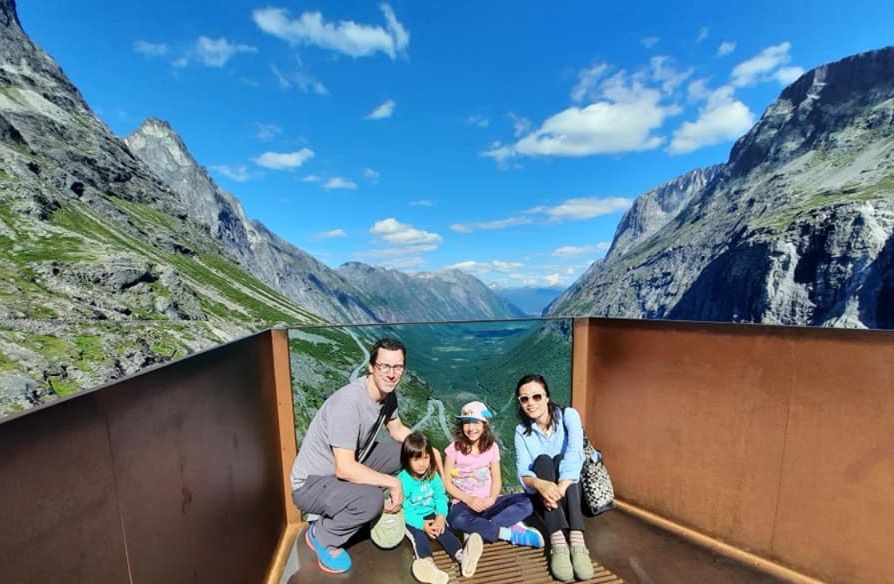
Trondheim, Norway, 2020, Warren Merkel and family, photo courtesy Warren Merkel
Korea, 2013
I’m standing in the bathroom of our apartment in Gwangju, South Korea. It’s a squat room where I can’t stand upright. When I pee, I’m forced to bend my neck, as if deliberating some piece of abstract art hanging above the toilet tank. For reasons still unknown to me, the toilet is housed on our apartment’s deck. It’s a narrow deck, just beyond the living room, encased in sliding glass windows, loose as old teeth, which rattle violently during storms. It’s August. My wife and I have lived here for two years.
This is our second apartment in Korea. The first, which we lived in for three years, was provided by the university where I worked. Our apartment was on the top floor. After leaving the elevator, we’d walk past the hollowed-out center of the complex, a seven-story drop into near darkness that contained what looked to be suicide netting at the bottom, a dusting of candy wrappers and plastic bottles beneath it. Outside our front door, a rectangular stoop had been designed for storage of footwear, a common feature of Korean domiciles. Inside, a cramped living room opened onto a utilitarian balcony where we washed and hung our laundry. Two bedrooms and a kitchen—each the same size—branched off the living room. The bathroom was stashed down a narrow hallway next to the front door: a small sink by the entrance, a toilet at the end, and a walled-off shower in the middle that I likened to a windowless phone booth.
My wife and I are English teachers. Back in the US, my friends have already moored themselves to monthly mortgages, slowly accumulating the equity I will envy years later. But in Korea, the thought of purchasing property seems at odds with the vagabond ethos of the expat society that my wife and I have befriended. One way or another, nearly all of us are in transit, and buying property doesn’t suit a nomadic lifestyle. For the three years my wife and I inhabit that apartment, we traverse the building’s hallways for missing ingredients and weekend gatherings, forming bonds with teachers from Toronto, Chicago, Auckland, Belfast, Manchester.
It’s often difficult for humans to express their deepest thoughts. Even more burdensome is finding one word that perfectly encapsulates what we feel. But for me, as I ponder my choice to live much of my life abroad, the German word Fernweh comes close. It translates to “farsickness,” or a longing for places we’ve never been. Its counterpart, if it has one, is homesickness, in which we pine for places we already know and miss. I would soon realize these two feelings aren’t always compatible.
Vermont, 2008
I met the woman I would marry in August 2007, in a one-year master’s program in Brattleboro. We started dating that autumn, stealing walks from campus along gravel roads wrapped in New England foliage. I proposed to HyeKyoung the following summer. By the time we finished the program, I had lined up a job at a university in HyeKyoung’s hometown of Gwangju, South Korea, but I also owed $22,000 in student loans, a debt I wanted to shake without delay.
I was 34 at the time, a seemingly auspicious age to buy property. Though I had never coveted the sensible college majors my friends had pursued—business, engineering, finance—I nonetheless felt I had gone astray. They were buying suburban houses or city flats, unused cars and leather sectionals, while I was questioning the wisdom of cuffing myself to a career in education. To me, home ownership also necessitated a burning desire to plant roots. It was a concept I could appreciate—my parents owned every house my sister and I grew up in: a bungalow in Iowa, a split-level and then a two-story house in Delaware, and a Cape Cod in Pennsylvania. There were two floors, sometimes three. A porch, a deck, a garage. A yard, a fence, a garden. Staircases galore. Stuffy attic spaces and dank basements. But in my thirties, I associated planting roots with the grim permanence of mortgage payments and yard work and residential knickknacks, none of which I was ready for.
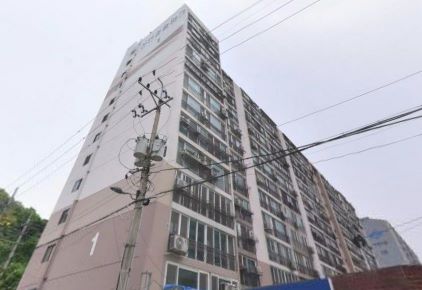
Korea, 2013
In Gwangju, we lived three years in university-provided housing, the building with netting in the stairwell. When I was promoted to a position that did not provide housing, we found the apartment with the low-ceilinged bathroom on the deck. It was a wreck of an apartment close to campus, next to an eight-lane freeway. The complex was built in the 1980s, ancient by Korean standards, dating back to the days of Chun Doo-Hwan’s military dictatorship. Strips of fake wood linoleum covered the concrete floor, and cruel, toe-stubbing thresholds awaited us in the doorframes. And, then, of course, there was a deck and the bathroom. But it was within our budget, and we would call it home for two years.
I hadn’t been in my new position for two semesters when I found myself wondering what I was doing. My students were intelligent and kind, but a pedagogical tedium had begun to set in: they couldn’t express themselves in English. Confucian ideals in the classroom also created tension as students’ respect for authority compelled them to fall silent before it. Still, I had a cavernous office to myself, replete with a reading sofa and view of the campus pond. Why wasn’t this enough for me?
It’s August 11, 2013. I’m standing before HyeKyoung, who is exhausted and teary-eyed after giving birth to our first daughter only ten days earlier. I will be leaving the next day, returning to the US to start a doctoral program at the University of Iowa. We’ve already visited Iowa together and become smitten with Iowa City and its bucolic rolling hills of farmland. We also love the safety of the Pedestrian Mall, a crisscross of brick paths lined with restaurants and shops, a fountain for children, and a playground next to the public library.
Iowa, August 2013
It will be a while before we enjoy these things. For my first two months in Iowa City, I rent one room of a condo from a married couple whose children have moved out. HyeKyoung, meanwhile, is marooned nine hours away in Ohio, where she and our newborn are living with my parents until I find permanent housing for us. Still carless, I begin cycling around Iowa City, canvassing the few neighborhoods with available real estate we can afford. In Korea we saved enough money for a modest down payment, but with scant projected income over the next five years, we know our choices are limited.
I first view a duplex on the outskirts of town, with yellowing shag carpet and a kitchen stove that looks like it left the shop floor during Reagan’s second term. It is within our budget, but five years becomes forever if you choose poorly. Within a few weeks, I settle on a small three-bedroom ranch built in 1954, painted a shade of green I’ll call mint. I coax myself into thinking it’s the one for us because it has a yard and hardwood floors. I inform HyeKyoung and put $1,000 into escrow.
The day I accompany the home inspector to the house is my second visit. His presence seems to bestow upon me powers I did not possess during the open house. It is as if I had realized on the second date that the lights were out on the first. I try to open a living room window but can’t; the frames have been sealed shut with paint, and the owners have no screens. There is a half bathroom in the basement, but a three-inch crack separates the door from its frame, either the mangled work of an incompetent carpenter or the consummated dream of a suburban voyeur. I also notice rot at the base of the house outside, the wood a crumbled cracker in my hands. The property to the left is another house, but to the right stands the Gospel Explosion Ministry. As a father, I am prepared to be roused each morning by a crying baby, but I have reservations about waking to songs on my worst nightmare’s playlist.
The home inspector walks through the house as if he is taking stock of a crime scene, jotting down the evidence in his notebook. For starters, the radon levels in the basement are above the EPA-recommended level, meaning we’ll have to spend nearly a grand on the purchase and installation of a sump pump. As he exits the house’s attic crawl space, he announces the presence of vermiculite, a mineral that expands when heated and was used as insulation in households across the US for the lion’s share of the twentieth century. A mine near Libby, Montana, one of the country’s biggest producers of vermiculite, also housed a large deposit of asbestos, which contaminated the vermiculite.
“Would you buy this house?” I ask the inspector, full well knowing a set of professional ethics forces him to recuse himself.
“This is a very sad house,” he responds.
What have I been thinking? I ask myself as I leave the hovel I’ve just purchased. The following day I go back to the real estate office and argue for the return of my escrow money. The owners are less than thrilled, having already forked over a down payment for the house they are moving into. I find myself wondering how the owner isn’t responsible for the inspection, or why a potential buyer would be asked to put money in escrow before, rather than after, the inspection. This seems wildly illogical to me, like a firm conducting a criminal background check after the candidate has been hired. But after pleading my case, I breathe a sigh of relief as the real estate agency returns the escrow money.
*
Home ownership is indubitably part and parcel of the American Dream. Though not as foundational as the core ideals of democracy or equality, home ownership is nonetheless invitingly palpable: it is tethered to the opportunity for individual prosperity, reified through maniacal lawn care, a major kitchen remodel, the addition of a back deck or swimming pool. But as my parents would caution, home ownership is complicated. To purchase property, they secured a loan from a bank, surrendered a down payment, agreed to the terms of a mortgage, and chipped away at that mortgage long into retirement.
Their house-buying exploits began in the early 1970s with a bungalow in Cedar Rapids, where my older sister and I were born. We then traversed the landlocked states between Iowa and the eastern seaboard when my father moved the family to Wilmington, Delaware for a job in sales. This house, the second, was a split-level my mother loathed. Once my parents could afford it, nearly a decade later, they moved us across town to a larger, two-story house, one where—unlike in the split-level—the things you needed tended to be on the floor where you were. In 1989, as my father neared fifty and a more lucrative opportunity arose, we moved to Lancaster, Pennsylvania, this time into a Cape Cod.
My parents never bought perfection, but they bought. In their effort to make sound financial decisions, I imagine they tried, with each house, to reconcile the limits of their budget with the agony of renovation and repair they surely knew awaited them. They ignored the swimming pool buried in the backyard of one and the frayed carpeting in the stairwell of another, the wood beneath it protruding like fractured bone. Yet my parents took solace in knowing that, despite these problems, each house was theirs. To fix, renovate, paint. To love, nurture, lament.
Iowa, Autumn 2013
It is late September when I locate a place I can envision us living in without dread: a two-story, all-white condominium in a four-unit building that we will purchase for $167,000. Constructed in 1978, the condo is not without its drawbacks. As HyeKyoung enters the front door for the first time, her face withers at the sight of the popcorn ceiling, an architectural STD if ever there was one. We also bemoan the warped floor above the garage, doorknobs that fall off, and a squad of raccoons that jockey for the best garbage in the dumpster we share with a string of rental apartments perpendicular to our unit. There is also the issue of the rotting spindles that cage the front deck atop the garage, not to mention the floorboards on the back porch slicked green with mildew from years of neglect.
Otherwise, it is 1,300 square feet of heaven. With four bedrooms, it offers more than a family of scarcely three needs. But the four units share a private driveway and a beautiful backyard. The condo also happens to be located above the floodplain, lucking us out of the additional cost of flood insurance. And we are close to campus. I can cycle to my office in 17 minutes.
All of this for $32,000 down. It is by turns an American hardship and an American dream—our savings thinning with each mortgage payment and oil change —yet the suburban nirvana of comfort and routine still materializes. We wash the car in the driveway and trim the rose bushes that lead to our front door. I fling snow off the deck above the garage, and we set up a swing in the backyard. We also marvel at the wildlife: chipmunks, squirrels, hawks, foxes, deer, and the occasional wild turkey. We cycle to swimming pools, festivals on campus, and the downtown public library. And, in the spring of 2017, we welcome a second daughter.
Yet as we acclimate to Midwestern family life, the mortality of my academic cocoon becomes more apparent—five years, and then I’m on my own. I know the academic job market awaits me, a perverse game of musical chairs that strands many an applicant for agonizingly long stretches. In autumn 2017, as graduation looms, I begin searching for jobs. By summer 2018, when I graduate, I have applied for and been rejected from nearly fifty positions across the US. Oddly, a wicked inverse ratio seems to be forming: more education begets less opportunity.
I also apply for positions outside the US but am reluctant to take us abroad. If I were still single, or perhaps married but childless, the decision would be simple. But carrying the burden of my children’s linguistic and cultural adjustment, HyeKyoung’s struggles to find work, and the added torment of navigating an alien bureaucracy of taxes and insurance and childcare seems too much.
I tell myself that I need to care for my family, and I am willing to leave the country if that’s where steady income resides. This much is true, but I know there is more to it. My own father, after all, suffered bouts of unemployment, yet he never thought about moving the family outside the US; he and my mother won’t even get passports until years later, when they are gifted the opportunity to visit their own children abroad.
My willingness to move around stems, in part, from the alien idea of planting roots. During my youth, I lived where I lived not because that was where I was from but because my father’s work took us there. For decades, my extended family has been scattered around the country like the flotsam of a capsized ship—in Washington, Florida, North Carolina, Ohio—in states that span time zones, and rarely, if ever, border one another. In hindsight, I understand—or at least can imagine—the allure of having a place I can call home, of generations of my family living in proximity to one another. But with this allure comes a caveat: home is a place I would prefer to visit, not reside.
Perhaps, it is Fernweh that drives me. Some people seem to intuit from a young age what they want to do with their lives. They lock in and pursue, and by dint of passion and hard work become doctors, lawyers, engineers, counselors. That never happened for me. For years, I simply avoided what I didn’t want—long hours, short vacations, excessive stress, cubicles and suits and briefcases—and only then tried to figure out which options remained. Ultimately, my soul-searching led me to the study of foreign languages and the teaching of English so that I might work around the world. By the age of forty, I have lived in three foreign countries for a total of nine years and traveled to dozens more. But I will soon learn how a family will complicate this lifestyle.
In my darkest moments, I wish I weren’t built this way. I wish I could find happiness in planting roots, in providing my children the stability of community until they are ready to leave the nest and decide, of their own volition, whether they want to stay put or break free.
Norway, 2018
One of the positions I apply for is in the Department of Teacher Education at the Norwegian University of Science and Technology (NTNU) located in Trondheim, Norway. When I backpacked around Europe in my early twenties, I confined my adventures to tourist-compromised destinations, namely any site that promised long lines, high prices, and a dearth of locals. Norway, understandably, never crept onto my radar. It is Europe’s geographic hermit, and its decision to reject EU membership meant my Eurail train pass was invalid there. Decades later, I still imagine forest trolls and the Swedish-chef prosody of the language, but am also attracted to Norway’s quality of life, equitable education, and rustic tranquility.
I send my application in February. In June, I interview and teach a mock lesson via Skype. That summer, as I finish my dissertation and graduate, I begin reading about Trondheim. I try to picture our life in the images I find. The city of 200,000 residents offers Nidaros Cathedral, the oldest Gothic church north of Hamburg, as well as strings of colorful houses lining the Nidelva River, which weaves through downtown. I dream of days spent cross-country skiing through Bymarka, the thirty-square-mile nature reserve that flanks the city, the girls bundled up in a pulk that we tow behind us. But I keep my daydreaming shallow; the more I conceive of this future, the less invested I become in the reality we still face. By September, I forget about my interview, but days later I receive an offer.
On December 14, 2018, we arrive in Trondheim. The apartment we will be renting, arranged via Skype by the moving company that my university has hired, is located on Fridtjof Nansens vei, named after the famed Norwegian polar explorer. The large two-bedroom apartment sits atop a hill that overlooks the Trondheim fjord, which at 130 kilometers long is Norway’s third largest. Across the street, a hill awaits us with seasonal activities. In the winter it beckons us for sledding and cross-country skiing; for a few weeks in late spring, our daughters will roll around in its blanket of dandelions; and in late summer, once the foliage has soaked up nearly twenty hours of sunlight a day, we will plunder its wild raspberries.
It takes time, but we eventually get our bearings. For nearly three years, we traipse through forests and swim in the fjords a few days in summer, minutes at a time. We spot beavers, the vandals of the animal world, and the fallout of their handiwork—felled trees that look as though they have succumbed to God’s pencil sharpener. I adapt easily enough to the 37.5-hour Norwegian work week, and both our girls sponge up the language in their Norwegian kindergartens. HyeKyoung finds work as a cook at a restaurant downtown and teaches Korean on the side to some of my university students.
But the climate of Norway, over time, does us in. I’ve long feared the idea of extreme northernness, believing humans aren’t meant to settle in the abyss of dark and cold. It goes against our physiological constitution of near hairlessness and our lack of built-in defense mechanisms. In the first year, both HyeKyoung and I feel our bodies change. We begin to ache, as if we have been catapulted straight into our sixties. We cherish the snow in the months we feel it should be there but begin cursing it in May. A 10:30 a.m. sunrise and 2:30 p.m. sunset in the dead of winter is as depressing as it sounds. Even the four hours of hope are a lie—the sun does indeed rise and set, but we never see it. It is merely an idea, somewhere beyond the horizon.
Despite the cruel weather, Norwegians become one with their environs. As the maxim goes, “Det finnes ikke dårlig vær, bare dårlig klær”—there is no bad weather, only bad clothing. There is perhaps no better place to witness the purity of this ethos than at our daughters’ kindergartens. No matter how apocalyptic the weather, teachers usher the children outdoors, bundled in mittens, waterproof boots, snowsuits as puffy as down comforters, and a head covering that looks like a Scandic burqa. Large flood lamps light up the playground like a Texas football stadium while the children flip open a large wooden chest that hugs the kindergarten walls. There, they exhume pails and shovels and toy trucks, and small plastic sleds to whip down the little hills by the back fence. As my colleague aptly puts it, Norwegians make the most of their misery.
It doesn’t help that our apartment is poorly insulated. In Norway, the first energy requirements for buildings were established shortly after World War II, which slowly morphed into today’s rating system of A-G, with A the most energy efficient. The beginning of the alphabet is reserved for new construction or for buildings whose owners upgrade the insulation. We never learn our apartment’s rating but are convinced that the apartment is worthy of a new standard, something further down the alphabet, like Q or Z.
Becoming an expert fire builder is at first enlightening, but the novelty wears off. One day in July, a month I would prefer to equate with sunburn and barbeque and swimming in unheated outdoor pools, I stuff wads of newspaper beneath three logs and some kindling in the fireplace, then set it ablaze.
But just as I wouldn’t have gone to Norway without a job lined up, the same philosophy applies to a departure. We face a daunting conundrum—we want to buy property, but we aren’t sure if we want to stay. Would it be wise to plant roots in a fallow field? How many people in this world live in a place not because it’s where they want to be but simply because it’s where they are? Figuring we’ll be stuck here for a while, particularly during the thick of the pandemic, we start to look at property. The idea of owning property in Norway is appealing enough, as we could purchase a small apartment or duplex with a better energy rating. And, with a stroke of luck, the girls—who are by now four and eight, the latter of whom has begun to covet privacy—would have their own bedrooms. We like our chances. Although Norway’s home ownership ranking in Europe is unremarkable—in 2021 it ranked fourteenth—it hovers around 80 percent, significantly higher than the US’s 65 percent.
In Norway, www.finn.no is the Holy Grail of transactional websites. Sift through its pages and you’ll find people jonesing to buy, sell, rent, jettison, or barter most anything under the shrouded sun: an electric car, a beer brewing kit, crampons. It’s also the website HyeKyoung and I visit, along with nearly everyone else in the country, as we begin searching for property. On the occasion we find something within our budget, we contact the realtor to arrange a viewing time. Open houses tend to last an hour or two, but during COVID lockdowns, each potential suitor is penciled into a 15-minute block.
HyeKyoung and I plop the girls into the back of our Nissan Leaf, then mask everyone up before heading inside. During our first open house, we immediately notice what the Norwegians get right. In their almost embarrassingly straight-edged endeavor to be honorable, they divulge everything up front. The seller pays for the home inspection, whose contents are chronicled in a standardized brochure that lays bare every last detail regarding construction, damage, repairs, renovations, and energy rating.
Yet as we visit properties, HyeKyoung and I become aware of a sobering reality: home ownership thrives in Norway not only because of generous bank loans but also because of inherited wealth. Parents become grandparents and downsize, bequeathing the homes (or the equity from selling them) to the children they raised in those homes. I suppose this is the case throughout much of the world, but I’m not accustomed to it. I’ve long been inured to the common piecemeal model adopted by middle-class American parents: support the kids until they leave the house and pay for their undergraduate education if you can; the remainder goes to them when the parents die. For the thirty-odd years in between, kids are on their own—the parents are concurrently saddled with their own mortgage payments.
In our mid-forties at the time, we are pitted against the cavernous pockets of Norwegian couples in their twenties and thirties and find ourselves on the poor man’s end of bidding wars for small three-bedroom apartments several kilometers outside the city.
A typical sale goes something like this: We contact a realtor on a Monday to register for a time slot on a Wednesday. If we are particularly keen on a place, we make an early bid for the owner to consider and for other buyers to gauge how fiscally hostile the negotiations might become. The following day, at noon, the official bidding begins. We submit a bid through a form on www.finn.no, and within seconds we hear a Ping! on our phone. It is a nerve-wracking if expedient process, as if we are wagering a two-dollar prop on which team will score first in the Super Bowl, rather than gambling on a property—since all bids are binding—to which we’ll be shackled for years to come. It is essentially a life-altering auction regulated via text.
Early in our search, we find a three-bedroom condo a short distance from our rental. HyeKyoung and I discuss the ceiling of our budget before the gates open. I submit one of the first bids and immediately call HyeKyoung from my office.
“It’s in,” I say.
“Fingers crossed.”
“Do you think anyone else will bid?”
“No idea,” she responds. As we speak, my phone pings. Once. Twice. Then again.
“Is that your cell?”
“I’ll call you back.”
After hanging up, I check my texts. In a matter of minutes, several other bids come in. Each bid increases by several thousand dollars. I call HyeKyoung.
“The last bid was $10,000 more than ours.”
“$10,000?” she repeats. She has heard the figure just fine; her response is the echo of disbelief, of fizzled hope. As we speak, my phone pings again and again. After I hang up, I stare at the selling price, which is $75,000 more than the asking. This swiftly becomes our bleakest expat revelation in Norway: the impossibility of buying a small something we can call our own. Horribly deflated, I do what any sensible transient would—I decide it is time to try our luck elsewhere.
*
The peace of mind that comes with home ownership extends far beyond establishing equity. It is knowing you can decorate and renovate as you please. It is letting your girls paint their bedroom walls any shade in the swatch and neglecting the constellation of pushpin holes and smears of sticky tack. It is getting a pet. It is tolerating your children as they stomp on the floor because you own that floor and because nobody lives below you. Or you live below you—that floor is yours, too.
*
Since I have dragged the family to Norway for a permanent position that I no longer want, I ask HyeKyoung for permission to try one final location where we might settle. In the spring of 2021, I apply for a lecturer position in the English department at Albert Ludwigs University in Freiburg, Germany. One stipulation of the position is German language proficiency. I am contacted for an interview in June and immediately begin to fret about my German. I studied in Germany for a year in the mid-nineties, but I worry the quarter-century decline of my skills will be my undoing. Yet the day after the interview, I awake to an email with the subject line “Invitation to join our team.” The position starts in October. I will barely be able to squeeze in the requisite three months’ notice to leave my post in Norway.
Packing throughout the summer, I cradle large boxes as I stand on the bathroom scale. My older daughter calls out the numbers I can’t see at my feet as we try not to exceed the moving company’s cargo weight limit. We also begin another search for real estate, this time without a university-funded relocation firm to assist us.
The In-between
As we soon learn, much of Germany’s rental market is borne out of large houses. The owners, often grandparents whose children have long since moved out, live on the ground floor, while the upper floors are renovated with kitchens and bathrooms for renters. Or the owners may live elsewhere altogether, and rather than sell a home that has been in their family for generations, they rent out the floors to offset the property taxes and other ancillary costs.
At a hair under 50 percent, Germany holds Europe’s second-lowest home ownership rate, behind only Switzerland. The popularity of renting in Germany today can be chalked up in part to a relatively affordable market as well as strong renters’ rights. Tenants are protected from contract termination by a legal notice of a minimum of three months. And the longer the tenant resides, the longer the eviction notice becomes—some contract terminations require nine months’ notice. Strong renters’ rights, unsurprisingly, precipitate in owners a desire to find the right renter. On the one hand, establishing trust and a clear line of communication is a must. On the other, particularly for owners who still live in the house or visit on occasion, the pursuit of a fringe benefit—friendship—is also embraced.
After sifting through dozens of online rental advertisements and contacting several owners, we finally receive a response. Before our negotiations fall through—the owners want to meet us in person, but we refuse to fly to Germany when we feel a video call will suffice—we learn of the availability of the ground floor of a house in a nearby town by the name of Elzach. Roswitha, a retiree who owns the house with her partner, hints in her email to me at the importance of establishing a good relationship with her tenants. “We are certainly very demanding,” the missive begins. “We want more than just paying tenants. Since we share the garden, we would like to have friendly tenants with whom we can talk about God and the world over a glass of wine.”
As our moving date nears and we are still without housing, I contact Gert, my soon-to-be advisor who is assisting us throughout the process. I inform him that time is running low and that I can’t conceive of beginning the position without my family accompanying me, who—with our visas expiring in Norway—would be forced to return to the US or Korea until I procure living quarters for us.
“I think there may be an opportunity,” he tells me. As it turns out, a professor in the English department has recently retired, and because she lives by Lake Constance with her Swiss husband, she wants to rent out her house near Freiburg so it won’t remain empty. After a friendly interview via Skype, it is settled. We will be renting part of a furnished house in Stegen, a town about seven miles east of Freiburg with 5,000 residents in the heart of Dreisam, a valley that lies within the Black Forest.
As we prepare for the move, one of our most pressing concerns is leaving our Trondheim apartment in mint condition. Because owners expect immaculate cleanliness upon departure, it’s common for renters to rely on a professional cleaning service to ensure satisfaction. For our part, we contact Lykke Hjemme, or Happy Home. According to the website, the hourly rate for a 100 square meter apartment is nearly $150 per hour. Oddly, as the square footage of the domicile increases so does the price, as if the customer is being punished for burdening the company with additional income opportunity. I immediately call bullshit on the pricing. Back in the late 80s and early 90s, my weekend plans were often dashed when my parents pinned down my sister and me with domestic chores. We vacuumed, dusted, mowed, weeded, trimmed, and washed. If we got paid anything at all, it was miles south of $150 per hour. HyeKyoung and I translate the Norwegian cleaning guidelines and then go it alone.
One day in late September 2021, HyeKyoung busies herself with last-minute wiping and dusting; the owners will arrive shortly, having flown up from Oslo to collect the keys and evaluate our cleaning skills. Our lone worry, of colossal proportions, is the black ring our stainless-steel coffeemaker has burned into the wooden countertop in the kitchen. Meanwhile, I am in transit with the girls. We fly from Trondheim to Frankfurt via Amsterdam, then board a train to Freiburg. HyeKyoung will arrive a day later.
“The woman stood on a chair in the kitchen and ran a finger across the cabinetry,” HyeKyoung tells me as we wait in Amsterdam. “We owe about 600 dollars.”
“For a little black circle?”
“The little black circle costs 1,200. We both pay half. They have to replace the countertop.” If we had owned the apartment, I would have held onto the damage, a keepsake of our folly.
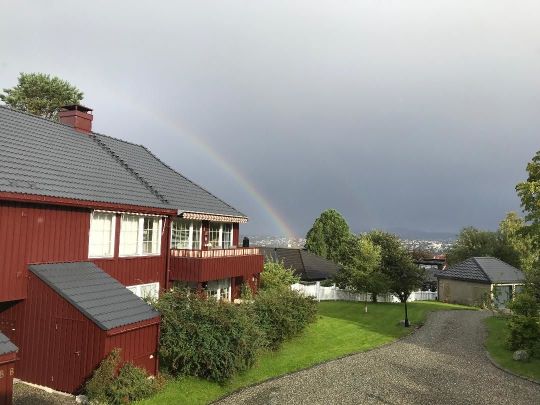
Norway, 2018
One of the positions I apply for is in the Department of Teacher Education at the Norwegian University of Science and Technology (NTNU) located in Trondheim, Norway. When I backpacked around Europe in my early twenties, I confined my adventures to tourist-compromised destinations, namely any site that promised long lines, high prices, and a dearth of locals. Norway, understandably, never crept onto my radar. It is Europe’s geographic hermit, and its decision to reject EU membership meant my Eurail train pass was invalid there. Decades later, I still imagine forest trolls and the Swedish-chef prosody of the language, but am also attracted to Norway’s quality of life, equitable education, and rustic tranquility.
I send my application in February. In June, I interview and teach a mock lesson via Skype. That summer, as I finish my dissertation and graduate, I begin reading about Trondheim. I try to picture our life in the images I find. The city of 200,000 residents offers Nidaros Cathedral, the oldest Gothic church north of Hamburg, as well as strings of colorful houses lining the Nidelva River, which weaves through downtown. I dream of days spent cross-country skiing through Bymarka, the thirty-square-mile nature reserve that flanks the city, the girls bundled up in a pulk that we tow behind us. But I keep my daydreaming shallow; the more I conceive of this future, the less invested I become in the reality we still face. By September, I forget about my interview, but days later I receive an offer.
On December 14, 2018, we arrive in Trondheim. The apartment we will be renting, arranged via Skype by the moving company that my university has hired, is located on Fridtjof Nansens vei, named after the famed Norwegian polar explorer. The large two-bedroom apartment sits atop a hill that overlooks the Trondheim fjord, which at 130 kilometers long is Norway’s third largest. Across the street, a hill awaits us with seasonal activities. In the winter it beckons us for sledding and cross-country skiing; for a few weeks in late spring, our daughters will roll around in its blanket of dandelions; and in late summer, once the foliage has soaked up nearly twenty hours of sunlight a day, we will plunder its wild raspberries.
It takes time, but we eventually get our bearings. For nearly three years, we traipse through forests and swim in the fjords a few days in summer, minutes at a time. We spot beavers, the vandals of the animal world, and the fallout of their handiwork—felled trees that look as though they have succumbed to God’s pencil sharpener. I adapt easily enough to the 37.5-hour Norwegian work week, and both our girls sponge up the language in their Norwegian kindergartens. HyeKyoung finds work as a cook at a restaurant downtown and teaches Korean on the side to some of my university students.
But the climate of Norway, over time, does us in. I’ve long feared the idea of extreme northernness, believing humans aren’t meant to settle in the abyss of dark and cold. It goes against our physiological constitution of near hairlessness and our lack of built-in defense mechanisms. In the first year, both HyeKyoung and I feel our bodies change. We begin to ache, as if we have been catapulted straight into our sixties. We cherish the snow in the months we feel it should be there but begin cursing it in May. A 10:30 a.m. sunrise and 2:30 p.m. sunset in the dead of winter is as depressing as it sounds. Even the four hours of hope are a lie—the sun does indeed rise and set, but we never see it. It is merely an idea, somewhere beyond the horizon.
Despite the cruel weather, Norwegians become one with their environs. As the maxim goes, “Det finnes ikke dårlig vær, bare dårlig klær”—there is no bad weather, only bad clothing. There is perhaps no better place to witness the purity of this ethos than at our daughters’ kindergartens. No matter how apocalyptic the weather, teachers usher the children outdoors, bundled in mittens, waterproof boots, snowsuits as puffy as down comforters, and a head covering that looks like a Scandic burqa. Large flood lamps light up the playground like a Texas football stadium while the children flip open a large wooden chest that hugs the kindergarten walls. There, they exhume pails and shovels and toy trucks, and small plastic sleds to whip down the little hills by the back fence. As my colleague aptly puts it, Norwegians make the most of their misery.
It doesn’t help that our apartment is poorly insulated. In Norway, the first energy requirements for buildings were established shortly after World War II, which slowly morphed into today’s rating system of A-G, with A the most energy efficient. The beginning of the alphabet is reserved for new construction or for buildings whose owners upgrade the insulation. We never learn our apartment’s rating but are convinced that the apartment is worthy of a new standard, something further down the alphabet, like Q or Z.
Becoming an expert fire builder is at first enlightening, but the novelty wears off. One day in July, a month I would prefer to equate with sunburn and barbeque and swimming in unheated outdoor pools, I stuff wads of newspaper beneath three logs and some kindling in the fireplace, then set it ablaze.
But just as I wouldn’t have gone to Norway without a job lined up, the same philosophy applies to a departure. We face a daunting conundrum—we want to buy property, but we aren’t sure if we want to stay. Would it be wise to plant roots in a fallow field? How many people in this world live in a place not because it’s where they want to be but simply because it’s where they are? Figuring we’ll be stuck here for a while, particularly during the thick of the pandemic, we start to look at property. The idea of owning property in Norway is appealing enough, as we could purchase a small apartment or duplex with a better energy rating. And, with a stroke of luck, the girls—who are by now four and eight, the latter of whom has begun to covet privacy—would have their own bedrooms. We like our chances. Although Norway’s home ownership ranking in Europe is unremarkable—in 2021 it ranked fourteenth—it hovers around 80 percent, significantly higher than the US’s 65 percent.
In Norway, www.finn.no is the Holy Grail of transactional websites. Sift through its pages and you’ll find people jonesing to buy, sell, rent, jettison, or barter most anything under the shrouded sun: an electric car, a beer brewing kit, crampons. It’s also the website HyeKyoung and I visit, along with nearly everyone else in the country, as we begin searching for property. On the occasion we find something within our budget, we contact the realtor to arrange a viewing time. Open houses tend to last an hour or two, but during COVID lockdowns, each potential suitor is penciled into a 15-minute block.
HyeKyoung and I plop the girls into the back of our Nissan Leaf, then mask everyone up before heading inside. During our first open house, we immediately notice what the Norwegians get right. In their almost embarrassingly straight-edged endeavor to be honorable, they divulge everything up front. The seller pays for the home inspection, whose contents are chronicled in a standardized brochure that lays bare every last detail regarding construction, damage, repairs, renovations, and energy rating.
Yet as we visit properties, HyeKyoung and I become aware of a sobering reality: home ownership thrives in Norway not only because of generous bank loans but also because of inherited wealth. Parents become grandparents and downsize, bequeathing the homes (or the equity from selling them) to the children they raised in those homes. I suppose this is the case throughout much of the world, but I’m not accustomed to it. I’ve long been inured to the common piecemeal model adopted by middle-class American parents: support the kids until they leave the house and pay for their undergraduate education if you can; the remainder goes to them when the parents die. For the thirty-odd years in between, kids are on their own—the parents are concurrently saddled with their own mortgage payments.
In our mid-forties at the time, we are pitted against the cavernous pockets of Norwegian couples in their twenties and thirties and find ourselves on the poor man’s end of bidding wars for small three-bedroom apartments several kilometers outside the city.
A typical sale goes something like this: We contact a realtor on a Monday to register for a time slot on a Wednesday. If we are particularly keen on a place, we make an early bid for the owner to consider and for other buyers to gauge how fiscally hostile the negotiations might become. The following day, at noon, the official bidding begins. We submit a bid through a form on www.finn.no, and within seconds we hear a Ping! on our phone. It is a nerve-wracking if expedient process, as if we are wagering a two-dollar prop on which team will score first in the Super Bowl, rather than gambling on a property—since all bids are binding—to which we’ll be shackled for years to come. It is essentially a life-altering auction regulated via text.
Early in our search, we find a three-bedroom condo a short distance from our rental. HyeKyoung and I discuss the ceiling of our budget before the gates open. I submit one of the first bids and immediately call HyeKyoung from my office.
“It’s in,” I say.
“Fingers crossed.”
“Do you think anyone else will bid?”
“No idea,” she responds. As we speak, my phone pings. Once. Twice. Then again.
“Is that your cell?”
“I’ll call you back.”
After hanging up, I check my texts. In a matter of minutes, several other bids come in. Each bid increases by several thousand dollars. I call HyeKyoung.
“The last bid was $10,000 more than ours.”
“$10,000?” she repeats. She has heard the figure just fine; her response is the echo of disbelief, of fizzled hope. As we speak, my phone pings again and again. After I hang up, I stare at the selling price, which is $75,000 more than the asking. This swiftly becomes our bleakest expat revelation in Norway: the impossibility of buying a small something we can call our own. Horribly deflated, I do what any sensible transient would—I decide it is time to try our luck elsewhere.
*
The peace of mind that comes with home ownership extends far beyond establishing equity. It is knowing you can decorate and renovate as you please. It is letting your girls paint their bedroom walls any shade in the swatch and neglecting the constellation of pushpin holes and smears of sticky tack. It is getting a pet. It is tolerating your children as they stomp on the floor because you own that floor and because nobody lives below you. Or you live below you—that floor is yours, too.
*
Since I have dragged the family to Norway for a permanent position that I no longer want, I ask HyeKyoung for permission to try one final location where we might settle. In the spring of 2021, I apply for a lecturer position in the English department at Albert Ludwigs University in Freiburg, Germany. One stipulation of the position is German language proficiency. I am contacted for an interview in June and immediately begin to fret about my German. I studied in Germany for a year in the mid-nineties, but I worry the quarter-century decline of my skills will be my undoing. Yet the day after the interview, I awake to an email with the subject line “Invitation to join our team.” The position starts in October. I will barely be able to squeeze in the requisite three months’ notice to leave my post in Norway.
Packing throughout the summer, I cradle large boxes as I stand on the bathroom scale. My older daughter calls out the numbers I can’t see at my feet as we try not to exceed the moving company’s cargo weight limit. We also begin another search for real estate, this time without a university-funded relocation firm to assist us.
The In-between
As we soon learn, much of Germany’s rental market is borne out of large houses. The owners, often grandparents whose children have long since moved out, live on the ground floor, while the upper floors are renovated with kitchens and bathrooms for renters. Or the owners may live elsewhere altogether, and rather than sell a home that has been in their family for generations, they rent out the floors to offset the property taxes and other ancillary costs.
At a hair under 50 percent, Germany holds Europe’s second-lowest home ownership rate, behind only Switzerland. The popularity of renting in Germany today can be chalked up in part to a relatively affordable market as well as strong renters’ rights. Tenants are protected from contract termination by a legal notice of a minimum of three months. And the longer the tenant resides, the longer the eviction notice becomes—some contract terminations require nine months’ notice. Strong renters’ rights, unsurprisingly, precipitate in owners a desire to find the right renter. On the one hand, establishing trust and a clear line of communication is a must. On the other, particularly for owners who still live in the house or visit on occasion, the pursuit of a fringe benefit—friendship—is also embraced.
After sifting through dozens of online rental advertisements and contacting several owners, we finally receive a response. Before our negotiations fall through—the owners want to meet us in person, but we refuse to fly to Germany when we feel a video call will suffice—we learn of the availability of the ground floor of a house in a nearby town by the name of Elzach. Roswitha, a retiree who owns the house with her partner, hints in her email to me at the importance of establishing a good relationship with her tenants. “We are certainly very demanding,” the missive begins. “We want more than just paying tenants. Since we share the garden, we would like to have friendly tenants with whom we can talk about God and the world over a glass of wine.”
As our moving date nears and we are still without housing, I contact Gert, my soon-to-be advisor who is assisting us throughout the process. I inform him that time is running low and that I can’t conceive of beginning the position without my family accompanying me, who—with our visas expiring in Norway—would be forced to return to the US or Korea until I procure living quarters for us.
“I think there may be an opportunity,” he tells me. As it turns out, a professor in the English department has recently retired, and because she lives by Lake Constance with her Swiss husband, she wants to rent out her house near Freiburg so it won’t remain empty. After a friendly interview via Skype, it is settled. We will be renting part of a furnished house in Stegen, a town about seven miles east of Freiburg with 5,000 residents in the heart of Dreisam, a valley that lies within the Black Forest.
As we prepare for the move, one of our most pressing concerns is leaving our Trondheim apartment in mint condition. Because owners expect immaculate cleanliness upon departure, it’s common for renters to rely on a professional cleaning service to ensure satisfaction. For our part, we contact Lykke Hjemme, or Happy Home. According to the website, the hourly rate for a 100 square meter apartment is nearly $150 per hour. Oddly, as the square footage of the domicile increases so does the price, as if the customer is being punished for burdening the company with additional income opportunity. I immediately call bullshit on the pricing. Back in the late 80s and early 90s, my weekend plans were often dashed when my parents pinned down my sister and me with domestic chores. We vacuumed, dusted, mowed, weeded, trimmed, and washed. If we got paid anything at all, it was miles south of $150 per hour. HyeKyoung and I translate the Norwegian cleaning guidelines and then go it alone.
One day in late September 2021, HyeKyoung busies herself with last-minute wiping and dusting; the owners will arrive shortly, having flown up from Oslo to collect the keys and evaluate our cleaning skills. Our lone worry, of colossal proportions, is the black ring our stainless-steel coffeemaker has burned into the wooden countertop in the kitchen. Meanwhile, I am in transit with the girls. We fly from Trondheim to Frankfurt via Amsterdam, then board a train to Freiburg. HyeKyoung will arrive a day later.
“The woman stood on a chair in the kitchen and ran a finger across the cabinetry,” HyeKyoung tells me as we wait in Amsterdam. “We owe about 600 dollars.”
“For a little black circle?”
“The little black circle costs 1,200. We both pay half. They have to replace the countertop.” If we had owned the apartment, I would have held onto the damage, a keepsake of our folly.

Germany, 2021
Upon our arrival in Freiburg, we begin piecing together a life. We open a bank account. We register with the town and receive our residence permits. We buy a used Volkswagen Polo and enroll the girls in German kindergarten and school, where they will learn the language and make friends. A year later, in 2022, we start prospecting real estate. Most everything is out of our budget, but when we expand our search into the sleepy towns that dot the Black Forest, we find a few options. One apartment we discover—a three-bedroom, 90 square meter third floor walkup—gives us hope. The asking price is just under 400,000 Euros. It is located in Staufen, widely considered one of the most beautiful towns in the region, marked by hillside vineyards and the ruins of a twelfth century castle. It is also a short bicycle ride to the train station. I make an appointment with a home equity advisor at Sparkasse, the bank that holds our 75,000 Euros. I stumble through the exchange, describing as best I can terms like mortgage and down payment. The home equity advisor’s response, however, is clear.
“The bank needs 140,000 Euros up front,” she says. “You’ll retire in 2040, and your pension won’t cover the monthly payments. What funds will you have to pay the mortgage then?”
I acknowledge the amount as human behavior dictates: I repeat it, lilting the final syllable. HyeKyoung is still unemployed, and we have no credit history to speak of in Germany. The bank has tracked my potential earnings into retirement, and I realize then how risk-averse Germany’s real estate market is. It isn’t as simple as what I can offer now. I need to provide evidence of financial solvency. Forever.
*
Fernweh, “farsickness,” and heimweh, the longing for home. I come to realize that I’ve been stuck between the two; I yearn for something of home, but I do not want to return to the US, and though my desire for Fernweh has come to fruition, some of the happiness I knew before moving abroad has eluded me.
I am filled with a deadly brew of dread, guilt, and anxiety. HyeKyoung is frustrated at having to learn a new language and adapt to yet another new place; understandably, she wants comfort and routine. I cry as I leave my younger daughter on the first day of kindergarten, her face smeared with profound worry. And my older daughter is angry—she wants out. She had friends in Norway, and now I have forced her to start third grade in an elementary school where most of the students have experienced little beyond the village I have just moved us to.
I suddenly regret forcing my own family to do what I myself once hated. After my freshman year of high school, as my father took a new job, I left Delaware, where I had lived since the age of two, and moved to Pennsylvania. But this separation was a mere seventy miles—to the undiscerning observer, the only palpable difference was the license plate; the language was the same, and by and large so were the people.
In hindsight, the thought of moving my family abroad has been unmistakably quixotic. I only envisaged the enchanted version, a fairy tale life of holidays in new countries, casually crossing national borders by train, our children becoming citizens of the world. I didn’t fathom the heartbreak we’d endure, what I would put my family through, and how I’d shoulder it all, deserved or not. It is as if I were swimming toward the shore of a pristine lake only to realize I might drown.
*
It’s summer 2023. We’ve been in Germany—and the retired professor’s house—almost two years. On days when the fog hangs low in the valley longer than I’d like it to, or when a bill is dropped through the mailbox whose contents HyeKyoung and I can’t understand, I think about returning to the US. I share this sentiment with my older daughter, but her misgivings about a return are not steeped, as mine are, in exorbitant tuition costs or active shooter drills in schools. Her response is lighthearted, as it should be.
“I don’t want to learn about stupid miles and feet and pounds,” she says. “Why can’t Americans use the metric system?”
Spring arrives. Our daughters step into the garden and gawk at the storks that are building a nest atop the utility pole just beyond the backyard fence. Time and weather permitting, I cycle to my office in Freiburg, along a spectacular seven-mile paved trail that hugs the Black Forest before running parallel to the Dreisam River as I enter the city. On a warm weekend in May, we drive into the mountains to Schluch Lake, where day-sailors tack about and a crush of pedalos linger near shore. And then there’s the French border, and the Swiss one too, ours for the taking, only an hour away.
For almost two years, we rent the retired professor’s house. Yet the accommodations were always meant to be temporary, so in July 2023 we uproot ourselves again. But this time it is just a few hundred meters down the road. Word spreads fast in a small town, and the parents of our daughters’ school friends have started asking about our housing search. We hang a flier in a local grocery store and within a few weeks someone contacts us. We move into the third floor and finished attic of an old farmhouse, which sits on a horse farm that has been owned and run by the same family since the early 1600s. Each morning, we wake to the clip-clop of a dozen horses being led into the field to graze. For the first time in almost two years, we unpack all our boxes rather than live out of them.
My daughters have few recollections of the US: a scraped knee at a playground, the color of our living room wall. That’s it. They now see the US as a foreign country. It’s where we go on vacation to visit family. It’s someplace else. A few million people move to the US each year. A more nebulous statistic is the number of Americans who leave. The US doesn’t keep track of emigration; these citizens are now the responsibility of the destination countries. Yet their lives continue.
In the middle of a dreary April, we drive to Munich. My college roommate and best friend, whom I’ve known for more than 30 years, is flying in from the US, taking a much-needed vacation with his family. We are both excited; we haven’t seen each other in years. He owns his home in Charlotte and is remodeling his kitchen and master bedroom and has a yard that’s all his. He has the life I thought we’d have. Shortly before their departure, when I imagine they are busying themselves with eleventh-hour preparations and pestering their boys to pack their bags, I receive a text. He and his wife have taken out a second mortgage to pay for the renovations, and the stress of it is almost unbearable.
“Looking forward to the trip,” my friend writes. “And a break from real life.”

Warren Merkel is a lecturer in the English Department at the University of Freiburg in Freiburg, Germany. His creative work has also been published in Hippocampus Magazine, Two Hawks Quarterly, The Last Syllable, Eclectica Magazine, Lowestoft Chronicle and elsewhere.