
The Pelicans of Memory | Kit Carlson
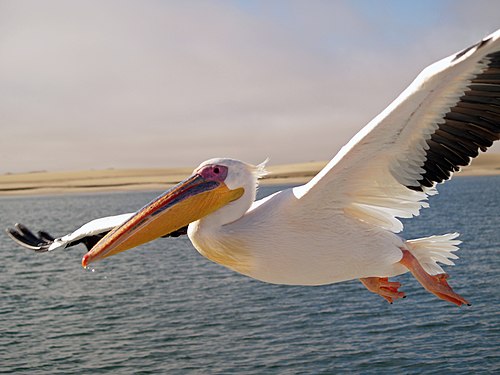
Images thanks to Wikipedia
Sitting on the seawall, I watch brown pelicans rest on the green swell of the Gulf of Mexico. A vague miasma of salt, rotting seaweed, and dead fish—the scent of a Gulf Coast summer afternoon—floats on the intermittent breeze. The seawall’s lumpy concrete etches dimples into the back of my thighs, but I do not move. The sun beats on my head like I am a sack of fries under the heat lamps at McDonald’s, but I do not move. I’m hiding in plain sight. If my parents want me, they can come and get me. I’ve finished cleaning for the day, but I know I must have done something wrong. I generally do. So, if they want to come screaming at me for not making those beds the right way, well. Here I am.
All around, seagulls scream, swoop, dive, but the pelicans just float serenely, until one begins to stretch huge, ungainly wings. It lifts into the air with rhythmic strokes, hovers. It peers beneath the water’s surface, waiting, then suddenly plummets, wings bent into acute angles. At the last instant, the wings sheer back. The bird becomes a spear shooting into the wave with a loud splash, then up and out. It tips its saggy beak skyward, swallows the fish, and rests on the water again.
I might as well watch pelicans on this hot July day when I am fourteen and completely unoccupied. I sit in front of our worm-eaten cypress beach house, burrowing my toes into the sugary sand, probing through scalding grains to find the cool moisture deeper down. Next door, the Gulf Tides looms, that mint green, stuccoed monstrosity of a motel my parents bought as a ticket out of Michigan winters and the suburban rat race. It’s a two-story, L-shaped hulk of crumbling cement and perpetually rusting steel, each of its ten rooms done up in shabby mid-century style: Hollywood beds, terrazzo floors, and jiggly jalousie windows that leak air conditioning out and let steamy heat in.
Ten rooms to feed a family on. In fact, “It’s a family venture” has become my parents’ maxim, the argument-ender that is supposed to shut me up when I protest. Still, I spit back, “No one gave me a vote on this.” Because it is a family venture, my twelve-year-old sister and I are compelled to be chambermaids—scrubbing toilets, changing beds, folding towels, sweeping walkways.
But now, done for the day, I hope, I am watching pelicans. I am tired of television, of soap operas, Mike Douglas, and the weather channel, which in 1973, was simply a robotic camera scanning a row of gauges, back and forth, unceasingly: temperature, wind speed, barometric pressure. From the open door of the motel laundry room, I hear my father yell my name. My stomach drops, the way a barometer needle falls when a storm comes rolling off the Gulf.
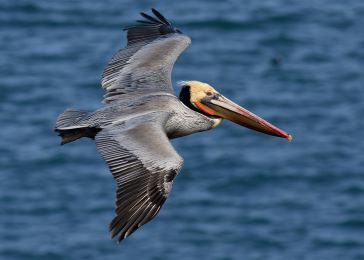
Brown Pelican
*****
To dive the way a brown pelican does should be crippling, even deadly, as it plummets headfirst from as high as sixty feet above the waves.
To survive the impact, pelicans evolved air sacs around their breast and neck that inflate like a car’s airbags. They learned to stiffen their necks, to sweep their wings back straight and smooth against their bodies, to rotate slightly to moderate the force of impact, and to open their bills wide enough to cause a braking effect as gallons of water sweep into the gular pouch. They learned how not to shatter on the water’s surface.
So much has to go exactly right for a pelican to survive the impact, for it to stun and secure and swallow that fish.
****
Hovering over a memory that will not stop swirling there, just below the surface of consciousness, I must dive, strive for that event. Other memories wait in the depths, but for now, perhaps I can find one to snag and swallow whole. A single fish out of a whole school of churning mullet.
To dive would be to see. To dive would be to know. To dive would be perhaps to shatter.
****
A hot day in July 1973. A bored teenage girl. A motel on the beach. Birds. All of this is a memory, of sorts. But also, not a memory. Rather, it is a construction of memories, a patchwork of visual images, stitched to the stories my sister and I have told for half a century. The only actual memory at the core of this “memory” is one of pelicans, rising from the Gulf’s surface to plummet for fish.
Even the pelicans are not actually a memory but just another compilation. I have watched so many pelicans in my life that they blend now into this one bird, the bird of my adolescent distraction.
The rest of the memory then? The hot July day, the tedium, the motel, my father’s irritation? All of that is true. Summers were hot, humid, baking. The motel was demanding, except when it wasn’t … when the guests were happy, and the rooms had all been cleaned. Being fourteen was an endless slog of tedium, and my sister and I were often bitter about our life on the beach. Pelicans did offer a kind of distraction and entertainment.
There could have been a July afternoon just as I have described it. But I don’t remember it. I remember all the pieces, but actually, I have cobbled together one memory out of many smaller memories. It feels true. But is it?
What is the cost of remembering?
And what is there to remember? The list of my adolescent grievances is long: to be forced to grow up at a motel on an island, with only my two volatile parents and my younger sister for company. (“We put the nuke in nuclear family,” I sometimes joke. That is one way to elide the memories, with snark.) To have no one else my age nearby. To ride the school bus daily over three bridges to the mainland to a small magnet school where I was thoroughly ostracized for two years. To live with inch-long palmetto bugs slithering from the crevices of the cypress wood siding of our house. To scrub shit from toilets and peel cum-stained sheets off beds. To hear, late at night, the distant thunder of battle—my parents cursing and shouting, furniture falling, doors slamming, the car screeching off, tires spraying sand and shards of shells against my window.
To live right on the beach, everybody’s dream, right?
****
This is not a memory. This is a list. Neuroscientists call this sort of list “semantic autobiographical memory.” Not a memory tied to any specific episode, any single year or day, SAM is comprised of a general sort of knowledge about my situation, anchored by a few piercing images—giant cockroaches, filthy toilets, a blazing white sand beach, floating pelicans. But these aren’t the memories I am hunting. I want specific ones. Where are they—these fish I cannot see, swimming below the surface, obscured by waves and shadows?
****
Once we moved to Florida, my parents started taking us to church. This was new. We had not been regular churchgoers back in Michigan, but Florida was all about fresh starts. Perhaps we would be religious for a change. They chose Church of the Redeemer—an enormous, stuccoed, Spanish Colonial church with blood-red doors that face across US 41 to Sarasota Bay. Its symbol is the pelican, inscribed as a black-and-white, woodcut logo on the cover of every service leaflet: a large pelican sitting on her nest, with three chicks craning upward to drink the drops of blood springing from her breast as she pulls out her own feathers to feed them. It is a metaphor for Christ the Redeemer, who sacrifices his own life to sustain his children with his Body and Blood. Every week, during the lo-fi mutters of the priest at prayer, as crimson flecks of light from stained glass windows dappled the leaflet, I colored in the woodcut using one of the small yellow golf pencils from the pew racks. Every Sunday, I impressed this image into my mind—this bird, this kind of parent, sacrificing for its children’s well-being.
This memory is still more semantic than specific.
****
Remembering those years when I was growing up at the beach is hard to do. I hover above the surface of memory, lift higher to see better, peer down through the disruption of years, into the inscrutable, poorly recollected depths of my life to seize that one thing, the image that almost swam away.
There is a more particular sort of memory, different from semantic memory. Episodic memory, they call it. Instead of an assembled list, an episodic memory is a singular experience burned into a neural network that crisscrosses the entire brain, a constellation of neurons firing across the folds of the cerebral cortex. You see, smell, hear the memory all over again, as though it were real, as though you were right there, right back in the middle of all of it.
These are the memories I’m reaching for, episodes to fill in the gaps and explain my aversion to talking about life at the Gulf Tides. I want to remember what I was meant to forget.
****
Mint green Comet scouring powder. Glaucous blue Sani-Flush toilet cleanser. Burnt orange Pine Sol all-purpose cleaner. Neon blue Windex glass spray. Each cleaner with its own surreal shade and its own distinctive smell—of chlorine, or ammonia, or a burning kind of Christmas tree piney-ness. I know them all. Each had its spot in my bucket of supplies: bleachy Comet to scrub the bathtub and sink, tangy, ammonia-based Windex to spray the mirrors and chrome towel racks, sticky, stinky Pine-Sol for scrubbing the floors, and granular Sani-Flush poured into the toilet bowl to fizz and pop, “committing germicide,” the commercials promised. (Sani-Flush would eventually be discontinued for being too good at its job—environmentally hazardous, dangerously germicidal.)
I was eleven when my mother taught me how to clean a motel room. “Don’t mix ammonia and bleach,” she warned. “The gas will kill you.” This has stuck with me, the terror of an accidental cleaning death. When I married, I told my husband that the bathrooms were his to scrub. I wouldn’t do it anymore. The whiff of ammonia in a squirt of Windex still makes me sweat with sudden fear, and I am back in a Pepto-Bismol-pink-tiled motel bathroom, belly balanced on the bathtub’s edge and scrubbing, scrubbing, hoping not to die.
“My God,” my sister said once. “They didn’t even make us wear gloves.”
****
Today, the biggest threat to Gulf Coast pelicans is human rubbish, especially monofilament fishing line tossed by fishermen onto the sand or into the mangrove bushes along the shore. When a pelican blunders into discarded fishing line and becomes tangled in those almost-invisible bonds, it cannot fly, spy, plummet, or feed. Eventually, it starves to death in that accidental snare.
So hard to see, those lines that constrict and restrain. You have to get close to discover what holds that pelican down, what lashes its wings to its body, where the hook is snagged in the leathery folds of its gular pouch. It’s not easy to untangle all the filaments that bind and break and distort a pelican’s wings and legs and neck.
****
Like shadows cast by fast-moving clouds on the green Gulf swell, images come and go, light and dark, incomplete and fragmented:
Four purple circles on the underside of my mother’s arm, four circles the size of my father’s fingertips.
Waking up one morning with both of them gone, the living room a shambles of books and glassware and overturned chairs. Picking up nubby glass shards of a bottle of Schweppes Bitter Lemon from where it had been heaved against the patio door.
A suitcase half-packed on their unmade bed. The way her black lace nightgown pooled on the golden shag carpet beside it.
****
Filaments also bind my memories—so fine, so transparent, that I forget they are there. They are strong, tangled, and virtually unbreakable: The code of family: family venture, family business. We didn’t talk about the family outside the home. Whatever we had gotten into, we four, we kept it to ourselves. We didn’t talk about not enough money. We didn’t talk about why my parents each worked two additional jobs in addition to running the motel. We didn’t talk about drinking. We didn’t talk about fighting. We didn’t talk about the cruelty that passed between them after the drinking and during the fighting.
We talked about the guests instead. We told stories about the odd and humorous aspects of life in a family-run motel. We laughed over the elderly couple who watched the sunset while sitting with their backs to the Gulf, looking over their shoulders as the great red ball of sun slipped below the horizon. Every year, we hosted a man who invented the “clean room” for Oak Ridge National Labs, or at least that’s what he said he invented, because who knew what went on behind the locked doors of a national laboratory? We made enough room for a hippie in a VW bus who arrived with a pink, plush-covered coffin where he stored his stereo equipment. Not everything was terrible, not every day.
And of course, I loved my parents. My mother could make any day a party, and my father painstakingly taught me life skills: how to change a tire or hang wallpaper. They watched every crazy performance that my sister and I staged for them. They talked with us about Watergate and inflation, Shakespeare and La Traviata. We argued at the dinner table, pulling dictionaries or the encyclopedia or the latest issue of Time magazine off the shelf to prove a point.
Decades later, both of them have died. And after therapy—theirs and mine—and after the passage of time that perhaps blurs all wounds, even if it does not heal them, I recognize the strain they labored under, trying to keep that place going through hurricanes and red tides, desolate autumns with no guests, and the relentless, rusting, destruction of salt breezes that chewed every metal thing into orange dust. How it almost broke them, ground their marriage under the heel of fear and worry, buried my sister and me along with them.
****
Here is a memory: I don’t know if this was a specific day, or if this happened more than once. I do know that while my sister and I hid, dark and quiet in our bedroom, listening to our parents’ shouts and screams, we asked each other, “What if they really divorce this time? What if it’s really over?” “Well, I wouldn’t want to live with her.” “Well, I wouldn’t want to live with him, either.” Always the impasse, never a resolution. Only quiet afterwards and everything the same. As though it had never happened.
****
But this happened. A memory refracted, trying to slip away.
In the middle of the twentieth century, grocery stores offered “green stamps”—a little bonus for shopping in their establishment, a prehistoric “cash back” program to build customer loyalty. For every dollar spent, the shopper got some number of stamps to paste into special redemption booklets.
At our house, the stamps lived in a wooden box, until enough of them had piled up to start pasting them into booklets. A completed stack of booklets meant a trip to Sarasota, to the S&H Redemption Center in the Ringling Shopping Plaza. There, we could choose from artfully displayed housewares and accessories, even furniture. These eight Libbey glasses in a cute red and white gingham pattern? Four books. That Timex watch? Six books. That color television set? Seventy books. The actual stamp booklets were worth only about two dollars in real cash. The value lay in their mystical ability to purchase so much more.
“1200 stamps fill this S&H Saver Book,” proclaimed the cover of the redemption booklet. The cover featured a four-color illustration of a stereotypical family—father in a shirt and tie, mother with an auburn bouffant flip, like my own mother’s hair, a boy, wrapped in the crook of the father’s arm. Bizarrely, that same father’s arm grips the right hand of a little girl with doggy ears, holding her hand up and away from the partially filled page of the stamp booklet in front of her, as if to keep her from harming it.
Each book had twenty-four pages, and each page would hold the equivalent of fifty stamps. Filling a page could be as easy as licking one Fifty stamp and pasting it down, or two Twenty-five stamps. But the agony came with the Ten stamps. They came out of the machine at the supermarket like tiny lottery tickets, a stream of green paper. The stamps were flimsy, the paper thin, the glue poorly applied and sticky to lick. Licking fifty little stamps and pressing them carefully to the page left my fingers crusty with drying glue, and my mouth coated with a thin sheen of it.
One day, my mother sat me down in the sunroom with a pile of booklets and the overflowing box of stamps and told me to paste them all in the booklets. When I complained about licking so many stamps, she offered a bowl of water and a paper towel to dab the stamps with. But the paper towel was useless. I couldn’t get the glue to loosen up enough to make the stamps stick. And the taste of the glue if I licked the stamps was nauseating.
I just wanted to get it all over with. So, I began to dunk entire stamps into the bowl of water, and press them, soaking, onto the pages of the booklets. Just get through it. Just get it done. In the end, I had ten or more filled booklets, soaking wet, and beginning to stick together in solid blocks of glue as they dried.
****
These are the tangled filaments that bind the green stamp memory: the snare of family loyalty. The perpetual panic over money—those booklets were meant to purchase something we otherwise could not afford. And of course, love—the love that fears unloving.
But here is the memory fished up once those filaments are shed: My father, red-faced, grabbing me by the shirt, shaking me, holding a soggy, dissolving book of stamps in front of my face shouting, “Eat it. Eat it. Open your mouth. You are going to eat what you destroyed.” The sour coating of glue on my tongue covering the backwash of nausea as I struggled to break loose. His hand tight on the back of my neck, fingers digging in and holding, pulling me toward that lump of gluey paper and stamps. My mother and sister pulling him off me. The panicked realization that without their interference, he would have made me do it.
****
I realize now that my parents were as strung up and snared as I have been—by generations of anger and addiction, by the hooks and lines and tangles that bound their own memories and brokenness. That there was so much I could never know, so much they would never tell. So much that they, perhaps, could not even remember for themselves.
You can’t really know when you set out to do something how it’s going to go. You can liberate yourself from long winters, from working for some life-sucking corporation, from the ever-vigilant neighbors who call police when the fighting gets too loud. You can decide to live in the sun, on the beach, own your own business, be your own man. You can imagine another story for yourself and your wife and your daughters. You can try to do it differently, try to be different. What you can’t do, ever, is start completely fresh. Because you don’t really know what you still carry with you. Just because some things are too hard to remember doesn’t mean they are forgotten.
****
Until it was outlawed in 1972, DDT was the best mosquito killer ever developed, even winning its inventor the Nobel Prize. DDT also killed pelicans and other predatory birds—not by making them sick, but by annihilating their young. The pesticide moved up the food chain in the fish the birds devoured and thinned the shell of every egg they laid. So, when a pelican settled down in the nest to brood its eggs, it crushed the chicks before they could hatch. It didn’t intend to. But the poison was already there.
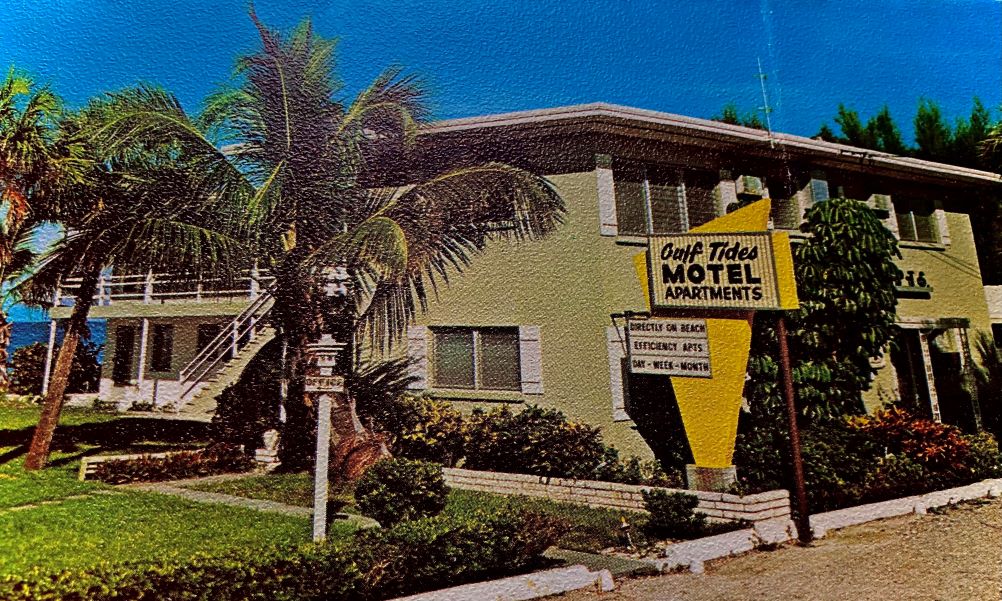
Gulf Tides Motel postcard, provenance of Kit Carlson
Kit Carlson is an Episcopal priest and a life-long writer with work recently published in River Teeth, EcoTheo Review, Beautiful Things, Bending Genres, and Burningword Literary Journal, among others. She has been nominated for a Pushcart Prize and for Best of Short Fictions and was recently named a finalist in Orison Books’ Best Spiritual Writing contest for 2025. Kit lives in East Lansing, Michigan, with her husband, Wendell, and Lola, a nervous rescue dog. Find her at kitcarlson.org.