

Invisible | Sandra Jensen
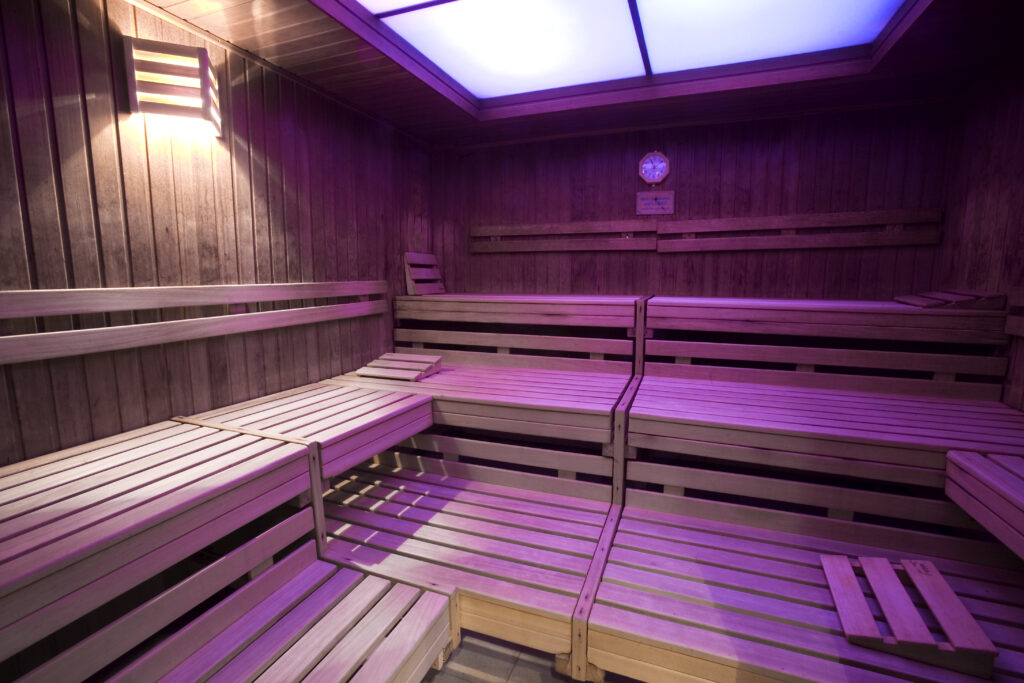
Sauna in Bath House (Müllersches Volksbad). Munich, Germany, by Jorge Royan, Wikimedia Commons
So there I was, soaking up the heat in a Berlin sauna. If you’ve not been to a German or Austrian sauna spa affair, then probably the wrong image springs to mind—particularly if, like me, you’re English. Perhaps you imagine sweaty bodies fondling each other in the dark, a little wooden room with benches like shelves that you sit on uncomfortably in your bathing suit which is getting itchy, and you inch your way further from the big guy sitting next to you, only there is no room to inch, he’s taken up all remaining space, and you don’t want to press any part of your semi-naked body to any more of the surface than you need to, for you don’t know who’s been leaning up against that wall or on the shelf and what with. Then you go out and maybe dip in a chlorinated pool or have a warm shower, and you say, Well, I don’t think I’ll do that again.
A German sauna is so far removed from such an experience it’s unimaginable. The particular sauna I’m thinking of is as big as a generously sized child’s bedroom. You can lie down full length on your choice of wide benches: there’s room for twenty or more people. Not all lying down, no, but if you’re short like me, you can lie down and no one would mind.
It’s hot. Particularly on the high bench. Very hot. You don’t wear anything. If you do, you’ll get some strange looks.
However, if every part of your fully naked body is not separated from the wooden bench or wall by a towel, you will be told off in no uncertain terms by the Sauna Master. It’s a good rule, if you think about it. All those bodily juices. I worry about bodily juices more than most. I live in the kingdom of the sick, as Susan Sontag put it, and I’m highly susceptible to germs. As my kingdom is invisible, most people think I’m just fine. But you look so well! they exclaim, and carry on as if I am, in fact, well—inviting me to events I can’t manage, getting upset if I have to cancel a coffee date at the last minute or if I forget the date entirely due to my brain fog. I’ve lost many friends over the years because they can’t handle my limitations.
The fact is I’m not well, not at all, but the post-sauna heaven experience can make me feel, just for a while, that my body is something desirable to live in, that life itself is desirable.
In Finland, hosts greet arriving guests with Sauna? This, to me, makes much more sense than Drink? (Although I understand the Finns are no strangers to drinking). Finland is the home of the western sauna (sauna is a Finnish word). In fact, there was a time when women gave birth in the sauna, and where bodies were washed before burial. Some in Finland believe the sauna is a liminal space, a vital bridge for spiritual and mental health. If it weren’t for Brexit, I might move there.
I’m not sure what they do in Finnish saunas, but in my German sauna, at half-hour intervals, or maybe hour intervals, I don’t know, in such places time ceases to matter, the Sauna Master opens the door, carrying a towel and a wooden bucket sloshing with aromatic water. The Sauna Master is fully clothed. They shout something forceful in German, and those inside shout something forceful back. It’s all very friendly. The Sauna Master swings the door to and fro to let fresh air in and stale air out. They announce that anyone who wants to escape better do so now. No one does. We are all here for the full treatment, and, more importantly, we need to assert our ability to withstand intense physical discomfort. Luckily, my illness has given me a great deal of experience with intense physical discomfort.
The Sauna Master gives us an enigmatic grin and hangs a warning on the outside of the door: Nicht betreten! Do not enter! She or he (the sex of the Sauna Master is unrelated to whether it’s women-only or men-only or mixed sauna day) will then announce the scent of the water—often something flowery like lavender, jasmine or chamomile, or more woody, like sandalwood and vetiver. The Sauna Master dips a sauna ladle into the bucket and douses the coals in the hot stove, causing a sizzling eruption. The heat rises, at first not much, just nicely.
It’s time for the aufguss, a word untranslatable into English because the English don’t have a sauna culture and don’t do nudity very well, unable to refrain from ogling. Aufguss is a kind of sauna “extra”: after pouring water onto the coals, the Sauna Master flaps the towel around the room, moving the now moist—and hotter—air from one person to the next to make sure everyone gets the full treatment.
Some Sauna Masters are more skilled in flapping than others. Some just flap up and down mechanically, but there are those who turn it into a sort of dance, the towel flowing this way and then the other, a bird, a wave. The effect of all this flapping and waving is that a mist of heat layers itself onto your naked body. You sigh. It’s very good. The Sauna Master repeats the process. Once. Twice. Three times. At this point, the hot mist is a searing fire, and your heart is enlarging rapidly, and you are certain this is all you can stand. In fact, it was all you could stand about two minutes ago. In fact, you are not sure if you are able to actually stand, let alone make it to the door. You are not sure it’s allowed, even if you could. One thing you know for sure: you cannot stand another wafting.
The Sauna Master says, Ein weiteres mal? And you go, Oh no, no, no, but everyone goes Jah, or maybe even Jawohl—but probably not, given the situation. The Sauna Master pours another ladleful of water onto the hot coals and raises the towel to the air for one last flap. You think you are surely going to die as tiny boiling droplets fall onto your already seared skin and your exploding heart is going boom boom in your ears like a death drum, and you know this is past bearing, completely past bearing, even for those, like myself, well acquainted with the past bearing.
But miraculously, you don’t die. Instead, you wait a moment, a desperate moment—for it’s all you can do to hold yourself back from leaping towards the door, and the only reason you do not is you know you’d faint or collapse or burst, or worse. But you do wait a moment so the rest of the inhabitants don’t think you’re a total wuss, and then you very carefully—very carefully—make your way towards the door, trying as best as you can to appear as if you are not going to pass out.
Once you have made it out into the cool, you have entered the outer rings of heaven. To enter the inner rings of heaven, you must make your way to the shower areas where there are not only several showers and some stomach-level taps with rubber pipes attached to direct water to whatever part of your body you wish, there is also a bucket-type contraption attached to the ceiling which is filled with ice-cold water. You stand under this, pull on the thick rope, and then heaven falls on your head.
To fully experience heaven, you leave the shower area and drift to the rest area and lay your body on a marvellous lounge chair that is designed for perfect reclining position, legs slightly raised. There is not a thought in your head. Not one. Not even Soon I’ll feel my usual dreadful self.
But I want to tell you about the Turkish woman. Women-only sauna days could be a bit iffy because of the many Turkish women who frequented this particular sauna. Not that I have anything at all against Turkish people. On the contrary, I’ve always found them uncommonly friendly. But these women like to do a scrapy thing in the sauna. Either with one of those unpleasant exfoliating plastic gloves, or with a plastic scrapy thing. This item can be anything really, even a credit card, but you can buy a special sauna body scraper if you are so inclined. The Turkish women do not use credit cards. I don’t know what they use. I’ve not looked too closely. They scrape their skin back and forth using long strokes, down the arms, down the legs, down the abdomen, again and again and again. It makes a sort of shhhh shhhh sound.
While you are lying there in the dim light of the sauna, in the heat and the muffled silence created by all that wood, you do not want to hear shhhhh shhhh shhhhh. Especially when your mind wanders, as it will, towards what is actually happening: all those skin cells being scraped into the sauna. Being flapped around in the air when the Sauna Master comes in with his towel.
Well, anyway. This one time I was sitting on the lower bench. I’d had a couple of hours already of this near-death/heaven experience and was resting before calling it a day. A woman with creamy, milk-chocolate skin sat nearby, near the door. She had a lush body and a solid quietness. I liked this. I felt warm towards her. She did not do any scraping. We said nothing to each other. She was obviously Turkish, and I was obviously not. She occasionally glanced at me, and at some point, she said in German: Sprechen Sie Deutsch? I shook my head. Only a little, I said. Nur ein bisschen. I’m English. Ah, she said, a Turkish sort of Ah, her chin raising slightly, her long black hair sliding down her shoulders. She stared out the small glass window embedded in the door. I stared at my knees. They were very red.
I enjoyed this woman. I enjoyed our more or less language-less female companionship. She made me think of the Estonian/Finnish/French art-house documentary Smoke Sauna Sisterhood, a beautiful and deeply moving film about a group of Estonian women who come together in the protective darkness of a traditional smoke sauna, share their deepest secrets, and wash away the shame and pain accumulated in their bodies. It was the first time I saw breasts that didn’t make me feel my own were inappropriate.
After some time, the Turkish woman said, in her own language, which I did not understand and yet I did, You are slender, you are so lucky, her eyes shadowy pools of sadness. I blinked. She blinked. She turned away from me, but gently. I sat there with my tiny body beside her enormous body. You could see the outline of each of my ribs, my hip bones, my collarbone, fully defined. You could see the fullness of flesh about her body, a luxurious vastness, the rolls overlapping, creases of skin against skin, fluidly drawn charcoal lines, flesh speckled attractively with moles.
I thought for some minutes what to say to her. I had to say something. I knew she considered my body preferable to hers.
Finally, I said, I’ve been ill. I am ill. Ich bin Krank.
The woman looked at me. She did not smile or give me any indication of sympathy. I was not sure she believed me. I was not sure what she was thinking. Perhaps she worried what I had was catching. Perhaps she hoped it was catching. I waited for the usual response, But you look so well! but she did not say it. Instead, she said her Turkish, Ah. She raised her shoulders tenderly, and then she asked again, Sprechen Sie Deutsch? I shook my head, No, I said, I’m sorry.
Schade, she said. It’s a pity.
She gathered her towel, modestly wrapping it around her body, turned her expansive back to me and left, letting in a cloud of cool air. When she shut the door, I sat there feeling bereft. I wished I’d thanked her for not saying I looked healthy. I wished I’d told her she was beautiful, that she didn’t want my body with its pinching lungs and sore kidneys and strange fevers and viral eruptions. I hoped that we might one day sit together in a cafe somewhere in Kreuzberg sipping Turkish mint tea, our stumbling attempts at each other’s language no hinderance to intimacy, to the sharing of deepest secrets and the story of our troubled female lives, and by doing so, become visible to each other. But I never saw her again.
I’ve had my chronic illness for three decades, an illness which has wasted my own body in ways that are actually both invisible and visible, if you know what to look for. Unfortunately, the visible reflects the idea so many women are fed—that their bodies should be nothing but skin and bone. I’ve noticed other women look at me in the same way the Turkish woman did, eyes pools of envy and sadness, as if my body is something to want.
My body is not something to want. If I could give it away, I would. Malaise, crushing fatigue, swollen glands beneath my ears, pressure inside my skull, muscle weakness, tachycardia, pancreatitis, sciatic pain which folds me in two. And then there are the syndromes, symptoms without an identifiable cause (or cure): dry eye syndrome, dry mouth syndrome, restless leg syndrome, burning foot syndrome, burning mouth syndrome. The list of my symptoms is arduous. Don’t get me started. I’ve only just begun.
Sometimes living inside my body is so uncomfortable all I can do is wait for the relief of sleep, if I do sleep, that is. If it isn’t my restless legs or my burning feet keeping me awake, there’s the bilateral tinnitus which increases in volume from the time I wake in the morning until I go to bed, at which point it is almost unbearable, although that word cannot be correct for I do bear it—what choice do I have? When it’s bad I can do nothing but listen. Imagine the tone of a fire alarm in a public building. This is what I listen to.
The only time I experience ease in my body is after a sauna, but I live in England, a country where saunas are considered a luxury or, at most, an optional but expensive addition to the workout I cannot do. There’ll be that chlorinated pool or warm shower as an adjunct, and worse: the men who assume you don’t know they’re ogling you, odd given the full-on stare, the saliva escaping their lips.
I now long for those Turkish women and their shhhhh shhhh shhhhh scraping, for the woman with a body of luxurious vastness. For her, I’d learn German, or better, Turkish. I’d offer to scrape her skin, delicately lifting her long hair from her exquisite, Rubenesque shoulders. Perhaps she’d lay a hand on my skeletal ones, and say, Shade, shade, and for a single blessed moment I’d feel truly seen, and the fire alarm in my head would cease. I’d ask her if she might wash my body when I’m gone, if she might use her scrapy thing to liberate my cells into the dark, soft air of the sauna for the Sauna Master to waft about with his towel, moving me into death’s liminal space of pure silence, pure stillness, pure darkness.
I hope there might be company in that space, a woman to whom I was visible, and together we’d discover the light in that darkness. We’d murmur the scented language of flowers and trees, and in the stillness, we’d watch each other dance, and all manner of things would finally be well.
Sandra Jensen has over 60 short story, essay and flash publications including in World Literature Today, The Irish Times, Descant, AGNI, The Irish Times and Hobart. Awards include winning the Bridport Prize for a first novel and the Grindstone Novel Prize. Sandra has been living with chronic illness for three decades, and a commission by Story Machine in the UK to write a book for writers with chronic disabling conditions—“The Irrepressible Writer: How Writers with Ill Health Write Well”—is slated for publication in late 2024. Sandra was born in South Africa and is now living in Brighton, England. You can find her at http://www.sandrajensen.net