
Yes Bye Where! | Joy Gehner

Night Traffic in Brno by Martin Dvoracek
The fire engine swings into the parking lot, no lights or siren, just a flare of bright red and silver in the July sun. I see Clara take note with her superpower peripheral vision. Does she understand they are here for her?
My hands have not stopped shaking in the ten minutes since I tapped out 9-1-1 on my iPhone. I’m dizzy, my face blotchy with tears. Anyone watching might think I’m the one who needs emergency assistance: a middle-aged white woman collapsing of heatstroke or a bad drug trip on this strip mall sidewalk between a Dollar Store and the giddily named Poodle Dog restaurant.
But I made the call for Clara, my developmentally disabled 21-year-old daughter. We arrived in the oily heat of this parking lot over three hours ago. She’d tapped my shoulder from the backseat and signed “toilet” midway through our two-hour drive to her annual week of summer camp, so I swung off the highway here into what felt like a safer space for us than a busy gas station.
Clara can be unpredictable, suddenly darting off toward temptations only she has noticed–a bus with welcoming open doors, crackers in a vending machine down a half-hidden hallway, the golden arches of McNugget-land beckoning across six lanes of traffic. She is exactly my height and weight; our foreheads tap just so when she leans her face to mine, stares deep into my eyes in her version of an air kiss, the most affectionate gesture her autism allows her. But Clara’s young body is much stronger than mine, and she has no sense of personal safety. This near-empty parking lot, where any lunch rush the Poodle Dog might enjoy is long over and with no fast-food favorites to distract her, seemed like a good place to maintain control.
Until she refused to get back in the car. For the past three hours I have managed to keep her safe from traffic and sunstroke, corralled into the slowly expanding shadow cast by block concrete walls on this dusty sidewalk. But I’m definitely not the one in control.
My maternal grandparents had five children in seven years, then my grandfather put a stop to it with a vasectomy before they left the hospital with my Uncle John. “I just never got tired of seeing a new little person take shape,” Nana told me about her craving for family that defied common-sense considerations of income and emotional stamina.
When Clara was born, I understood what Nana meant: the fierceness in my new baby’s gaze, her determination to gather the forces of her small body until she could grasp and scoot and toddle and make her mark on the physical spaces around her. In between raspberry kisses to her tummy and laundering load after load of tiny outfits, I watched for her to emerge. I whispered I love you and you’re amazing and listened for her voice, for her to start the conversation she wanted to have with the world.
She stayed silent. Instead of a growing vocabulary, through her first, second and third birthdays Clara accumulated diagnoses: deafness, developmental delay, autism. Instead of emerging she fell inward, from smiling toddler to solemn cipher, her eyes turned always away as if my gaze were painful.
As her being shifted, so did mine. Instead of watching her blossom, I latched onto her every movement and facial expression, trying to divine what she needed. Even common gestures did not come naturally. She didn’t wave. She never pointed, but would lead me to the kitchen and thrust her open hand over and over at the snack cupboard until I pulled down the right bag of Goldfish or box of Cheez-Its. Slap that same hand at me in frustration if whatever she was picturing in her mind wasn’t there, or she otherwise couldn’t convey what she thought the world should provide right then.
I heard her voice often, but only in my dreams, crying “mama” or “help me.” By day I pushed waves of grief away; I knew that ocean would drown me if I let it. My job was to stay on task, focus on the therapies that would someday help her escape the sensory overwhelm and communication challenges her autism and deafness caused.
Clara’s first word emerged when she was six years old, a silent tapping of pointer and middle finger against the pad of her thumb, a sign language no. She still wouldn’t look me in the eye, or only fleetingly. No remained her only word for months, but she deployed it with different tempos and degrees of forcefulness, from uncertain fingers fluttering mothlike at her side to a cannonade burst of no no no no no no no in my face. I rejoiced in her constant denials, in the exquisite variety of their expression.
She slowly added vocabulary over the years–this morning when we drove off, she signed “camp swim boat” with the added smiling “yes” she uses for emphasis – but she never gained a knack for answering questions. What, where, when, why, remain mysteries to her. Every conversation is an investigation in which I present choices, offer her multiple chances to point me toward her heart. Figuring out what Clara wants is like navigating a maze in flickering light. Sometimes she’s able to choose one fork in the path over another. Often we get stuck–my guesses are wrong, or her wishes too complex to pin down. Sometimes, fueled by her autistic love for repetitive patterning, we bump over and over against the same wall of incomprehension, like a trapped Energizer bunny. Like what is happening today.
After we visit the Poodle Dog’s handicapped restroom stall together, Clara follows me back across the parking lot to our car, but when I open the child-locked back door for her she pulls away. “No no no,” she signs. These days her eye contact is solid, even overly intense, when there’s something she wants me to understand. She stares straight into my eyes while simultaneously pushing away from the open door, backing toward a swiftly approaching car. I scoot behind to block her movement.
Clara was three when an occupational therapist taught me how to use my body to keep hers in safe spaces. She toddled at top speed after marvels that caught her fancy, all the things she had no words to ask about. I learned to stay close and be ready for sudden bolts towards swimming pools, bakery displays, busy roads, to extend my arms and maneuver us to a wall or other barrier that would keep her safe. This is second nature now, watching her, scanning for hazards around us. I barely register I’m doing it most of the time.
But today I am very aware that Clara is no longer the three- or four- or eight- or eleven-year-old I can keep safe with my arms if I have to. I feel fear blooming in me, sour and chill where I’m already sweat-damp from the heat. I try to pivot her back toward the car, signing one-handed. “Time for camp! Let’s go!”
“No,” she signs back, fingers flapping merrily, grin widening now that she too senses the new power dynamic. She breaks away from me and lopes across the glaring pavement to, thank god, the sidewalk back by the Dollar Store. I slam the car door and dash after her.
“What do you want, Clara?” I ask her, though I know she won’t answer, has never answered this open-ended question in all the thousands of times I’ve asked it over the years. She leans against the warm concrete, still smiling and holding my gaze.
I signal her to pull out her iPad with the app that sometimes helps her find different words. “Can you type, please?” I ask. Her fingers tap rapid-fire and she offers me the screen.
Yes bye, I read.
“Okay…” I sign. “Yes bye where?”
Her eyes dance. She seems to think we’ve communicated something, but I’m still in the dark about what it is. Yes bye where! she types back. Then erases it and types again: Yes bye where!
For the next three hours we continue our nonsensical conversation, like an endless Who’s On First routine with no punchline. “Time to go!” I sign, again and again. Clara signs a firm “no” to all my overtures – no car, no camp, no swim, no boat, no familiar anything she was so excited about just this morning. Yes bye where! she types on her iPad, whenever I try to elicit more from her.
Clara seems content to lean against this grimy wall forever, tolerating my futile efforts at communicating, watching people go in and out of the Dollar Store. She agrees to one foray inside for tiny tepid water bottles, but stomps straight to this same spot when I try to move her towards the car again. I also purchase Doritos and a peanut-butter cookie sweating in its plastic wrap as bribes, angry at myself for stooping so low. It doesn’t matter. Clara rises above with a fresh volley of cheerful “no’s” when I tell her we can only eat them in the car.
The sick fear I feel gradually becomes less about immediate danger and more about how this will end. I cannot physically move her where she doesn’t want to go without one of us getting hurt. Scenarios play out in my mind, others I might call to help, but the same problem remains. There’s no one who communicates more effectively with her than me; I’d have made that call first thing if there were. Clara hasn’t had a vaccination or blood draw without full anesthesia since she began resisting such care at the age of 13. How much more impossible is it to safely move a young woman into a vehicle by force? No one I know has this skillset. Does anyone? I feel the absurdity of our situation; I want to laugh out loud but my throat is parched with dread.
I wonder if this moment was inevitable. Raising Clara has always meant a battle of the wills. As she got bigger and stronger and faster over the years, the two prime directives I set for myself as her mother have come increasingly into conflict. I seek to read her mind through what she does with her body, so I can help her use words to interact with the rest of the world and have the life she desires. But I also need to keep her safe. I long for her to dance out into the world in complete freedom, yet I have to protect her from all the dangers she doesn’t understand.
I finally dial 911 because that number is ingrained since childhood as where you turn for help. I’m not sure what it will achieve. Does this count as an emergency? I feel reduced to a childlike state myself, powerless. When the dispatcher asks: “Do you need fire, police or ambulance?” I don’t know what to say.
“I just need someone who can help me.”
We’re still stuck against the same wall when the firefighters arrive. Three of them form a loose circle around us in their heavy gear and boots, seemingly unbothered by the heat billowing from the tarmac. Clara watches them. They ask their questions kindly, but I feel sick with shame. “Summer camp is one of her favorite places to go every year,” I tell them. “We stopped to use the bathroom and now she won’t get back in the car, and I don’t know why. I don’t know what she wants.” I am her mother. It’s my job to understand her, to keep her safe and happy, and I am failing.
I’m free-flow crying now that they’re here, humiliated to need them, relieved I’m no longer alone with her, that if Clara chooses to run, to dash across the busy freeway to where I know she can see McDonald’s arches and a Starbucks mermaid on the other side, there are others to help keep her safe.
Instead of running, Clara slides down the grimy wall to sit on the sidewalk, taking a position of power in this little feng shui corner of the world she’s chosen, her smile still in place as she watches us.
“Is she okay?” asks the firefighter who seems to be the spokesman for the posse. “Can you ask her what she needs?”
He and I crouch to eye level with her. “Clara,” I sign, “can you tell this helper what you need?”
Yes bye where! she types, and pushes her iPad into his gloved hand.
Our final hour is spent glued to this spot where Clara sits placidly while the nearby highway shimmers in the lowering sun. Radio calls are made, and I repeat the same information again to someone who may be a medic. I tell him she doesn’t need a hospital; I just need help getting her back in my car. A police officer called to the scene asks me if I’m sure we’ll be safe once we’re back on the road. “What if she tries to get out of the car while you’re driving?” she asks.
What if she does? I wonder suddenly. “She hasn’t done that since she was seven,” I say out loud, “and there’s the child safety lock.” The officer looks dubious but gives me instructions to pull to the side of the freeway and call them again if Clara removes her seatbelt or behaves dangerously on the road after we leave. Somehow I must be coming across as more competent than I feel; or maybe all these professionals already know what I have just realized today: how limited our options are.
After all the formalities are completed, the first firefighter reassures me that his crew can safely carry Clara to the backseat of my car if she’s not willing to walk with them. “I’m a wrestler, ma’am. We have safe holds we can use if she struggles.”
It’s a tenet of behavior support for someone with Clara’s challenges to not reinforce difficult behavior by giving into it. I am caught up in the need to maintain control, to carefully orchestrate our travels, to ensure her safety now and for her future. I win that battle today, if allowing three burly firefighters to lift my adult daughter in a wrestler’s hold and carry her to my car, while I, blinded by tears, scurry alongside, signing that I love her and they’re helping her and she is being very brave, counts as a win.
Once inside, Clara scoots swiftly over, snaps on her seatbelt.
By late high school, Clara could follow simple instructions to complete vocational tasks. Wash hands, put on gloves and hairnet, enter the chilled workroom, pull plastic bags of pallid hamburger buns from storage, arrange them on beaten-up aluminum trays. The first time she ran through every step of her lunchroom work independently, her aide texted me photo after photo, excited at our girl’s success.
Was Clara excited? I couldn’t say. She flashed a small smile when she accomplished something, but the accomplishments were never of her choosing.
Clara is a “high-support needs” autistic woman with line-of-sight supervision during every waking hour. She is never alone. But what if all she wants is to lift up and away from us all? What if what she dreams of most is what I can never give her?
Most adults have the right to get up to whatever crazy, unsafe fun we want. I think back to the cars I rode in with boys I’d only just met, skinny-dipping in moonlit lakes, sex in stairwells, under open sky, under bridges, that summer of sleeping on Spanish beaches. What will Clara look back on, as her wild and crazy youth? The time she escaped her sixth-grade classroom and got as far as the school library? The city bus she dashed to board when she was nine years old, appearing so certain of herself that the bus driver almost left with her before I pulled her back to safety?
I am attuned to Clara’s facial expressions in a way that is unnatural and exhausting. The thread that tethered me to her as an infant, that told me whether her cries were hunger or discomfort or the softer moans that precede warm drool and heavy sleep on my shoulder, is still with me. When language didn’t emerge, I honed this sixth sense, because what else was there? There was only reading the signals she put out in the world; there was only me to read them.
Her glee today was the kind she gets when something amazing is going on, that she can’t quite believe is true. It’s the smile she had at our big family Christmas party a couple of years ago, when someone passed her the plate of cookies making its way around the living room. This never happens. Cookies and treats are doled out to Clara sparingly and often in exchange for her eating something more nutritious first, but at that party I glanced across the room and saw her with the huge plate in her hands, sitting in a halo of light generated by her own excitement, her smile of pleasure but also disbelief, as if this couldn’t be happening and would it all go poof if she made a move, if anyone noticed? Her smile in the parking lot was the same one.
What if Yes bye where! is her cry for freedom? What if Clara is trying to say, Yes bye, mom! I see magic out here on this highway in high-res flashing signs and rushing cars. Yes! What’s inside these places with mysterious names in blazing fonts? Where are all these other cars going? What are all the places I’ve never been? How do I get there? Mom, please can I yes bye where?
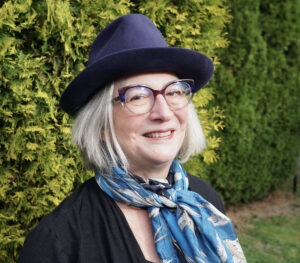
Joy Gehner writes to explore and illuminate the often unseen realities of raising a developmentally disabled child. She lives in the Pacific Northwest, writing in the early mornings before her day job, where she helps families navigate disability support systems. The rest of the time she grows tangles of greens, simmers stews, rises loaves, laughs with friends and performs other practical crone magics. Joy is working on a memoir about creating an empty-nest roadmap when you have a child who will never fly on their own. You can read more of her work and keep up with future projects at Circling the Center and at joygehner.com.