

Paths and Intersections | Lauren Woods
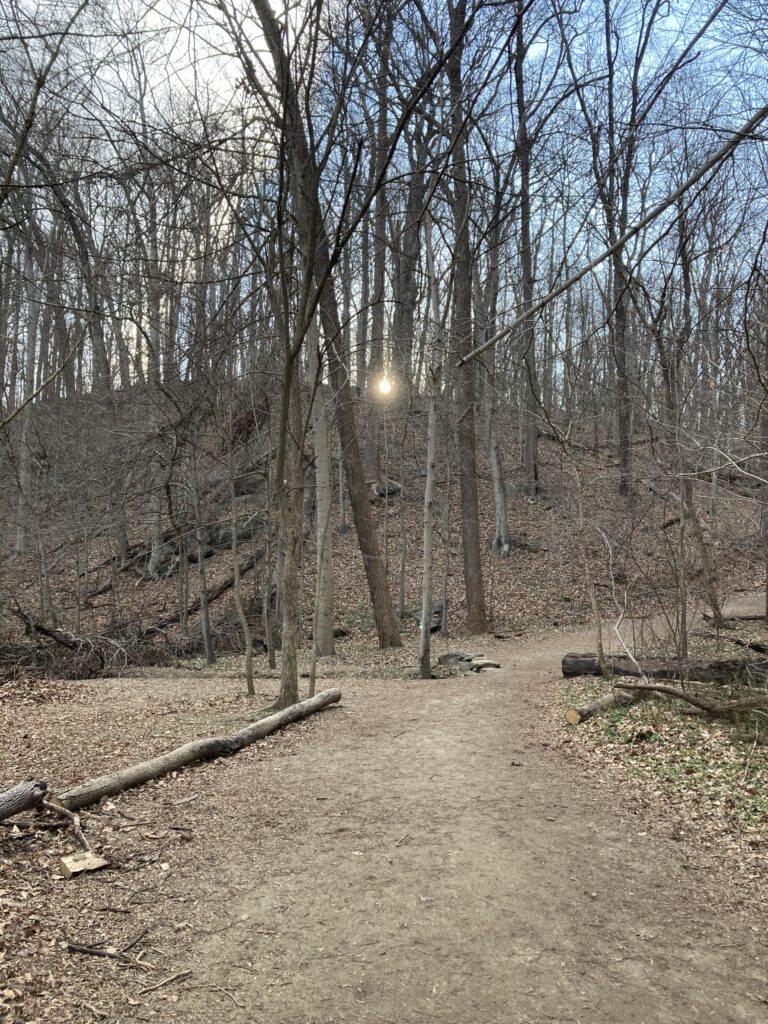
When I was still in the throes of an unhappy marriage, I used to watch two of my neighbors, teachers, who would walk together in the evenings through our neighborhood. She was on her second marriage, he on his first. She had one child, and they had another together. They were, to me, the ideal couple because of how they clearly loved each other, and her daughter, though older, was so kind to mine. I watched them passing outside my window, while I longed for that kind of easy relationship, a simple chat about the day, with the yearning for another life that comes when one is supremely lonely in their own life.
Walking alongside someone is a form of attention. And to me, careful attention is nearly synonymous with love. As a shy and often lonely child, eager for my parents’ attention, I enjoyed a daily evening walk with my father. Though it didn’t strike me at the time, I remember now how little he chimed in, while I chatted on about my day and the dramas of school, and which girls were fighting. He listened attentively and might comment that he couldn’t believe how mean the girls could be to each other. I felt understood, and I was glad my brother and sister didn’t join us, that it was our ritual alone. There was a particular feeling too then, with the sun coming down at low angles, and the end of the day approaching, that filled me with the sense that everything was as it should be. To some extent, I am always searching again for that particular walk.
Though I’m now far from my childhood home in Texas, I am lucky to live alongside so many trails. The trails I walk now, across the Washington, D.C. metro, are always meandering and intersecting with others. Rock Creek Park, close to where I live, branches off into other, smaller parks. Dora Kelley Nature Park, where I began walking after my first child was born, when I lived just west of the Potomac River, in Arlington, stretches south in a long, green finger along Holmes Run to Brookvalley Park, and on down to Ben Brenman Park, and Clermont Park, stopping and picking up again.
Around here, you can easily wander into another park and even circle back without realizing it. My paths frequently circle in on themselves. I have never proceeded easily in my life from point A to point B. And I marvel sometimes at how often I have crossed the same paths and how many ghosts of my past I encounter as I do.
Sometimes I think I’m going somewhere in my life, and sometimes I think I’m just wandering in zigzags over the years, like Moses lost in the desert, crisscrossing my own path, stupidly, as I try to figure out what it is to live a good life. Then again, there is something grounding in living in a space long enough so that its streets and paths become infused with different periods of life. Anyone who has grown up in a city and remains or visits it again as an adult can sense the overwhelming feeling of their own childhood waving from a bus stop, from the school they used to attend, from the home they used to live in. It is a little like that for me. Each path I walk down carries a version of life and of myself I can’t shake off and be free of, and what’s more, am not completely sure I want to.
Dora Kelley Nature Park
After my first child was born, I took walks with my baby in Dora Kelley Nature Park, not far from my home then in Arlington, Virginia. I would park my car and lug the stroller and baby down a steep set of rocky stairs, until we reached the bottom, and from there, would bump peacefully along the dirt road, taking in the springtime smells, my daughter sleeping or gazing around her. I remember, even now, the grip of that foam bar I pushed, the orange canopy of the stroller, how it bumped along over grass and rocks, a comfortable and overpriced SUV of a stroller but one that served my overwhelming need to escape, if only for an hour.
On my very first day along this trail, I ran into a woman who stopped me to say that she too had taken her daughter along this same trail in a stroller, her daughter who was now an adult woman, and here she was, walking the same trail. It was a different trail for me then. Not only the trail, but I was still in my first marriage, still convinced I would be like that woman, walking this trail, with my same family for the rest of my life.
I have been back to the trail several times since then, intersecting with my past self as I imagine her, the lonely, sleep-deprived self on maternity leave who walked up and down in the springtime. That self occupied a space somewhere between depressed and grateful for the little being in the stroller, vaguely aware of the cool air and just-warming spring sun, of the light on her bare arms after a long winter, and yet, feeling as though she were outside of herself, playing the role of a mother, who she did not yet know how to be.
A former traveler, I was now stuck in the tiny radius of my home, limited by my own lonely weakness and my baby’s needs. The Dora Kelley Nature Park trail was my first walking path as a new mother. And, I think fitting, that another woman encountered not only me, but her own past self on this path. I had the hint then, later to be confirmed, that I too would encounter my own ghosts of past selves as I proceeded through my life. Always, on these trails, I loop forward and backward, trying to remember, who was I then? I wish sometimes so badly I could comfort that exhausted and lonely self and let her know how many other trails were coming.
Occoquan Regional Park
After my first marriage ended, a long and slow passing, I later met someone new and moved 30 miles south to be with him. In the days after my move, I would sometimes go out with my two children to the nearby Occoquan Regional Park and watch the leaves coming down, my daughter scooting across logs, my son, barely a year old, holding leaves between his teeth like a puppy. The two of them crowding his stroller together, he on top of her, laughing, still fitting in the stroller, but not for much longer.
This was a new path, far south of where I had been living, a path that didn’t feel like mine at all. I tried to make it feel like home, but it lacked the familiarity of the paths farther north and closer to Washington, D.C., that I’d grown used to. I was mostly sad in this space. The shops, the library, the doctors were all unfamiliar to me. I spent that period feeling like an interloper in someone else’s life, thinking to myself—this is how it would be if I lived here, this is the tiny shopping center where I could pick up my groceries and library books—this is how the dinnertime would look—meager and rushed from the long commute. It was as though all of these little disappointments of living in a tiny suburb far from the city center weren’t also my life—or, as though I knew they wouldn’t be for long.
Those days south of Alexandria in Virginia were short-lived. I should have suspected sooner my first relationship after the divorce wouldn’t work. And began to know it when he started disappearing in the evenings with a vague name of a bar and returning late, when he stepped out so often for cigarette breaks on private phone calls, when my nature walks included only the children and me, and more, when I found I preferred them that way. Even through the turmoil of that period, in the worst versions of my life, I found peace, for a time, in those unfamiliar trails, in the tall, amber grasses and the great, enveloping sky that reminded me of my youth in Texas, and in the sticks and mud and beetles and flowing water that somehow buoyed me through it.
In those days, there was far less walking, and the trails were not as much part of my regular routine. I commuted miles for a job with long, stressful hours, dropping the children off to school just after winter sunrises, picking them up after the sky had grown dark again, working for a woman who piled work onto me so that my hours stretched into the evenings after I returned home. And yet, I was so determined to make her approve of me. I had not yet learned the art of letting certain things go. Those days were difficult, hectic, indoor days, all action, and little reflection, bookended always by the night. I was relieved to move again, months later, close to where I had lived before, to a small but sun-filled apartment that didn’t require the same commute and had just enough space for the kids and me. My relationship had ended. I was learning to let go of things.
Dora Kelley Nature Park
I had moved back again to my old neighborhood, a few blocks from my former house, and close once more to Dora Kelley Nature Park. But I remained far from the trails in those days, because when I moved to the little apartment, the man I thought I’d loved, that first relationship after my divorce, had moved to another apartment, just at the foot of the nature park, my trails, or so I thought of them. His was a noisy, cramped apartment that would turn out to have an endless supply of mice. And since he and I had ended things between us, I stopped walking in the Dora Kelley Nature Park altogether, because he was so close to it, and I did not want to run into him.
In the months that followed, spring turned into a hot Northern Virginia summer. One day, I saw the picture of my former partner, the one I’d moved south for, smiling with a mug of coffee, pop up on my phone. I hadn’t deleted the contact. He was calling me from the ICU of a Virginia hospital. There were blood clots pushing against his heart. He wanted to see me.
I joined a friend and visited him at the hospital. He, hooked up to IVs, looked little like his old self, smaller, less full of jokes and more earnest. And when he returned home and asked me to visit again, I did. He winced in pain each time he had to inject himself with the needles of blood thinners. He moved slowly and with great effort. My anger evaporated. I knew then that life is precious and uncertain, and though I knew we would never get back together, I tried to forgive him for what I held against him. When he felt up to it, we took a different walk together, this time as friends, alongside his big, jolly, beast of a dog, which barked and lunged at other dogs, nearly toppling me. We walked along the trails near his home, not talking much, so unlike when we’d first met, sunk into our respective reveries. It was the saddest I had ever felt on those trails, each of us mourning a version of our lives that would not return.
My former partner died at the end of that year in winter, suddenly, from another blood clot, while out with his dog, outside his new apartment. I would learn about it from a friend, and I would be glad we had made our peace first. Afterward, I would finally return to the trail with my children, on my own, parking at the nature center that emptied right up to the entrance of his old apartment complex. Back on the trails, I looked only ahead of me, careful not to see the memory of him in his gray sweatpants, not to imagine his big, brown, lumbering dog tugging ahead.
After a time, the feeling lifted some. I walked those trails more regularly with my children that summer, and it was ours again, though I still encountered his memory sometimes while walking. Even now, I cannot separate certain sections of that trail from him and probably never will. I always expect to see him around a bend, dog leash in hand, smoking a cigarette, sunglasses on, sharing a meme from his phone, laughing. But by this time, I had fallen in love with someone new. I found a spot on the trail where the trees opened up to the rocks and a shallow creek, where children splashed, and parents sat on the edges looking on, and I thought of this new love, my future husband, and felt lucky to be present and alive.
Rock Creek Park
It is fitting that the first time I interacted with my now-husband, virtually, as we had not even met in person, I asked him for a hiking recommendation, and he recommended a nature preserve nearby. I went hiking there with my children on a sunny fall day, thinking then I would like to meet him and even walk with him.
It took more months before this happened. The fall had to sink in, and then winter, and the ground had to freeze. We had to meet, and then, finally, we began walking together.
The first walk my husband and I took together was in my old neighborhood, only blocks from my old house. We had a ritual in which he would visit me, and we would walk to the grocery store some blocks away, buy a bottle of wine and some chocolate, and bring it back to watch a movie. It was a similar path to the one my former neighbors walked, and since my apartment was nearby, it passed right by my former home and theirs.
Our first walk was at sunset, when we were just off work. I was almost holding my breath, approaching the walk the way one does a delicate bubble you are afraid will burst at any moment. But I felt, soon enough, a conversation that flowed so naturally, and knew I was in the kind of dialogue about the self and the world that could go on and on.
Then the walk became another and another, and soon, whenever he would visit, we would carry on our ritual of walking, never driving, to the grocery store, for a wine and chocolate. And even more, when I learned our love of walking was mutual, and that our needs coincided, I found a lightness in that. It was simpler than I had expected, and I had longed for that synchronicity for so long.
One day while we were hiking in Rock Creek Park, when I was trying to articulate my fears over moving in together, I slipped on a slope and lost my footing. I don’t remember what I was trying to say exactly, but his hand caught mine, and I steadied.
My new walking path in Rock Creek Park, this time inside the Washington, D.C., city limits, where we now live, is becoming increasingly familiar. My husband and I sometimes speak of how we might not have worked out together if we’d met at another point in our lives, before each of us had experienced enough of life. But we met at this point, no earlier and no later, and how lucky that was. But also, how long the paths to get here. And this, I gather, is how the world works, since no person walks with us exactly from beginning to end, and we have only our intersections, long though they may be.
As often as we can now, we follow the same path up into Rock Creek Park. We amble alongside the creek, past a long tree arcing gracefully over the water, past chipmunks and woodpeckers, nuthatches and the occasional snake, onto a bridge, and if we have time, continuing forward, up a steep slope to another ridge, before heading back again.
One day, when my husband and I deviate from our usual trail and walk along a deeply wooded path, barely a trail at all, we see a deer, coming close, munching on leaves, right beside us. The deer doesn’t startle. It is too comfortable, small and hungry, with black, watchful eyes, cracking sticks underneath its hooves as it roots for food.
Virginia Woolf speaks of leaving the whole rest of the world behind when we walk. That is how I feel when I encounter the deer. The rest of the world, for a moment, ceases to exist. Woolf writes, “The shell-like covering which our souls have excreted to house themselves, to make for themselves a shape distinct from others, is broken, and there is left of all these wrinkles and roughnesses, a central oyster of perceptiveness, an enormous eye. How beautiful a street is in winter!”
And how beautiful Rock Creek Park is, hiking on a quiet winter afternoon, as my husband and I have done so many times now. The literature on walking, for the most part, is about the solo walk, but these days, our walks are often with the six of us, including the four children, each of us having brought two into the marriage.
The paces are what’s hard about walking together now. Various leg sizes, different people with different desires and walking abilities. A walk is a negotiation through life. One wants to set the pace, but the soldiers are inevitably disobedient, have agendas on their own. There is always a laggard in any family. When I was a child, on family vacations, it used to be me. My father would call me the lag lady, and slow down to let me catch up. But now my husband and I are responsible for helping to keep the pace, and the laggard is one child or another. Even in the children, I see ghosts of my past. I imagine every family repeating this dynamic across time. I imagine cavepeople urging the children to keep up, the parents sighing, evolutionary nomads all of us, but some better at it than others. All of us, at some point or another, annoyed.
Virginia Woolf writes, in a passage that sounds almost like a meditation, “The sights we see and the sounds we hear now have none of the quality of the past; nor have we any share in the serenity of the person who, six months ago, stood precisely where we stand now. His is the happiness of death; ours the insecurity of life. He has no future; the future is even now invading our peace. It is only when we look at the past and take from it the element of uncertainty that we can enjoy perfect peace.”
I think what I’m trying to say is that slowly, I am easing into what my life will become and also understanding more and more the woman I encountered that sunny, warm morning, in Dora Kelley Nature Park, who took a moment to chat with a tired, postpartum mom, and recognized herself.
It wasn’t a surprise that I could also encounter my past selves on walks. But it only now occurs to me that all along, I have also been crossing space with my future selves. Perhaps, when I was watching my happy neighbors walking together all those years ago, I was not only longing for what my life was not, but also what it could and would be, though I didn’t yet know it.
On a recent walk, my husband and I rest while the four children play together below us near the creek. The older boy is throwing heavy stones in the water, while the others run away from the splash. I call out once for him not to throw too close to them, but none of them hear me. It’s early spring, the first day warm enough to get in the water. The sun is piercing, but the air is still frigid. They take off their shoes and socks. The mud squishes under their feet. The boy will throw one of the girls’ shoes in the water and then later, his own. One will finish the trail barefoot. One girl will lollygag, drying her feet with a sweater, slowly getting her boots back on, as the others rush ahead.
In the moments that follow, one will run ahead, scramble up a tall hill, scoot down, using the hill as a slide, and then cry when he gets a stick in his shoe. The younger girl, again, will lag behind the others, even after the others have left, and we won’t intersect with the rest until much farther along on the trail, but eventually, for all of us, there is an intersection.
All this time that I have been walking, and waiting for my life to be right, I see that I have been living my life already, messy, chaotic, confused, lonely, searching, and also, as it should be. Each step has been my life, past, present, future intertwined. And along the way and back, treasures everywhere. A papery white wasp nest that has fallen at the base of a tree. The low early spring sun, afternoon light filtering across the forest, peeking through treetops before it reaches the ground at such an angle that it seems to be coming in sideways. The specter of our children’s futures, tall and confident, no longer living with us, walking among us, even now. Long shadows, growing longer, as the children grow taller with each walk and the dusk comes on.

Lauren D. Woods is the author of The Great Grown-Up Game of Make-Believe, winner of the 2024 Autumn House Fiction Prize, forthcoming in October 2025. She lives in Washington, DC with her husband, children, and cats.