
A Taxonomy of Devastation| Lynda Rushing
Subtraction
I’m already awake when my phone pings; my arm shoots out like a reflex. It’s my daughter, the latest in a string of early morning text messages she has taken to sending me since my granddaughter’s diagnosis was confirmed.
It’s 5:57. I subtract three hours; it’s not even 3:00 am in San Francisco.
hi mummy
I let out a slow exhale. My daughter is in her thirties, a big deal Brand Director for a major U.S. company, but she sounds like a second grader at her first sleepover. She is over three thousand miles away, but I can feel her presence as though she were lying right next to me. We are both in the dark, trying on our new realities, yet failing to come to grips with what they augur. I picture us breathing quietly, in sync, a continent apart.
I type, can’t sleep?
i’m scared, she responds.
I hesitate, my fingers hovering. Rarely in my life have I felt so helpless. The usual BS I tell my children to comfort them has become impossibly trite and hopelessly stupid; I can no longer stomach my own words. How can I say it’ll be okay when I’m not sure it will? I type the only thing I can come up with.
i know. i’m scared too. i love you.
The texts stop, as they usually do. I know she just wants to know I’m here, that she’s not alone. I picture her breathing slowing, her exhaustion finally giving way to a fitful sleep. And I tell myself at least she’s not in an ambulance again, speeding toward the ER in the middle of the night, her infant daughter in tow, as paramedics try and fail to stop the seizures wracking my granddaughter’s small body.
It’s a new world we are living in, subterranean and dim and filled with hidden dangers. We are struggling to remain calm and straining against the incessant thrum of fear that has overtaken our days and fractured our nights. We are existing day by day, not daring to think too far into the future. None of us sleeps much anymore yet sleep is not the only thing that has become subtracted from our lives. I try not to think of the other things that are no longer there.
Descent
My granddaughter and my son-in-law are playing “rocket ship.” The game makes me nervous but, unlike my own cautious children when they were infants, my granddaughter likes nothing better than to be tossed around in the air and to get as high up off the ground as possible. It’s now T minus one minute and counting. The engines fire up, Mission Control Center stands by. My son-in-law jiggles the baby’s chubby body from side to side as she squeals in anticipation. The countdown commences—three…two…one…zero, and—LIFT OFF! And off she blasts into outer space. Giggling uncontrollably, she rises higher and higher, her face lit by the sun, until she turns for the final descent back down to earth, and back onto her dad’s knee.
My granddaughter’s illness first asserted itself when she was seven months old and began having, what were initially dismissed as, infantile febrile seizures. They are a benign phenomenon and so common that even my 93-year-old mother, with only a fourth-grade education in pre-war Japan, knew about babies who seized with a fever.
But babies with that condition outgrow the propensity and ours did not. Eventually, my granddaughter seized without a fever or infection, without “provocation,” as the docs like to say, earning her a new diagnosis of epilepsy.
But that wasn’t right either. Unlike most children with epilepsy, my granddaughter’s seizures were atypical. They lasted longer than usual and were refractory to the standard measures to stop them.
She was hospitalized multiple times over the course of her first summer of life, poked and prodded and subjected to electrodes glued onto her head to try and understand her disordered brain waves. During one hospitalization, she stopped breathing when the drugs they gave her were too strong for her little body, and she ended up intubated and in the Neonatal Intensive Care Unit. During another admission, she seized on the pediatric floor for forty-five minutes before her seizures could be brought under control.
Her frightened and bewildered parents, newcomers to parenthood, didn’t know what to think. My husband and I, both retired physicians, tried not to think the worst.
In one of my granddaughter’s early hospitalizations, after an MRI ruled out a brain tumor, after the electroencephalogram is deemed non-diagnostic, after all the testing for infections, the on-call neurologist ordered a chromosomal analysis. The results take so long getting to us that we forget about them, and when they finally come back, we are staggered to learn that our granddaughter carries a random mutation that is associated with genetic seizure disorders. We learn that the diseases she could have range from those that are completely benign and self-limited to those that are deadly. But no one tells us where she falls on that spectrum.
My granddaughter is passed off to a pediatric neurologist, who sends her on to a pediatric seizure specialist, but neither one offers a conclusive diagnosis. The uncertainty, the not knowing, begins to wear on us. It feels like we have stepped off a cliff in the dark, our legs flailing, our hands grasping only air; we are falling into empty black space and there’s nothing there to break our fall.
The seizure specialist urges a visit to see her mentor, a clinical researcher at a name-brand university, and we gather in front of our respective computer screens for a virtual visit to learn about our granddaughter’s future, that is to say, our family’s future.
The new neurologist is a pink, cheerful-looking man. The rounded contours of his face give him a cherubic appearance, but his words are as sharp as a stiletto, their meaning clear and unmistakable. He announces that my granddaughter has Dravet Syndrome, the catastrophic end of the spectrum of disease foretold by her genetic analysis. It is a diagnosis so rare that my husband and I, with eight years of medical school and decades of practice between us, have never heard of it. Before the call, I tell a close friend it’s been “a slow train ride to hell, but at least we are at the final stop.” But I’m so very wrong. There is no final stop, just an endless plummet into a bottomless ravine. I fear we may never come up into the light again.
Education
The new neurologist schools us in the neurophysiology and pathology of Dravet’s. My granddaughter’s mutation affects a gene that is vital to the construction of sodium ion channels in the neurons of her brain. These channels are the way that the body regulates sodium, which is necessary for cell function. But there is a mistake in the DNA that codes for half of my granddaughter’s neural sodium channels. The structures that result from this mistake are defective, unable to shepherd sodium ions into my granddaughter’s neurons—they are nonfunctional, out of commission, on the blink. The brain requires lightning-fast opening and closing of these channels in order that neurons can function correctly, and the lack of normal sodium regulation can trigger a seizure of a particularly recalcitrant and malignant type. More to the point, my granddaughter’s seizures can kill her.
We are also told that my granddaughter’s disease, in addition to inciting difficult-to-control seizures, will eventually and inevitably cause profound developmental delays along with possible regression of the small skills she already possesses, starting as soon as her second year of life. And to add insult to grave injury, the doctor indicated that she was also at risk for developing serious difficulties with social interactions.
Outwardly, I’m listening calmly to the neurologist’s words, but this last bit is so impossible to fathom that I find myself suppressing an urge to shake my head. I have never met a baby so charming, so full of personality, as my granddaughter. I recall my daughter describing an outing with the baby in her stroller, watching while she smiles fetchingly at an older man walking toward them until he is finally forced to look down at her, asking, “aren’t you a little too young for me?” How could it be that this child, this infant femme fatale, was at risk for a communication disorder?
And to complete the lesson, we are told that she has a twenty per cent chance of early death, primarily due to “SUDEP” or “sudden unexplained death in epilepsy,” a term that is as useless as it is descriptive, since there is no way to prevent it except to monitor her around the clock, twenty-four hours a day.
We absorb this final bit of news like a punch to the solar plexus that leaves us breathless. I look at my daughter on my screen, her face is a pale expressionless mask, but I drop my gaze; it’s too difficult to look at her. I know her so well that I can almost feel, if not see, the slight vibrations of her body; I imagine she is jiggling her leg up and down to control her nerves, to keep from falling apart when she’s anxious, a coping mechanism she’s used since high school.
The new neurologist briskly suggests some changes to my granddaughter’s seizure medications and agrees to be her primary neurologist. We thank him and exit the meeting. My daughter and son-in-law call us shortly afterwards to “debrief,” but it’s a short call. There’s not much more anyone can say.
Loss
The type of genetic disorder my granddaughter has is classified as a “loss of function” abnormality, meaning that the mutation causes the gene to fail to produce its intended product. We are beginning to understand this concept all too well. While functioning competently has always been a given in our Type A family, we all seem to be losing our ability to do so.
We handle the cavalcade of worsening news, each in our own way. My daughter becomes afraid to be alone with her own baby, fearful that my granddaughter will begin seizing and that she will witness her baby dying in front of her. Remembering those tender early months with my own newborns, this is a loss so awful I can’t process it.
My son-in-law becomes convinced that his daughter’s only hope is an upcoming gene therapy trial and works his business connections to try and get an early report on when recruiting for the trial will begin. He also starts studying cell biology, in an effort to understand the scientific articles he begins reading on the internet. My husband, ever the Soviet-bred stoic, declares that our granddaughter’s looming disability would make him “love her even more.”
I don’t know what I do, precisely, but whatever it is, I don’t do it well. This experience is so far beyond anything I’ve ever had to face or grapple with in my own (as I’m rapidly beginning to understand) charmed life, that my usual well-honed act of looking and sounding composed no matter what life has wrought has broken down.
Early on, I text a few people that my granddaughter has Dravet’s, a genetic seizure disorder that leads to profound disability and early death, and one friend texts back: hope the little one gets better soon! I don’t know how to respond to that. I discover that no one understands what this is like (and, truthfully, how could they?), and no one knows what to say or do. Or they want me to give them reassurances. But I can’t do that. I can only manage my own fears, and I have no reserves to assuage anyone else’s. Eventually, I stop communicating with people entirely. Another loss to pile on the others.
Small
My daughter pulls my granddaughter out of daycare early on when we realize that coming down with a virus will trigger a seizure. Between me and my son-in-law’s mother, we take turns babysitting our granddaughter for nearly five months, my counterpart doing the brunt of the work. Both of us fly back and forth from homes on the East Coast; I make six trips between July and January of the following year.
Sitting in the eye of the storm, my granddaughter is fearless. She dances whenever she hears music of any type, including birdsong. She smiles and reaches out when one of the cats dares to venture near her. She gains a tooth, two teeth, and learns, finally, to feed herself. Although she prefers it if someone else would do the honors. And call me crazy, but she has the best sense of humor. During one of our trips, my husband makes faces and nonsense sounds to make her laugh, and she glances knowingly at my daughter, smiling a quiet smile as if to say, “are you seeing this guy? Bonkers, right?”
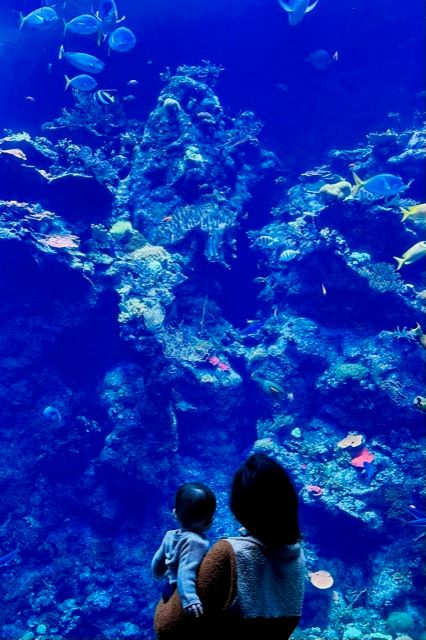
She is so extroverted, smiling at everyone she sees: men, women, children, other babies, dogs, fish at the Aquarium. I marvel at this and wonder where she gets it from. Did she gain nothing from our side of the family, filled with recluses and worried, anxiety-prone introverts? Is this inner joy somehow related to her illness, an unknown perk of her deadly mutation? Doesn’t she understand there is only terror ahead and an angry goblin around every corner threatening to steal her smile and spirit her away from us?
In the meantime, my world has shrunken down to our trips to San Francisco with brief trips home to take care of my mother and the house. When we are not needed by my daughter, we spend our time in San Francisco in a small room we are renting from a family several blocks away. There is no natural light in the room, it is too hot or too cold, and the family argues incessantly and loudly, although I can’t make out what they are fighting about.
The mattress under the sad floral bedspread sags, exacerbating my chronic back pain. I miss my giant cup of freshly brewed coffee made with freshly ground beans and topped off with foamy milk made for me each morning by my husband. I miss my sessions of pool running, which serve to keep my pain at bay. I miss my former life, the one that wasn’t punctuated by episodic anguish that this beautiful little being, so new to this world, will disappear and leave us all adrift like soulless ghosts.
I’m exhausted and in despair every night, but by the time I walk to my daughter’s house each morning, I have on my game face. And my smile when I see my granddaughter is real. I can’t help myself. Her smiles are contagious, there’s no other way to put it.
The new neurologist introduces my daughter to another mother of a Dravet’s child in the Bay Area, another patient of his whom he is pleased about; apparently, she is doing well, doing really well, much better than we can hope for with our granddaughter. He doesn’t say this, precisely, but he warns us against having too much hope, too many expectations, since the other child is unusual and doing unusually well. He says, “I don’t want you to think this is the way it will go.” I’ve spent over twenty years as a physician, and I’ve never heard another doctor inveighing against too much hope. But we are in a foreign land, and we are learning the customs here fast.
We visit the family, who are gracious and kind, but watch the girl in silence. She is clearly behind, disabled in a way it is hard to pin down. She can walk and say words but cannot string them together, and she does not look like a toddler. She looks older, worried, a concentrated expression contorting her face. She doesn’t have the carefree smile of a typical 2 ½ year old. Compared to her normal older sister, she is clearly struggling.
Her parents confess that it’s been hard on their jobs and their marriage. And in answer to my son-in-law’s question about how they handle travel, the mother simply says, “we don’t.” Their daughter had a seizure-free interlude that went on for months, which lulled them into visiting their former home in Southern California. But after arriving at their hotel, their daughter promptly seized and had to be taken to the hospital. That was travel enough for them.
We come home defeated after a quiet car ride, our thoughts private and pained. I’m in a closed dark chamber in my own mind—is this truly the best, the very best we can hope for? We sit at the dining room table and my daughter asks me if I think the girl looks normal. I waver for half a second and then say “no.” We are beyond telling lies to soothe each other. She dissolves in tears next to me. “Oh, mummy,” she says, “will my baby lose her beautiful smile?” My son-in-law, a seasoned traveler, with pre-kid dreams of traveling around the world, is grim and unhappy that they will likely have to put travel on hold. “Our lives will become small,” he says. The bitterness in his words is palpable.
But his words stick in my head, and I can’t stop thinking about them over the coming weeks. And I start to feel a new emotion: I’m angry. I’m angry at us, at myself. It’s we who have become small, I think. We are all in hell, no doubt about that. But there is no way to vaporize ourselves out of here; it’s where we live now. There is only a slow and steady slog through the days and weeks and months ahead as we adjust to the new terrain. And we need to keep going because—what else can we do? We’ve tried and failed to subtract our fears and we’ve tried and failed to discount our losses; those things are all real. But why do our lives have to be small? Can’t they be as large as we make them?
Channels
It’s now mid-January, and my granddaughter is on the floor laughing in the uncharacteristically sunny living room. When I woke up, I could hear the foghorns booming, and it was gray and damp, but the fog has since lifted. Dust motes dance in the channels created by the streams of light.
I watch as my granddaughter scoots across the floor on her butt; she’s over a year old now but still unable to stand by herself or crawl. Her legs work the floor like a swimmer’s frog kick while her hands gain purchase on the wood in front of her; she giggles when she realizes her dad is chasing her, and she pauses, her arms held out, her hands held up to warn him against coming farther. Her dad, no fool, stops.
She is full of life, not asking why or how, wrestling with existential angst, bargaining with invisible gods, or feeling separated from the rest of the world. She is not yet acquainted with bitterness, with sorrow, with smallness, leaving all of that for us to sort through.
We watch as she continues frog-kicking her way through the sun-splashed room, her laugh musical, buoyant, joyous, and we cling to it, our guarantee for now that enough sodium ions have made their way to their destination so that we are temporarily spared the worst of our fears. We are momentarily free to grab hold of what remains of our hopes, channeling them toward an uncertain future.
This is who she is right now, this is her world, and this is ours—as mysterious and vast as the Universe.