

Brother| Priscilla Long
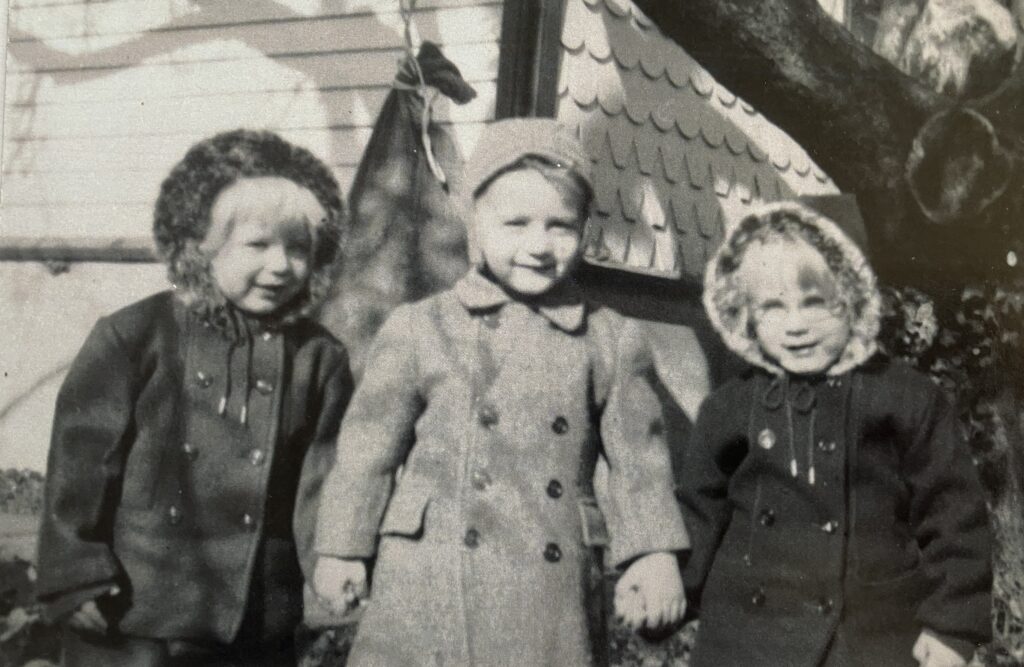
Priscilla Long, left, Andrew Long, center, Pamela O. Long, right
Photo
We are three kids, three years old. Winter coats and caps. Andy is ten months older than us twins and he is clutching us by the hand, one on each side. Slightly buck teeth, an earnest look. He has on a little double-breasted coat with two rows of buttons down the front. How tightly he grips our hands, keeping us safe, it may be, or keeping us lined up for the photo. I am the slightly blind-looking twin on the left who has yet to have her eye operation and get glasses.
Farmhouse
The old kitchen combined with the old attic above the kitchen is the oldest part of this shabby 200-year-old farmhouse. Once, when this was a two-room house, a staircase led from the attic down to the kitchen. The below-landing part of the staircase was long ago removed. There is a door that starts at the kitchen ceiling and ends halfway down the wall. Behind the door is the landing and top part of the staircase leading up to the attic room. Now the original two-room house is the corner of the larger farmhouse, and you access Andy’s room from the newer second floor.
In this scene he is about ten years old. He is in the stairwell screaming and crying. Both parents are below in the kitchen yelling at him.
Barnwork, Housework, Work
We twins switch off between housework and barnwork. One week, housework: do the laundry, hang out the clothes, do the ironing, make the school lunches; on alternate weeks, barnwork: bring in the cows at 4 a.m., help Daddy with the feeding and milking, wash the milkcans, feed the calves. We both have to work in the garden; for the entire month of August we help our mother with canning and freezing. In August we also join the crew that brings in the hay: Buck Washington and Neil Lindsey, the farm hands; our father, the dairyman; and Pammy and me. We are paid 25 cents an hour by our father’s boss, and this is our own money. I am proud of my work on the farm, proud to be a strong girl, proud to be such a good worker.
Where is Andy? I cannot remember him doing any work at all, and I can’t ask him. He died seven years ago at age 76. I ask Pamela. She says: He did no work! But our father submitted his “hours” to the boss and he got paid! Even if it was only 25 cents an hour, it was dishonest! The basic fact was (I think) that Andy refused to do chores, and they could not force him to do them. Our father was a hyper-moral, religious man. I wonder out loud how he could have allowed his son’s hours to be submitted, despite his son’s lack of work. This would have been my mother’s idea, she, the boss of our family. Our father was too weak to oppose.
The War at Home
How can I explain this war between our parents that goes on for decades? The shouting and yelling. Our parents had once been in love. Look at the happiness in their wedding picture. But by this time, our mother, who has a genius IQ, who has three children by age 19, who has five children by age 23, who dislikes animals, who dislikes farming, who has no friends, by this time, I say, our mother is deeply unhappy. And, despite our father’s work ethic and constant work—poverty. Both parents believe in paying bills, all of them, all of the time. Yet there is never enough money, and every month they have a shouting match over which bills to pay.
Children at Play
As for Pammy and Andy and me, when our homework is done, when our jobs are done, when school is out, we play and play. We play fort and we play Cowboys and Indians. When it rains outside, we play Parcheesi or Monopoly. All summer long we go barefoot. We swim in the Chester River every day. We row the boat out to the bight to lift eel traps set by watermen. We love to watch eels writhe and coil. This is on the Eastern Shore of Maryland.
Susie’s Story
They call us the Three Big Kids, and we play together for all the years of our childhood. Susie is three years younger. We snub her.
Every day after school the four of us get off the rural school bus and walk home down the mile-long dirt lane. All the way home, Andy torments Susie. I cannot recall his words. At the end of the lane, in the yard beside the old farmhouse, Andy gives Susie her daily beating, punching her repeatedly in the stomach. Pam and I stand and watch. Passive. Feeling nothing. How long does this go on? When do I start trying to protect Susie? Not soon enough. Tell our parents? They are hard-working and stressed out and we never tell them anything.
Later, Susanne (Susie) says to me, “I was a battered child.” It is then that I remember.
Stargazing
When we are in the Second Grade and Andy is in the Third Grade, he contracts what is thought to be tuberculosis (later re-diagnosed as histoplasmosis). He is bedridden for a year; we twins are forbidden to go near him. Andy is given a telescope kit and spends the nights looking at the stars. Here begins his fascination with astronomy.
The Weekly Bath
Church and Sunday School. Every Sunday we children take a bath. A tub is drawn. Andy goes first, then we twins go, then Susie, and finally Lizzie, born nine years after us. Liz now remembers how every Sunday she got the coldest, dirtiest bath water. We get dressed in our church clothes and our father drives us to town, to the Methodist Church.
When he is about 13, Andy decides he would rather be Episcopalian. A member of the Episcopal congregation comes to pick him up every Sunday and then returns him after the service. Andy is clever and witty, no doubt a good conversationalist. He may not know the phrase, but he wants upward mobility. He wants out of this life of poverty and shouting and chores. So, Episcopal.
The Road Out
Our father dreams of having a farm of his own. Our mother spends hours and years in bed reading mystery novels. (She also runs the garden, plus the canning and freezing—we grow most of our own food—and she does the cooking.) When we are 11, and she is 30, she decides to go back to college. Our parents had met in their first year of college, immediately after which they became pregnant and married.
In 1954, now with five children, our mother returns to college, graduates at the top of her class, goes on to graduate school, graduates at the top of that class. Eventually she becomes a college professor.
Our father wants us to stay on the farm. Our mother wants us out of the farm. The town high school being egregiously awful, our mother finds us full scholarships at rather posh boarding schools. We twins attend Moravian Seminary for Girls, where we are popular and happy. Andrew attends St. Andrews School for Boys, all by himself. Did he have even one friend?
Wife No. 1
An avid reader, Andrew attends St. John’s College but flunks out his freshman year. He joins the Navy, serving as a radioman on a transport vessel in the Vietnam–War era (never in battle). He has good buddies in the Navy. He learns to drink. He is honorably discharged and goes to Boston University on the GI Bill. This time he graduates and gets a job in Washington, D.C. at the Department of Veterans Affairs hospital administration. He works there many years. (I think he probably does a good job.) He gets married. Andy and Sue appear to be a great, compatible couple.
Interior Design
I love visiting Andy and Sue in their Washington, D.C. apartment. We spend long hours designing their new house, to be a Techbuilt, a type of prefabricated house where the load-bearing walls are the outside walls, so the inside walls can be moved around, the spaces to be designed by the buyer before the build. We have a great time talking, feasting on roast beef, mashed potatoes, and gravy. Sipping good wine.

Only the Best
The Techbuilt house in Columbia, Maryland. Andrew with his own private library, wall to ceiling books, many rare and leather-bound, the leather-upholstered reading chair, the fine rug. Sue has her sewing room. Upstairs, the vast living room looking out through glass at trees. The vast master bedroom. The carpet, the Yamaha grand piano, which Andrew is learning to play. The way Andrew puts Beethoven or Bach on the record player and then “conducts.” The way Andrew smokes Benson & Hedges cigarettes. The way Andrew drives his late-model, diesel-powered, leather-upholstered Mercedes Benz.
The bitter divorce.
Lunch with My Brother
On a visit to Washington, D.C., I go to lunch with my brother. He is now either director or assistant director of the Department of Veterans Affairs hospital administration. He arrives at the lunch counter. His hands shake violently. He orders a drink—is it a whiskey sour? A rum coke? I have no idea. Then he orders another drink, then another. In fast succession he swigs the drinks. Now his hands have stopped shaking.
Always a Reader
Our mother taught all of her children to read. An email arrives from Andrew, addressed to me and other relatives: He has just completed reading every page of Edward Gibbon’s six-volume Decline and Fall of the Roman Empire.
Astronomy Again
Every birthday, Andy sends me some sort of science book. It always comes with an inscription about how we are now the same age. (He being only ten months older, this eclipse of our ages occurs for six weeks every year). Also, he offers to help me puzzle out any aspect of physics or astronomy or electricity I might have trouble understanding. One of these books I still have is Alan Lightman’s Ancient Light.
Wife No. 2
Later he marries Sarah, and her son, our beloved Daniel, age 3, enters our family. During these years I don’t see him so often. The years go by, but something is wrong. Sarah has a trust fund (millions of dollars), but Daniel is sent to school in torn, shabby clothes. Our parents love Daniel dearly and often take care of him. Our mother, who has little money, takes him to Goodwill to buy him decent clothes for school. As a teen, Daniel once called his Gran (our mother) to say that Andy is beating Sarah. His stepfather has become a violent drunk. Our mother calls me. Wife beating! she says. (Daniel has no memory of this.)
Susie: Life and Death
Susanne (Susie), our little sister once beaten daily by Andy, grows up to be a great beauty. She is funny and creative. She draws and paints. She serves in the Peace Corps (Liberia). She marries, divorces, gets a master’s degree in Linguistics. She teaches English as a Second Language. In her early 30s she develops paranoid schizophrenia, with psychotic breaks rare at first, then frequent. This is a long story, not to be told here. At age 40, she disappears. We conduct a nationwide search. Four months later her bones are found, a likely suicide.
Under the Influence
Andrew is hospitalized for something-or-other, and the doctor tells him that if he doesn’t quit drinking, he will be dead within weeks. He has already quit his job or taken early retirement. He goes to a drying-out place, sobers up, and stays sober for a few years. Sarah and Andy move to Florida because “everything is cheaper in Florida.” Andy starts drinking again.
Andy and Sarah feud with Daniel, who is, with the support of his Gran (our mother), attending college. (The miracle is what a fine person our Dan turns out to be, what a good dad.)
Who Are You?
Our mother is dying. We all gather at the assisted living place where she lives. A tall, bearded man enters the living room. I do not recognize this person. Then, with a shock, I realize that this is my brother. This is Andrew.
On May 29, 2003, at age 80, our mother dies.
Sarah: Life and Death
Some time that same year, Wife No. 2, Sarah attempts suicide by overdose, in the process damaging her brain. (Sarah is sweet, but mentally unstable; it is likely that she habitually ingests opioids.) Now Andy and Sarah live in separate apartments across the hall from each other. Sarah says she “loves Andy, she can’t help it.” Due to the brain injury, she from time to time loses consciousness, but then she comes to and is okay. One night she runs into Andy’s apartment choking. He administers the Heimlich Maneuver and lays her down on the sofa. She has stopped choking but has lost consciousness. Thinking nothing of it, he goes to bed. The next morning, on May 30, 2005, he gets up and realizes that she has not moved. She is dead.
Money
Living a life of luxury and heavy drinking, they have spent Sarah’s entire trust fund. It is beyond my comprehension how they could have done this. They had no yacht, no airplane. They didn’t travel. They didn’t live in a villa. There were times they didn’t have access to her money, but still they spent and spent and spent. By the time Sarah died, the money was gone.
Andrew had borrowed money ever since he was ten years old. He was never known to repay a loan. The hatred—I can find no other word for it—between my father and my brother was related in part to money. A $5000 loan to him from our parents, never repaid, accounted for years of rancor. My policy: never lend Andrew money. Instead, on two different occasions, after receiving desperate emails, I gave him a thousand bucks, for which he was effusively grateful. Unlike some other family members, I was always on speaking terms with my brother.
Going Down
After Sarah dies, after the medical examiner’s report (no foul play), after Dan arranges for the burial of his mother in a family plot in New York State, Andy calls me to discuss whether he should move into a senior living place. (He is now living on his $2000-a-month pension.) It seems like a good idea. He moves in, but, after a time, there is a problem. He falls behind on his rent. His rooms, we later learn, are filthy, piled with junk, encrusted with garbage.
He calls our father to ask for a loan. The bitter struggle between them goes into another inning. Our father declines to lend Andrew money but instead pays his rent to the institution. The place obviously wants to get rid of him. With his charming, witty personality, Andy has borrowed money from various people in the senior-living community, never repaying one single cent.
Liz, our youngest sister, and Liz’s husband, David, go to Florida, in part to visit Andrew. He exhibits his nasty alcoholic side, snapping his fingers at the wait staff and ordering them around. His living quarters are appalling. Liz did not really grow up with him, and she fails to understand why anyone would choose to be in the same room with him.
Wife No. 3
Andrew is about to be evicted, with no place to go. Suddenly he announces that he is getting married again. This new friend, whom he likely met in a bar, offers him a place to live, but on condition that they get married. So.
We are happy for him. He has found someone who cares for him.
My brother-in-law David (Liz’s husband) looks up this new wife on the Internet. He finds her police mugshot and an account of her crimes. The worst: she approached the home of an elderly couple on pretext of selling something (cosmetics? kitchen ware?). Her gang grabbed the man and woman, stuffed them into the trunk of a car, drove the car from Florida to Texas, and abandoned it in the desert with the couple still in the trunk. It was only pure luck that, many hours later, someone heard the man’s tapping and they were saved.
Disappearances
Andy and this person who shall remain unnamed are living in Florida, and now they disappear.
In 2013 our father dies at age 91. He had moved to Seattle to be near me and my sister Liz, his youngest daughter. We doted on him. We now need to inform our brother of the death, and we need to transfer to him his not-huge inheritance. At this point we are clueless as to where in the United States he might be. By searching on the Internet, my clever brother-in-law David locates him and his wife living in an expensive hotel (which they could not possibly afford) in Biloxi, Mississippi.
In his will our father has carefully subtracted from Andrew’s portion the $5000 loan of decades ago, plus the $6000 of overdue rent. Having located Andy, we inform him of the death. The IRA distribution, an amount something like $10,000, is transferred to him. After which Andrew and Wife No. 3 disappear again.
Days pass. Weeks pass.
Next David discovers our brother in a police mugshot. He looks angry and drunk, just awful. He is locked up in a Florida jail, charged with domestic violence.
Well, we think. At least we know where he is. Also, they must feed him.
Anxiety
Again, he disappears. I begin having anxiety attacks. (This tells me how attached I am to him, despite everything.) Where is he? Who is taking care of him? Weeks go by. No word from Andrew.
Then he calls me from the New York City VA hospital. He has been living on the street. The Florida prison system, you see, releases prisoners to the train to New York, giving them a credit card with 50 bucks on it. Thanks, Florida.
I beg him to let the VA hospital help him. We get cut off. I call back. Noooo, the kind man at the other end says. He hung up on you. Oh. I say. Okay. I do not take it personally. I know my brother.We can’t help him if he doesn’t want help, the man insists. I thank him.
My brother is living on the streets of Manhattan. My anxiety escalates. What will happen to him? More weeks go by.
Next Harlem Hospital calls. Andy had been there the day before. They had called but I hadn’t gotten the call. The social worker tells me he is a homeless person, unbathed, with ragged clothes. His ID has been stolen. There is no way to contact him.
More weeks go by. Now Bellevue Hospital calls. Bellevue Hospital cares for anyone who needs care, even my brother.
Drawing a Line
Liz and Dave begin the process of finding him a senior living situation in Seattle, where they and I live. About this time, I am reading Andrew Solomon’s (for me) devastating book, Far from the Tree. The book explores families loving and trying to save a family member who has significant challenges. Each chapter delves into a different situation (in one it’s mental illness, in another, criminal behavior, and so on). What I remember about the book is the one family member who donates their entire life to trying to save this challenged family member.
I suddenly know what will happen if my brother comes to Seattle. We will find him a place. That will work for a while. Then he will get himself evicted. He will arrive at my house, where he will chain smoke and imbibe. Since there would be no other place for him to go, I would either have to keep him or throw him out on the street. I would not be able to throw him out on the street. In this way would my life be incinerated.
I write an email to the entire family. He may not come to Seattle. Liz and David drop the project.
Health Care for All
Bellevue Hospital deals with Andrew’s multiple health issues, gets him on Medicaid, and gets him into an assisted living place on Long Island. Saved by Bellevue Hospital.
Andrew’s Old Age
The rest of his inheritance comes through, a few thousand dollars. But we, following legal procedures, do not give it to him. If the money were transferred to him, within a week he would be thrown off Medicaid. Within a month the costs of hospital and care would run through the entire sum. Within six weeks he would be back on the street.
It becomes my duty to send him $200 dollars a month (an amount determined by his care facility) plus any non-monetary thing he wants, as long as the money lasts.
He issues his orders in detailed, careful script, as if I were a good-hearted but slightly dimwitted clerk. He orders up subscriptions to The New York Times, The Economist, and The New York Review of Books. He orders up a fine-bound, boxed book that costs $200. I cannot recall the title.
He orders up a Montblanc pen. A Montblanc pen? I looked it up. Holy Shit. The cheapest Montblanc pen goes for $600. I enter places I didn’t dream existed. I tell the Montblanc pen merchant the whole long story of Andrew and we have a vivid conversation. He asks if there is any security in this Assisted Living place. Nope, I say. None. The merchant opines that since I am the writer, someday I must have my own Montblanc pen. I couldn’t agree more.
It seems that at this new place Andrew has a couple of buddies. We are glad. Liz calls him and tells him that wife No. 3 (who is never seen again) is a criminal. Andy quips, she was such a nice girl. He appears to have no attachment to her.
Only the Best
Next comes the order for a watch. Andrew must have a Rolex watch. I look it up on the Internet. I am appalled. This cannot possibly be. The cheapest Rolex watch is $6,600. I just can’t do it. I go to Nordstrom and buy a thousand-dollar watch. Meanwhile I admire my own Timex, which I’ve had for years, which keeps perfect time, which I purchased for $16. I send the thousand-dollar Nordstrom watch to Andrew. He writes back. He is annoyed. This is not a Rolex watch. I asked for a Rolex watch! I write back: Could you please, then, return the Nordstrom watch so I may return it? This request receives no answer.
Okay. This is not my own money, it is money I am trustee of. If he’s going to flush it down the toilet, fine. I enter Seattle’s Ben Bridge Jewelers, purveyors of Rolex watches. I tell them the whole convoluted story of my brother, which is kind of humorous in a sick way. The Rolex merchants are jolly and helpful. Even though, given the cost of the watch, I would be too. Still, they are genuinely kind and funny. We have a considerable discussion about how we are going to get his wrist measurement. This watch must be adjusted to the individual wrist. We send Andrew a string to cut where it fits his wrist comfortably and not too tight, with instructions to return the string. I bring the string back to the store and they adjust the watch.
A Lonely Death
Andrew has some sort of health crisis and is transported to a hospital. There, all by himself, in the middle of the night, he dies. This occurs on August 28, 2018.
What Remains
What is left? The rest of “his” money is sent to his son. The only thing returned to me is the Rolex watch. I take it back to Ben Bridge Jewelers and they readjust it for me. I offer my Timex in exchange, which makes them chuckle. I am wearing Andy’s Rolex right now.
For whatever reason, most of our old family photos have ended up with me, including, I think, virtually every snapshot ever taken of Andrew. No one besides me wants one single one.
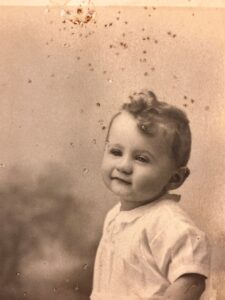
Here he is, a little boy with curly brown hair, dressed all in white. He must be about two and a half years old. A darling boy, looking at the camera. Someone has taken a sharp-pointed object—a nail?—and stabbed the photo again and again. It is pierced with small holes. Who did this? When did they do it? What was going on?
I have no idea. But it does seem to stand for Andrew’s life.

Priscilla Long is author of nine books including Cartographies of Home: Poems (MoonPath Press, 2026) and On Spaces and Colors (University of New Mexico Press, 2026). Her how-to-write manual is The Writer’s Portable Mentor. Her work has appeared in publications such as The Hudson Review, The Southern Review, and The American Scholar. Her awards include a National Magazine Award and ten of her essays have been honored as “notable” in various years of Best American Essays. She has an MFA from the University of Washington and grew up on a dairy farm on the Eastern Shore of Maryland. To learn more, go to www.priscillalong.com.