

Cleaning the Augean Stables | Nadia Ghent
Winner, Readers’ Choice Award, Summer Writing Contest 2024
On a clear fall day, when the light had shifted and the trees in Riverside Park swayed with early autumn brilliance, my mother called with the news that her young doctor wanted to change her medication.
“Nadzu, Dr. L. thinks Depakote is a much better drug than lithium. He wants to give me a drug holiday and then switch to a new regime. He gave me a sample, and I’m going to try it.”
This was the worst news possible. Nothing good would come out of this kind of vacation. At the clinic, my mother’s newly minted resident psychiatrists were always trying to be pharmaceutical cowboys, rounding up the latest big-name drug to put her on instead of old reliable lithium. It was always a disaster.
I was six months into life with a baby and a three-year-old and a full-time career as a freelance musician. I had no time to manage my mother’s illness. My two younger sisters were busy with setting boundaries. I was the oldest. Our mother was my responsibility, which I did my best to ignore.
Two weeks later, she called me twenty-seven times in one hour. The number was flashing in bursts of green LCD light on my answering machine when I got home from rehearsal. Sometimes, it’s hard to remember how insistent analog life was, how some messages couldn’t be ignored. You can’t ghost your mother when she’s going crazy.
“He’s after me,” she kept saying. “That delivery man from D’Agostino’s. He’s pounding on the door. He wants a bigger tip. I also think he wants to rape me.”
High velocity words tumbled out of her mouth like miniature tornadoes. She said people were watching her from across the street. The front door could mysteriously open by itself. Somebody climbed in through the fire escape and ate all the olives in the fridge. Her olives! My mother rambled on, incoherent connections mixed in with a run-down of her delivery order and that she’d forgotten to buy butter.
After a decade of remission, the grand sweep of my mother’s madness had returned. I erased all twenty-seven messages. I could feel a familiar sense of dread lodging in my throat, taut as a gag smothering me in confusion.
This time, my mother’s paranoia was exactingly specific. That man is after me. True, she was an elderly woman living alone on a dark and deserted street at the edge of the West Village. But it was hard to know how much this hysteria had been whipped up by the 1010WINS news radio reports she listened to all day long, or if man meant Mannie, her ex-husband, ironically a psychiatrist. All men, especially ex-husbands, were suspect.
But I knew she wasn’t being harassed by some man who had a thing for older women. The trans women and gay men in her neighborhood looked out for her, kept her safe, even the sex workers in their torn fishnet stockings and hot pants, the ones she shared Tic-Tacs with. They helped her across the street and carried her packages. This could only mean her mind was collapsing again, her delusions making her conflate all men with the name of my stepfather, a man she despised. Even the kind young boy who each week hauled her groceries from D’Agostino’s up five flights of stairs and helped her put the perishables into her refrigerator. He too became a predator.
I dreaded having to rev up the old machinery of threats, arm-twisting, and outright begging her incommunicado psychiatrist to get her admitted to the hospital. Even my husband, a physician-scientist years past his own residency and technically Dr. L’s superior, couldn’t get him on the phone. In the end, it was my mother’s pacemaker that made Dr. L sit up and take notice, not the fact that she was wandering around Greenwich Village barefoot. If she went into cardiac arrest and died while psychotic, Dr. L. would be held accountable. As a young doctor at the beginning of a lucrative career in psychopharmacology, he got the message fast.
Twenty-four hours later, my mother was in the psych ward at St. Vincent’s, admission number eleven or fifteen or twenty-one. I’d lost track of how many there were. But I could measure my life by her breakdowns. I knew exactly which grade I was in by where she was taken, sometimes voluntarily, other times on a 5150 hold, in restraints and handcuffs, once in a straitjacket. Fifth grade, University Hospital; sixth grade, Beth Israel; seventh grade, Cabrini. Sometimes, I’d remember the particular shade of blue in the bellbottoms I liked to wear on Saturday afternoons when I was thirteen (Bellevue), the floppy granny hat I was attached to when I was fourteen (New York Hospital), or how self-righteous I felt as a fifteen-year-old pretending to read Germane Greer (Mount Sinai). Sixteen, seventeen, and eighteen were repeat years (Mount Sinai three times in a row). After that, I gave up counting. Her illness had been a thousand-page book of my life.
I visited my mother exactly once, just before she was discharged. I asked the babysitter to come a few hours early so I could have time in the afternoon to attend to the visit. The children didn’t want me to go. The baby cried and my first-born clung to me, desperate to make me stay home. I wouldn’t see them until long after midnight, and they would already be asleep. I listened to their wailing as I walked down the corridor to the elevator, the quick intake of breath and then their steady screaming that diminished only as I got farther away, until the elevator door closed and all was silent again.
I was supposed to have taken care of her apartment. There was just enough time to sweep the floors and dust the furniture and still get to the hospital for a visit before I’d have to leave for my concert. I knew I should have gone sooner to water her plants and pick up the mail. It was guilt, really, that made me walk twelve blocks out of my way, down the cobblestone streets, my violin case strapped to my back, the bag with my concert clothes slapping against my thighs. Guilt that I hadn’t taken better care of her things, and perhaps too, of her life.
I lingered on the sidewalk outside my mother’s place. Trucks rumbled down Washington Street toward the UPS depot. She’d moved to this complex of low brick buildings, squat and plain, after the divorce from my stepfather when I was eighteen and my sisters were eight and eleven. Everything had been new, a chance to start over. New appliances, a parquet floor, clean white walls, a child-gated window looking out at a concrete courtyard, and just beyond, a sliver of the Hudson. But there was nothing to see. The iron stanchions of the elevated West Side Highway blocked all but the most flamboyant sunsets.
Now, the complex looked worn, with grimy windows and missing bricks, a row of battered trash cans out front. Her apartment had never been my home, even for the few weeks after college when I slept on the daybed in the living room, listening to her drinking all night at the claw-foot table. My stepfather’s lowball alimony deal meant she could afford only a five-story walk-up that had room for my little sisters and the dog, but not for me.
I could recite the feminist cant by memory: the idea that liberated women weren’t supposed to depend on men for money, that my mother’s dependence on her ex-husband’s pittance meant she deserved her impoverishment. Maybe I believed it a little. But I didn’t want to admit that for a woman over thirty, forty, fifty, with a slight crinkling around the eyes or a tinge of gray in the hair, anything that made you look less desirable, more desperate, especially a woman who needed to be hospitalized for psychosis once or twice a year, finding work was next to impossible. That I was now thirty-six didn’t figure into my belief system, or that I was married to a husband who made significantly more money than I did.
I was never going to be old or crazy like her. I was sure of it.
I climbed up the five flights of stairs, trying not to think about my mother clutching the banister on the way downstairs the night she took herself to the hospital. I hadn’t offered to help, hadn’t wanted to leave my sleeping husband and children and take the subway from 125th Street all the way downtown at three in the morning to help her down these stairs. I hadn’t held her hand, hadn’t called a taxi, hadn’t sat with her in the ER for hours waiting for a nurse to bring her something to calm her down until she was admitted. She’d done all those things by herself.
At each landing, a mirror had been tacked to the cinderblock so you could see behind you if someone unexpected slipped through the front door before it closed, a safety measure cheaper than surveillance cameras. I glanced at the image of myself in each mirror as I climbed. I was resolute in the first mirror. By the second floor, I saw wariness; by the third, I saw fatigue. At the fourth floor, a defeated woman with dark circles under her eyes stared back at me, a woman with a washed-out face, hunched over and tired, with stringy hair and a violin case strapped to her back. A jolt of recognition reminded me that the instrument on my back had once been my mother’s.
This wasn’t who I was, I thought. I wanted to be carefree and beautiful, unencumbered by the weight of my mother, but the reflection I saw at the fifth floor looked eerily like her. People said we sounded alike, especially on the phone. I looked carefully at my haggard face. I’d have to do something about that hair before the concert, pull it up into a twist and secure the unruly mass with a glittery barrette. Something elegant when I felt slick with sweat and misgiving. It occurred to me that musicians and mourners both wore black clothes. Perhaps I was already in mourning for something I could not yet name.
I paused to catch my breath. The moment just before I entered, there was that familiar pungent smell, a sweet-sickish odor of cigarettes and fruity rot that I had never smelled anywhere else but there. I hesitated again, then unlocked the door.
I thought I was in the wrong apartment. The place was even more of a disaster than I had imagined. All the plants were dead. Overturned chairs blocked the window and books sprawled open on the floor. Half-filled coffee cups had mold growing in them, and piles of food-encrusted dishes teetered in the sink. Papers and music were stacked everywhere, and a layer of dust blanketed the piano. That smell of decay and mildew and overflowing ashtrays. Her bed had no sheets on it. There was what looked like blood on the walls.
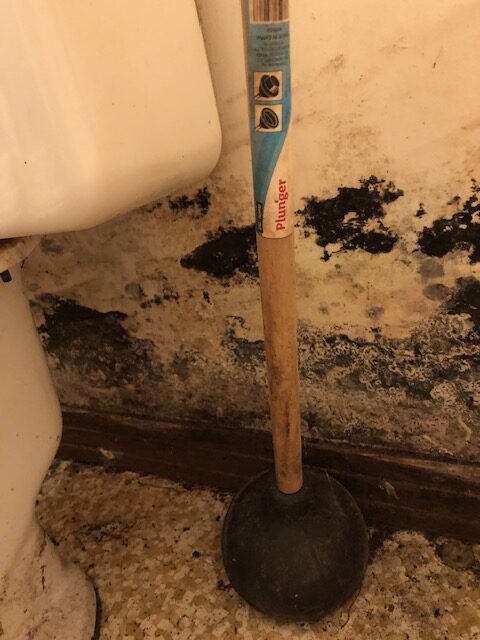
In the bathroom, dirt and years of soap build-up adhered to the cracked tiles. I could smell the odor of a fetid body getting wet but not clean in the shower streaked with grime. There was a dark ring three-quarters up the sides of the bathtub. All this had taken time to happen. And yet, I felt personally responsible for the extreme state of the walls. I had to fix it. I had to clean. I was determined. This job was going to be a symbol of my single-minded intention to scrub away the mess of her life. Here were my Augean Stables, and like Hercules, I was going to make a heroic effort to get it done. If I could make the tiles gleam again, it would mean that decay was reversible, that energy and effort could wipe bad things away.
I rolled up my sleeves and got to work. For a while, I believed the tiles were getting cleaner. It felt good to breathe in the sharp smell of Comet and shake the gritty powder all over the unpleasant bathtub. I remembered cleaning days with my mother before she moved to this place, how she loved to sing while she worked, the smooth feel of soapy water in the pail she’d ask me to carry, her long chestnut-colored hair tucked under a bandana.
But that day as I scrubbed, I knew the situation was more than unpleasant. It was foundational. I’d been so sure that everything could be fixed with the right medication and the right initiative. Elbow grease and chemicals. And yet, I’d neglected to realize just how difficult living day to day was for my mother. She’d been unable to clean off the morning toothpaste from the surface of the sink, now a stratum of sludge layered like an archeological dig, since what did it matter? The artificiality of cleanliness was just a distraction from the devastating work of psychosis.
Still, I thought that if I could make even the slightest improvement in the appearance of the bathtub, everything would change. I would get my mother back, brand-new and shiny-bright. My herculean effort would pay off. But as I scrubbed with a rusty Brillo Pad I found behind the rolls of toilet paper in the back of the vanity, nothing really changed. No dirt disappeared from its stubborn clinging to the porcelain, no patina of whiteness became visible through the fresco-like layers of accumulated filth. It was all filth. Her bathroom, her body, her mind, and the greatest filth of all was my irrational attempt to clean it up.
I kept scrubbing, shaking out more Comet on every inch of the filthy tub, but the ground-in dirt was unrelenting. I scrubbed until my hands were red and raw. I cried as I scrubbed. I climbed into the tub and ran more water from the spout onto the slurry of scouring powder, tacky and thick. Tears flowed down my cheeks and dripped into the dirty water. Nothing would change. I sank onto my hands and knees, wet, filthy, howling like an animal.
I don’t know how long I stayed in the tub. Nadzu, your fingers are wrinkled as prunes, my mother once said, come out of the water. Who would tell me what to do now? I pulled the door shut behind me. Stumbling down Morton Street, I headed east toward Sixth Avenue and the hospital. I kept my head low because I didn’t want people to notice my face, puffy and red from crying. I was sure my appearance betrayed my guilt, that I had ignored my mother when she needed me. I had let her apartment become a rat’s warren of filth. I should have helped her more, I kept thinking, but how do you help an unstable manic-depressive who burns through her own life and threatens yours? I thought of the time she thrust a butcher’s knife at my throat, when I was sure she was going to kill me.
But my mother had also taught me about beauty. She taught me how to listen for the resonance of Bach on a winter afternoon, how to appreciate the color of the sky during thunderstorms. The violin I played had once been hers. She had been a prodigy and played at Carnegie Hall. She was my first teacher. In a way, I was trying to do over her life without madness, and yet I had failed at the first task, which was compassion.
I crossed Hudson Street thinking of how much my mother had yearned for a cultured, elegant life. She’d wanted a warm and welcoming home with high ceilings and crown molding, a garden in the back and bedrooms for my sisters and me, a life in which she was the happy mother in the kitchen making macaroni and cheese every night, and we had a cheerful father or stepfather or some kind of attentive man we could call a father, and everything would be lovely and calm. Once, these too had been my dreams. Now, the brownstones I passed were cold and impersonal, filled with other families and their own dramas.
As I walked, I willed myself to look away from the gaze of passersby, steeled myself with that New York imperturbability, a façade of disregard for such trivial things as a mother’s mental illness. I had had good training in that exterior toughness. I could call up my urban face and block out the stares of others. But really, nobody cared. People passing me had on that same face. They could not be bothered. We were all trying to project an image of utter indifference.
Across Sixth Avenue, I saw the old Women’s House of Detention and the Jefferson Market Courthouse where men in shiny cars had once yelled up to their women locked inside, and the women yelled down, get me out of here, Tony. Now, the buildings had been converted into a library, a place I had never been comfortable reading in as a child, where I could still feel the presence of the incarcerated women waiting to be released. The buildings had been rehabilitated at great expense, the exteriors sandblasted and repaired, and flowers planted out front. A few roses bloomed in the shadows.
Who would rehabilitate my mother? I crossed the street and stopped at a deli. I’d lost my appetite, but I needed to pick up something for her. She’d called the night before with her order. “Nestea,” she’d said on the phone. “The kind with lemon. And a sandwich, please. Ham on rye bread with mustard, not mayonnaise.” As usual, she was being demanding; she might have said she was just being specific. I did not yet understand the difference, or that being demanding was the only way she knew how to connect with me. I’d so easily fallen back into the role of dutiful daughter that only compliance was left.
But I wasted too much time standing in front of the deli’s refrigerated racks of Coke and Pepsi and Canada Dry, cold air blasting my face, and choosing the only drink that didn’t come in a can. At the psych ward’s locked door, an apologetic guard confiscated the bottle of iced tea I’d so carefully picked out. I was embarrassed that I had forgotten the prohibition against glass, but maybe my forgetting was deliberate. Maybe I wanted to inflict on her the pain of deprivation, the convoluted way her absence deprived me of my mother.
I took the elevator to the eighth floor. I still couldn’t adjust to the fact that after ten years we were back to the long corridors that smelled of disinfectant, the day room with a blaring TV, the bars on the windows, the nurses’ station enclosed in Plexiglass. Everything was too familiar; I felt as if I were once again swimming underwater, holding my breath. I carried my violin and the bag with my concert clothes, but it was really discomfort that I was carrying. You got a machine gun in there? a wizened man in a wheelchair asked me as I walked down the hall looking for my mother.
I found her doing nothing but waiting in her room for my arrival. She sat on the bed, dressed in a purple top and her favorite green pants, with foam slippers on her feet and a hospital bracelet around her wrist. She seemed stiff, medicated, but her hair looked freshly washed. A roommate lay stretched out on her own bed, moaning softly. My mother and I sat side-by-side, because I couldn’t bear to look at her. I could feel the ticking of my watch against my wrist. Our silence was heavy, endless.
“I watered your plants and picked up the mail,” I said, finally. I couldn’t tell her that I’d watered the shriveled dead branches of her geraniums. “I also cleaned the kitchen and scrubbed the bathroom.”
“Thank you, Nadzu, I’m sorry it was such a mess.”
“I did what I could,” I said, twirling the zipper of my jacket. My watch was ticking.
“I’m so sorry about what I’ve put you through all these years. I want you to know I love you very much. You’ve been so good to me.” My mother looked away. She was crying.
I shifted uncomfortably. Then I reached out to hug her. “It’s okay, Mom.”
“No, it hasn’t been okay for a very long time. Dr. R. told me I have to be honest with you.” She drew my hair through her hands. I remembered the way she used to brush my hair at night when I was a child, easing out the tangles, how she would ask me if I wanted one braid or two. I would do anything to make her linger, the feeling of her hands in my hair, before she left me in bed and shut the door.
She continued. “You know that after your sister was born, I tried to kill myself. I didn’t want to go on. I couldn’t be a good mother when I was so manic.”
She was sobbing. Now, I was the one looking away. It made me too uncomfortable to remember that time. I thought about the summer when I was ten, after her first illness, and the story she told me about the mother who sewed stones into her pockets and walked into the ocean. I knew which was the story and which was real life, but I imagined the way my mother could have done the same thing. There was an ocean in front of her, the waves she thought would wash away her sadness.
Then, I’d wanted her to vanish into the ocean, or at least that version of my mother, the one who was crazy, the one who wasn’t my mother. I had carried that weight for years, the weight of her madness. Now, I didn’t even know what I felt.
My mother had been crying for a long time. I handed her some Kleenex from a box at her bedside. She dried her eyes. Her face was red and blotchy. My mother’s face, which was my face too. Then I pulled her close. The smell of some kind of meat for dinner drifted down the corridor.
She straightened herself as we embraced. I could feel the hard ridge of her backbone, the soft flesh of her body slack against me. Her voice was low and uneven. “I know I’ve caused you so much pain with my hospitalizations, and the divorce, everything you suffered.” She trailed off into silence. The space of that silence held her own suffering. She was the most lucid I had ever heard her. It was hard to believe she had been psychotic.
The truth was I’d wanted her dead. I imagined her dead. The work of madness was relentless. I’d rushed to her side to do the mop-up, but I’d spent the only free afternoon I had failing to clean her bathtub. I was tired. My children were home with a babysitter they didn’t like. I wanted a normal mother, my own mother, not this one I had already consigned to the grave.
But it didn’t occur to me in my wallowing selfishness, when I could think only of myself and not what my mother had lost, what she would never get back, that what I really wanted was the death of her illness. This would haunt me years later. I had not been able to tell them apart, could not distinguish my mother from her psychosis, or which death I would truly mourn.
Then, I thought only of the bathtub, the moldy tiles, my hands still caked with Comet. I was never the child she bathed in that tub. I could not yet put aside my resentment and forgive her. I tasted the bitterness of that resentment as I held her close, her wet cheeks soaking into my shirt, the ham sandwich sitting on the bedside table in its greasy wrapper. There was a faint tang of claustrophobia wafting around the room. I felt that if I didn’t get out of there immediately, if I didn’t extricate myself from my mother’s sorrow, I would never find my way out the door and back into my own life.

For over two decades, Nadia Ghent was a professional violinist in New York. She holds graduate degrees from Manhattan School of Music and Harvard, and she performed regularly at Carnegie Hall and Lincoln Center. After a career-ending injury to her hand, she turned to writing. A graduate of GrubStreet’s Memoir Incubator program in Boston where she was mentored by Alysia Abbott, she is writing a memoir about music, madness, and love. You can find more of her writing at https://www.nadiaghent.com/.