

Compulsory Doll Collection: An Abecedarian | Nancy McCabe
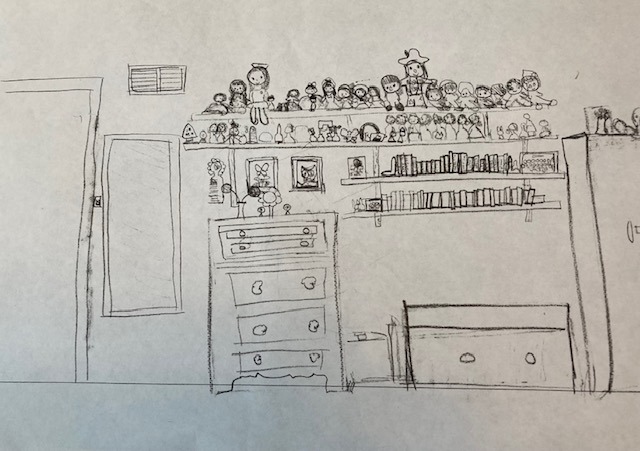
My bedroom wall, drawn when I was twelve.
Around the World Dolls
Supposedly designed to teach girls about other cultures, these dolls all looked pretty much alike, with the same Anglo-European faces framed by blonde or black braids and clothing with frilly collars and aprons: plaid for the Scottish doll, paisley for the Indian doll, red silk for the Chinese doll. My cousin Jody and I practiced the feminine arts, sewing new clothes for them. The sheath dress I made was clumsy with uneven stitches. Jody sewed fancy three-tiered skirts. I was jealous of her skill. When I turned my doll dress inside out, it unsettled me to find the twin row of thread, the identical underside, my every-which-way stitches a duplicate reminder of my ineptitude.
Baby Dolls
“You never liked dolls,” my aunt Shirley once said to me in an accusing tone. “You never played with them.” There is photographic evidence that says otherwise: me toting a doll by her shock of hair at two; a doll in a toy highchair next to me at the table when I’m three; me pushing a doll in a stroller at four; me crouched beside the doll house my dad built for me when I was eight. A photo of bean bag dolls with colorful outfits, heart-tuggingly vulnerable in pajama-like casings, their big eyes on the verge of sleep. Mostly they slouched in a row on my shelf. I didn’t really play with them. Maybe my aunt was right. Or maybe I just didn’t play with dolls the right way, whatever that was. I even found them a little creepy.
Chucky
In adulthood, I googled “Why are dolls so creepy?” and was surprised to find that many other people had asked that very same question. On Yahoo Answers, one parent complains about her daughter’s doll: “I can’t stand it staring at me. I keep expecting to look over at it and see it move or blink.” Others report turning dolls around so they’re facing the other direction.
Maybe, one person theorizes, we find dolls creepy because of associations with Chucky, the doll who is possessed by a serial killer in the Child’s Play horror movies. We’re afraid our dolls will come to life and strangle us. Chucky, one dollmaker complains, is responsible for the widespread “porcelain doll stigma.”
Dancerina Ballerina
In TV commercials, this battery-powered doll with aggressively pointed toes, a pink tutu, and a pink tiara comes to life to spin en pointe, arms curved gracefully overhead, pink gauzy tutu wafting around her. I longed for a Dancerina Ballerina doll, or maybe I just wanted to be like her when I reviewed ballet positions in front of my mirror. I could turn my feet out with little effort. I practiced plies, pirouettes, and arabesques around my room. In class I was so self-conscious, I executed those same moves with the grace of a drunk baby elephant.
When I was nine, my parents got me a Dancerina Ballerina doll for Christmas. She danced once. I could never make her work again; her ballet career, like mine, was short-lived.
Eliza Magnolia, Effie Madeline, Elaine Caroline, Elberina Sasha, Elberta Lindi
These were just some of the names of Cabbage Patch Kids, dolls that came with birth certificates and adoption papers and were such a fad in the 1980s that they caused near-riots at toy stores and department stores as crowds fought to purchase them. One line of Cabbage Patch Kids produced in the 1990s had to be recalled: the Snacktime kid, designed to “eat,” couldn’t distinguish between the plastic snacks it came with and children’s hands and hair, leading to injuries.
Folk Dolls
My dolls turned into an official collection the day my aunt bought Jody and me identical rag dolls from a sawhorse table at an outdoor flea market. I was ten. “I want you to have doll collections,” my aunt said. That night, I gathered my childhood dolls and lined them up on my bedroom shelves: a doll collection. My vacation souvenirs from bluegrass festivals, folk arts centers, and historical homes and museums were, from then on, dolls: a boy scarecrow doll, cornhusk dolls, a wizened apple-head doll, a Little House Charlotte ragdoll. When pen pals asked me about my hobbies, I had something to reply: “I collect dolls,” I’d say. I never thought about whether I wanted to collect dolls. I did it because I was supposed to. Because it made my aunt happy.
Growing Up Skipper
I envied Jody her Growing Up Skipper doll whose process of becoming a woman was so simple and seamless. She arrived in her box flat chested, but when you turned her arm backward, boobs appeared.
Heads
Girls in the nineteenth century bought penny doll heads at the local merchants, choosing them, like marbles, from a basket, then sewed bodies and clothing for them as part of their process of learning the domestic arts. I wonder how many pioneer nightmares were inspired by those baskets clacking with rolling doll heads, like body parts fresh from the guillotine.
Indoctrination
Presented as fun toys, dolls were originally designed to prepare girls to be mothers, to embrace femininity and fashion. Rag dolls taught girls to sew, Betsy Wetsy dolls taught them to change diapers, Barbies invited them to practice adult scenarios like dates and weddings. Contrary to current mythology, they didn’t typically inspire girls to enact engineering tasks at the Aerospace Center (Aerospace Barbie), to drive cattle at an Australian ranch in a khaki dress and high boots (Jillaroo Barbie), or to think calming thoughts at a meditation center (Zen Barbie) (I might have made that one up). Sixties TV commercials on YouTube show girls excitedly combing their Barbies’ hair—presumably an activity that provided hours of fun—or dressing their dolls for dates with Ken.
In the seventies, Jody had a Barbie collection complete with Dream House and pink convertible. My own Barbies never fared well. My brothers liked to pull their heads off. I’d find decapitated Barbies abandoned on the GI Joe battlefields of the living room carpet, their heads rolling under the couch.
Jo Doll
My aunt gave Jody and me Madame Alexander Little Women dolls for Christmas when I was thirteen. Jody got Jo, the writer, the heroine, the creative, spunky, fun one. I got Amy, the selfish brat who burned Jo’s manuscript out of spite. This gift was like a slap, leaving a small bruise that lasted for years. Was this how my aunt saw me? When I received my MFA in creative writing nearly ten years after my aunt’s death, Jody presented me with a graduation gift: a Jo doll.
Kiddles
As children, Jody and I created many dramas involving our Lucky Locket Kiddles, three-inch-tall vinyl dolls with brushable hair. Our dramas did not involve dates with boy Kiddles, but rather stories of orphans finding families and girls becoming movie stars.
Loretta Mason Potts
The title character of this book by Mary Chase is an “awful, awful, bad, bad girl,” with a sly, mysterious smile. She’s under the spell of a secret dollhouse world with a countess and general who find impudence in children to be delightful. “How very amusing,” they say when the children are rude. “How utterly, utterly refreshing.” The story features a doll named Irene who sings eerie songs. “Don’t ever leave me sweetheart/if you do I’ll surely die/Don’t ever leave me, darling/or the tears will fill my eye,” the doll sings when picked up. Or, “Please tell me, dearest playmate/that we will never part/O pick me up and hold me close/or you will break my heart.” I read this book over and over when I was eight and nine, creeped out every time.
Mortality
Nowadays, I find dolls kind of corpselike, at least the life-sized ones with waxy skin and empty eyes. “Why ARE dolls so creepy?” I once asked my students.
“Because they have soulless eyes,” said one. “They’re empty, there’s no light, no spark, just death.”
Naked Barbies
In the end, all Barbies end up in the same place. No, not dead—though they might as well be—abandoned under beds, in bins, and shoeboxes with no clothes. Astrophysicist, Business Executive, Chief Sustainability Officer, Microbiologist, and Olympic Athlete Barbie all end up naked anyway, all alike, their careers forgotten.
Years ago, my mother sent me a pile of disintegrating boxes. In one, I found a pile of doll clothes—did the dolls’ bodies decompose, leaving only these stiff, dusty garments? I also discovered a box containing nothing but doll arms, their bodies nowhere to be found. When you move someday, a friend suggested, you should leave doll arms for the next owner to find under the sink, in the dark corners of closets, behind the refrigerator, in the attic crawlspace.
Olympic Athlete Barbie
In countless households, she did a few flips, ran a few races, took a turn around an imaginary rink, and then ended up on closet floors, naked.
Pajama Dolls
These dolls had big plastic hoops that held their skirts wide, with zippers that, when unzipped, revealed a secret compartment for storing pajamas. The dolls were Christmas gifts from my grandparents. As much as I loved secret compartments, why, I wondered, did I need a place to store my pajamas, those flammable costumes left over from Halloween? Was there something unsightly about a girl’s pajamas that required a special place to hide them away?
My cousin Melinda’s doll was pink while mine was blue. This seemed vastly unfair since my room was pink and hers was blue, but my aunt said it would be rude to swap. It all seemed like just another example of how Melinda, a cousin on my dad’s side, with her tiny feet and sweet voice, got all the girl credit. I sneaked away to read a book while Melinda talked fishing with Grandpa, complimented the aunts’ scarves, and whispered with our cousin Leslie, who got the yellow doll, about boys.
Queen Victoria’s Cult of Mourning
You know what else I found in those boxes in the basement my mother sent me? Envelopes containing hanks of my childhood hair. The first time I opened one, I screamed. Perhaps saving children’s hair was a remnant of Victorian death rituals. Those included making the deceased’s hair into jewelry or gluing bits of their hair to a photograph. If I’d died unexpectedly as a child, would my mother have glued bits of my hair to a picture of me? Or to a doll that looked like me?
Rotting Dollhouse
When my daughter was eight, we rescued the dollhouse my dad had built for me when I was her age from my mother’s garage. We had the base replaced. We repainted the house, put in new carpet, furnished the rooms with pieces from a street market in China and miniature stores in Chautauqua and Buffalo. My daughter never really played with the dollhouse, but if you look closely, you’ll find, in the bathroom, an Anne of Green Gables doll with her head in the toilet, where it’s been since my daughter left it there fifteen years ago. If you look more closely, you’ll find the dolls in the living room reading miniature copies of Dr. Seuss books and Fifty Shades of Gray.
San Clemente
One morning in San Clemente, CA, eight families discovered porcelain dolls resembling their ten-year-old daughters on their doorsteps. Was it a prank? A threat? Was someone watching their children? The families reported being creeped out, freaked out, disturbed.
It turned out that a neighbor had been cleaning out her doll collection and decided to surprise the neighbor children. “In retrospect, I think she wishes she would have left a note,” one neighbor is quoted as saying.
Toes
Barbie is famous for purposely misshapen feet so that she can walk only if she’s wearing heels. “Oh my God! Look at your feet!” a neighbor girl once shrieked at me. The neighbor girls, certified tomboys, watched TV, played with Matchbox cars, and sang alto. They found me foreign with my books, my dolls, my second soprano voice—too girly, even while my family found me not quite girly enough. I could never get it right. At that moment, I was sitting with my legs stretched out in front of me, flattening my double-jointed feet on the floor. “They’re deformed!” the neighbor girl exclaimed.
At twelve, I left behind the pink leotards and white tights of my ballet years, the pink shoes with felt bottoms that whispered magically across floors. I was the tallest one, and I thought you had to be the best, the smallest, to be seen dancing. I turned awkward, zipped up tight in silence, with no confidence that I had anything to say. I was twenty-one, sitting on a couch, when another friend stared at my feet, toes tipped toward the floor. “You have ballet feet,” she said. She sounded awed. And in that moment, I saw myself differently. Not as a clumsy freak, but as someone with a peculiar kind of grace.
Uncanny Valley
The Uncanny Valley phenomenon is an unsettling feeling at being confronted by an object that possesses a human likeness. My dolls smiled relentlessly and inappropriately from my shelves no matter how chaotic my life or mind was. But girls were supposed to smile and exclaim about how cute these dolls were, ignoring their own uneasiness at the dolls’ disturbing cheer.
Voyeurs
At ten, I read Ruth Arthur’s A Candle in her Room and then, still haunted by the book’s evil doll who casts a spell over three generations of girls at Pembrokeshire, lay in bed imagining the glittering little eyes of my dolls staring down, their plastic smiles suddenly full of malice. Watching me, always watching.
Perhaps there’s a more disturbing subtext to dolls, ostensibly meant to teach us about other cultures, motherhood, the domestic arts, fashion, femininity, dating, and marriage. A subtle reinforcement of the idea that we shouldn’t trust our own intuition. A reminder of our role as the objects of others’ gazes, there to be stared at, measured, and evaluated. My dolls sat on the shelf like spectators in the bleachers. What were they watching with fixed gazes and unwavering smiles?
Me.
Wildlife Conservation Barbie
What happens to Wildlife Conservation Barbie in the end?
Naked.
X-ray Technician Barbie
What becomes of X-ray Technician Barbie? Also naked. In the end, no matter what we aspired to, did any of it really matter?
We managed to mostly ignore these fraught messages. By then, we’d gone on to other things, we were busy with our lives, we didn’t have time to dress Barbies or comb their hair anymore.
Yeloli Moon Festival Dolls
I tried to raise my daughter differently, with fewer expectations about what it means to be a girl. I don’t remember her playing with dolls, though friends and relatives plied her with them: Barbies, Bratz dolls, a couple of Chinese moon festival dolls that, when wound up, crept slowly forward, eerie music playing, their eyes flashing red, like something right out of a nightmare.
Zippered compartment
My daughter felt free to get rid of those creepy dolls right away. In contrast, as a child, I hung onto things, unaware I was allowed to set them loose. I never hid a diary, love notes, jewelry, birth control pills, or pajamas in the hoops of my pajama doll’s skirt. Instead, I zipped up items too awkward or ugly for display: grimy shells from the beach, jagged stones from the rock and mineral show, restrictive notions of female roles and worth.
Eventually, we all emerged into womanhood, if not always following the expected order of developmental milestones, of embracing our femininity, whatever that meant.
I and the cousins I envied, Melinda and Jody, carried remnants of our younger selves. But we also freed ourselves from them, freed ourselves from the ominous stares of dolls and the pressure to organize our lives into some strict, socially approved order.
Eventually, I gave away all of my dolls, including Dancerina Ballerina, including the pajama doll, heavy and rattling with unsightly things.
Nancy McCabe is the author of nine books, most
recently the comic novel The Pamela Papers: A
Mostly E-pistolary Story of Academic Pandemic
Pandemonium (Outpost 19, 2024), the ya novel
Vaulting through Time (CamCat 2023), and the
memoir Can This Marriage Be Saved? (Missouri
2020). Her work has appeared in Michigan Quarterly
Review, Prairie Schooner, Gulf Coast, Salon, and
Newsweek, received a Pushcart, and been listed ten
times as notable in Best American anthologies