

More Comfortable Couches | Mark Abdon
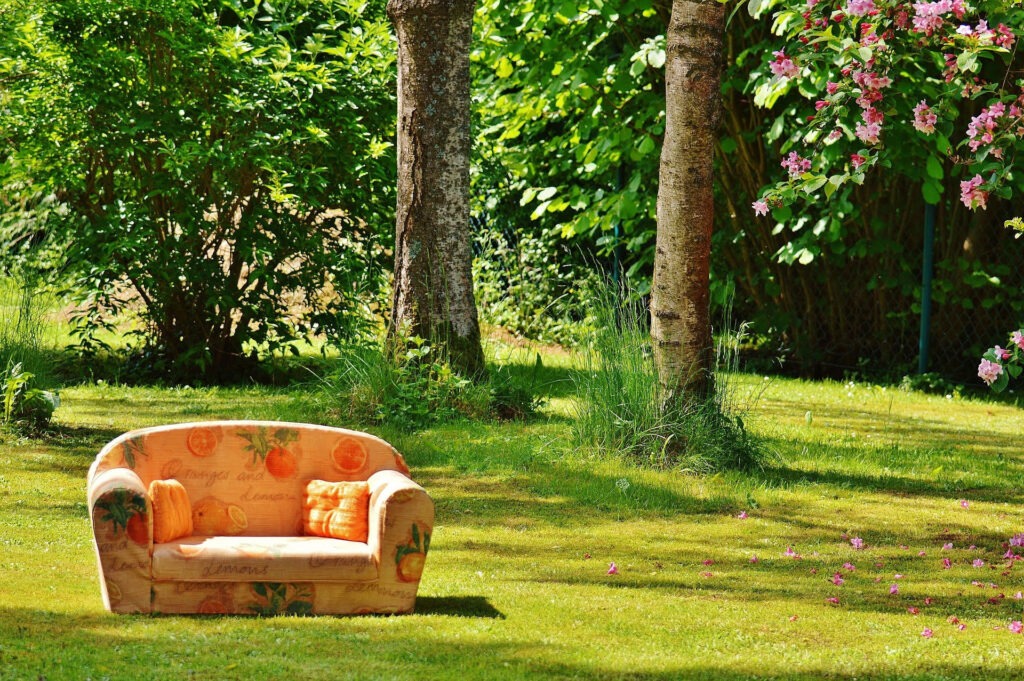
I used to be good at sleeping on couches. Leather, pleather, loveseat, or Lawson. I was younger then. A kid. Compact. I’d tuck my knees to my chest, pull up the knit throw blanket, and resituate the lumpy cotton of the accent pillow. Then I’d fall asleep. Easy as that.
*
I still fall asleep with relative ease. However, trained by our three young boys, staying asleep is another matter. Like the other night. I wake up bleary-eyed from a dream about flying. A distant sound. Is that knocking?
I look at the clock: 2:37 a.m. My wife is sound asleep next to me. I decide no, it is not knocking, roll over, try to get back to flying. I plummet like a stone. But there it is again. Yes, knocking. I stumble downstairs, turn off the alarm, and open the front door.
I can’t see him—he blends into the night. But I hear him. He’s sobbing hard. It’s our neighbor boy who lives on the north side of the Section 8 duplex next door. He’s maybe ten years old and the oldest of five siblings. I know what’s happened even before he tells me through heaves and chokes. It’s D’Andre’s mother again.
My wife, Laura, wraps a robe around herself as she pads downstairs. I catch her up to speed, call 9-1-1, state the location of our emergency, and ask for an ambulance. We head next door with D’Andre. The thin woman is sprawled on the floor, shards of a broken mirror scattered around her. She’s bleeding—small cuts on her hands and feet interrupting her sprawling tattoos. Suddenly aware of the sensitive nature of the situation, I send D’Andre upstairs to round up his three younger brothers and sister.
D’Andre’s mother opens her eyes, sits up, and wobbles to a stand, disoriented.
“Please don’t call anyone. CPS is going to take my kids!” She stumbles once, then tumbles down to the floor like a drunk. My wife shakes the skinny woman’s shoulders, but she’s unconscious again.
I leave my wife, a medical professional, to care for the woman. As the kids trickle back downstairs, I muster hollow energy to explain that they get to have a sleepover at our house. You can sleep on our couches. I brand it as an “adventure.” And maybe it is. Up to now, they’ve never been inside our house.
*
Our middle-class friends talk about us like we’re some kind of heroes for sticking it out here. But the truth is this: I need this place.
I loved my childhood. It was a typical middle-class childhood in many ways. Laura might say the same. We both grew up in fairly homogenous communities—insular places. Places that prized hard work, sure. But also comfort. Nice houses, nice cars, nice schools, nice vacations. Growing up, I rarely interacted with people that had real, tangible needs.
When we got married, it seemed all too easy to recreate the world we’d both known. Left to our own devices, do we all gravitate toward comfort? I did. And still do. Something changed along the way, though. For both of us. Maybe it was studying abroad during undergrad. Or mission trips to inner city Managua or Chicago. A new desire was born, dim and small. Grateful for our upbringings, we also began to wonder if our lives might be on a different course—where our kids wouldn’t grow up in a bubble, doomed to the same kind of cross-cultural deficit we had. A place with plenty of interruptions.
I doubt that my wife, Laura, needs this place for the same reasons I do. Bursting with compassion, she simply needs a receptacle for all of it. She gives a lot to this neighborhood. I hope some of her compassion rubs off on me. Maybe that would dampen the thoughts. The ones that say we don’t belong here, that we should move out to the country. The self-protective ones. The loudest ones.
*
“The air in here does not smell like ours,” D’Netta says with a sleepy smile.
I know what she means and tamp down the judgmental thought about the smell of poverty. As calmly as I can, I gather blankets and pillows for five. As I settle the boys into their sleeping bags around our living room, D’Netta asks what a she-zure is. The flashing red light of the ambulance seeps through the windows.
I tell all five of them to lay their heads on their pillows. I do not say I love you as I do for my own children but opt for goodnight instead. Then, I second-guess the choice, come back in, and settle for I’m glad you’re here, as I turn out the last light. Then I go and check on our own boys. All three are sawing logs.
I sleep on the downstairs couch, one room over, in case someone needs me. I suspect that tomorrow I will have back pain somewhere in the L3 to L5 region. An hour later, I can’t sleep. I check on the five children, this impromptu sleepover in my house, this adventure. The three youngest boys have abandoned their sleeping bags. Instead, they’re dog-piled on the sectional couch, limbs and bottoms sticking up in odd directions. D’Netta snores gently in her sleeping bag. They’re all such sweet kids. Even in his sleep, D’Andre wears a worried expression. He looks just like his mother.
At 6:00 a.m., she calls to tell us she’s been released from the hospital with a bottle of Keppra. “I’ll take it this time,” she says, and we believe her. When she arrives home, she’s just in time to get her kids dressed for school, and asks us to send them over.
The boys get on their shoes. D’Netta does not. She smiles the same sleepy smile and walks barefoot across my lawn. The rest zombie-walk out our front door as our neighborhood turns a brownish gray, the same color as the mourning doves with their signature call. I tell D’Andre that it’s going to be okay. I tell him he’s brave and strong. That I’m proud of him. Words I should probably say to my own sons more often.
My wife and I sit on the porch and sip our coffees, not yet talking. I’m thinking about what kind of school day is ahead for these kids. And their teachers. I wonder if any of them will be sent to the principal’s office to get some extra sleep on a firm school couch, the kind where you can see the springs through the cushions. I think about D’Andre and how fast he’s had to grow up as the oldest. I think about some statistic I read from the Institute for Family Studies, how black boys are twice as likely to go to college with a father in the home. Twice as likely to go to prison without one. There are four boys in D’Andre’s family. And his mother is just one seizure away from making them all orphans.
I attempt to scrub this thought of any grand meaning: Our boys have slept through the whole thing. I capture a second thought, an ugly one. The kind fighting for my right to comfort: Wish I’d slept through it too.
*
If I ever meet Peyton Manning, former Indianapolis Colts quarterback and Hall-of-Famer, I’d like to thank him for my house. The Peyton Era began with a rocky start— 28 interceptions his rookie year. Before long, though, the Colts appeared in two Super Bowls, winning one of them. The money came pouring in. They built Lucas Oil Stadium. With the new stadium came the ability to host the Super Bowl. And sure enough, in 2010, the world came to Indianapolis. So did a lot of NFL money used to revitalize urban neighborhoods. We bought our brand-new home for about $120,000. Granted, it sat among a number of vacant and boarded-up houses in a high-crime area. Naturally, our parents cautioned us against such a move.
The director of our local Community Development Corporation attended our church, so it was all too easy to become excited about revitalization. No one called it “gentrification” then. Plus, the CDC was working ahead on that issue, building affordable housing among single-family homes, and refurbishing rental units—like the Section 8 housing next to us—to keep long-term residents in the neighborhood. It took five years for the neighborhood to start to feel like a community. And five more for market forces to take over and price out long-term residents who had been here for thirty-plus years. Really puts the “complex” in savior complex, doesn’t it?
*
At 6:30 this morning, I’m pouring a cup of coffee. Our doorbell rings, though it’s too early for company. I have a guess. But it’s only been a week since the last episode. I don’t move. Ignore it, hoping it will go away. I’ve got twenty essays to grade for my Advanced Composition class. It rings a second time. I swear under my breath. Another interruption.
I open the door to find five children on my porch. None of them have shoes on. So much for a quiet morning. An embarrassing thought, given the circumstances. Then I feel a stab of panic—my wife is out of town this time. I’m acutely aware of how I lean on her in emergency situations, especially of a medical nature.
“Mama had another she-zure,” says D’netta, over the sound of our alarm. She walks right past me like she owns the place. She’s so calm.
I motion for the rest of them to come inside. Then I head to the back of our house to turn off the alarm. I’m not fast enough, though, and it awakens two of my boys, four and six years old. They plod down the stairs rubbing their eyes. No time to explain, though. D’Andre confirms that no one has dialed 9-1-1 yet, so I make the call. Then I leave eight children alone in my house and head next door to see what kind of condition D’Andre’s mother might be in. I tiptoe past a small mountain of mismatched shoes in the entryway. No broken glass this time. Their mother is asleep on the couch. No longer seizing. She’s safe.
The next ten minutes of my life are a strange juxtaposition of two worlds: my neighbor’s house and my own.
Next door, paramedics flood the room. They’re asking me questions. I only know some of the answers. But these paramedics need information in order to give her the proper treatment.
In my own home, kids flood the room. They’re asking me questions. I only know some of the answers. But these kids need breakfast before I take them to school in thirty-five minutes.
I bounce back and forth between the two conversations, splitting my time between my neighbor’s house and my own.
“Mister Mark, can I eat my oatmeal dry?”
“Sir, do you know anything about her medical history?”
“Mister Mark, how does oats turn soft?”
“You don’t even know her last name?”
“Can we have Skittles for breakfast Mister Mark?”
“Do you know what hospital she’d prefer?”
Thankfully, help arrives at both scenes. Next door, a paramedic familiar with my neighbor’s condition arrives to fill in the gaps. She isn’t particularly friendly, confiding that this one always wakes up confused, she fights us, won’t answer any of our questions. She also seems competent. I step away and walk back to my own house. The sky is the gray-brown of dawn again.
When I re-enter our kitchen, my middle son is taking breakfast orders, heating up oatmeal, dropping off yogurts to the table, placing spoons before his friends, and doing it all with a smile. He’s a natural host. Like his mother. I get a glimpse of something my middle son is becoming. A swell of gratitude fills me that we live right here.
We’re finishing up breakfast. Seven kids have now been fed. However, all eight kids will have to walk to school together, since my wife is out of town. My oldest is still sound asleep.
At 7 a.m., I gently shake him and whisper his name. He looks confused, like he’s the one just regaining consciousness after a seizure. Briefly, I explain what’s going on, how he doesn’t need to get ready for school yet, but that he needs to put on some shoes. His confusion turns to annoyance. He says nothing. He’s like me. He’ll need this neighborhood, too.
*
Over the years, my wife and I have racked up our fair share of experiences owing in large part to our urban location. We’ve taught neighbor kids to read, tutored them in math, and played a thousand games of catch. We’ve celebrated holidays together, lent them money, learned not to lend them money. We’ve sent over barbecue sauce at 10 p.m. We’ve had our bikes stolen. We’ve called the police for domestic violence. We’ve had evicted neighbors live with us. We’ve watched gang fights in the streets through our blinds. We’ve ducked at the sound of gunshots. We’ve gone to funerals. Sometimes, I think our presence here has made a subtle difference in our little community. Sometimes I don’t.
Sometimes the doorbell rings and I pretend I’m not home.
I get stuck in this thought-loop. Where I feel guilty for being a middle-class white man who moved to an urban neighborhood and contributed to gentrification. I fantasize about living in the country, nestled into a porch swing with Laura, reading Wendell Berry or Marilynne Robinson, overlooking ten acres of land. The only gunshots are the ones that announce the beginning of deer season.
And I wonder who would live here, in this house, and if they’d have ample couches for the nights their neighbors need to sleep over. I hope that’s not a savior complex. If anything, I’m the one who needs the salvation.
*
“Mister Mark, I can’t find my shoes!”
We’re back in their house. Their mother has been whisked away to the hospital. I don’t even know which one—I was still serving up breakfast when the ambulance left.
D’Netta has two tags sticking out sideways from her clothes.
“Are these new?”
“Yep! Our mom took us shopping for school clothes.”
I do a sweep of the downstairs. Magically, each of the five kids has found a tub of their own clothing and is pulling on something school appropriate. The clothes are wrinkled, but organized, and clean. This is a mom who cares deeply for her children. She’s a good mom. And these are good kids. It feels important to say that.
D’Shaun, the youngest, pulls out a long-sleeve shirt.
“How ‘bout this one Mister Mark?” he asks in a tiny voice.
“Bud, it’s going to be eighty-five today. Can you find something short-sleeved?”
He rummages around in his bin for a bit. Snags something.
“This?” He’s holding up a knit sweater. I join him in the search to see if we can find something appropriate for an Indiana September, increasingly hot over the decades since I was his age.
A small miracle, we all get out the door. We’ve got eight minutes to walk three blocks. All nine of us. They turn it into a game. I get nervous around the intersections. But their mom has taught them well. In fact, it’s my youngest who runs headlong into the street without looking. We’re lucky this time.
As I drop them off at the elementary school, every single one of these kids gives me a hug. D’Netta and D’Andre tell me to have a nice day. I say the same back to them. One of the plucky sidewalk attendants catches me.
“Aren’t those kids always so happy?” She has no idea—the morning they’ve had.
Back home, I open our front door and lie down on the couch to collect my thoughts, though I doubt I’ll fall asleep. I’m tired. I hate interruptions. I sit up to close the blinds. And pray the doorbell doesn’t ring again. I lie back down, close my eyes, and envision a house with a wraparound porch and some land. I wonder about farming a small plot like my ancestors. I imagine the silence of the country. Nothing to disturb the slowness.
But I drift off thinking about those kids instead. D’Andre’s worry. D’Netta’s shoes.

Hailing from Indianapolis, Indiana, Mark Abdon is fairly new to the publication scene. His stories are popping up in places like The Pinch Journal, Catamaran, X-R-A-Y, Chautauqua and others. He teaches writing at Indiana Wesleyan University and reads for The Harvard Review. Connect with him on socials: @markabdonwrites