
Once You've Seen a Meteor | Cortnie B Duran
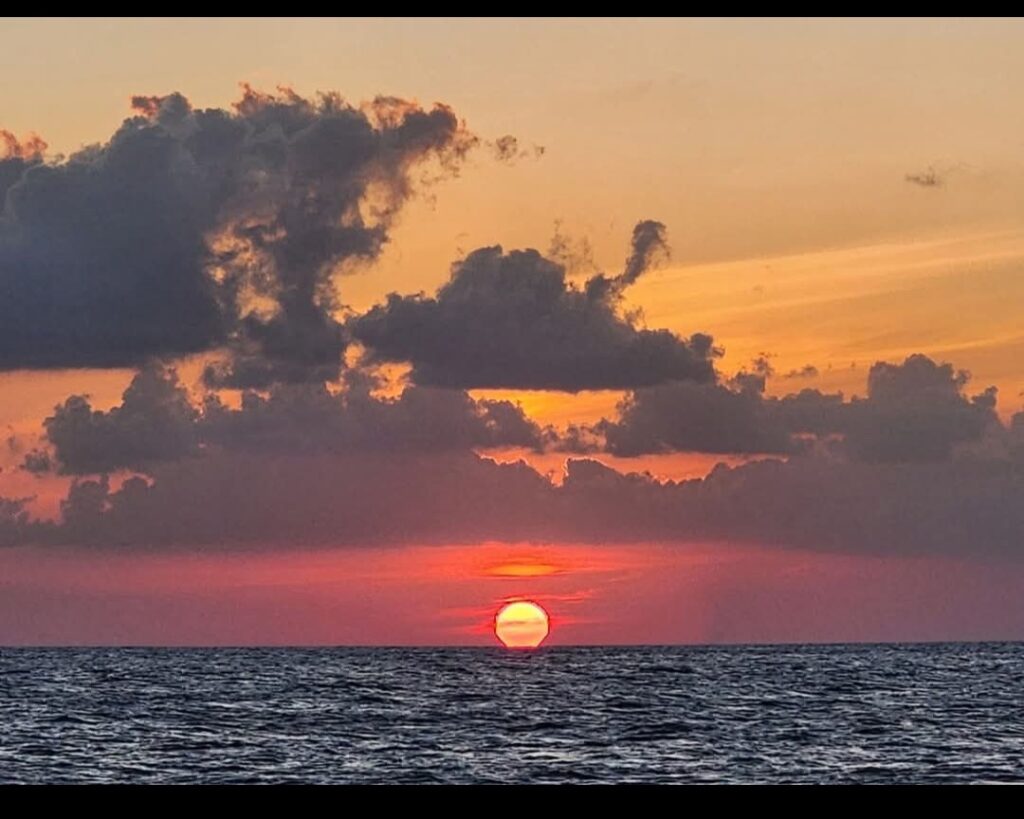
Caribbean Sunset by Cortnie B Duran
Once you’ve seen a meteor, the stars don’t hold as much sway. I mean, I think they’ve dimmed a little. They still bewilder me, though. Just the other night I asked a friend, “Is it possible from Mexico the stars are closer but not as bright?” She said, “No,” and then told me all about her kitchen remodel. Since there’s no one who wants to talk with me about stars anymore, I enrolled in an online astronomy course, but I couldn’t grasp the math.
Did you know there are beaches in Japan where the grains of sand are shaped like tiny stars when you magnify them? Turns out they’re not really grains of sand, but the fossils of trillions of single-cell organisms washed up from the sea. When I read that, I remembered Carl Sagan saying in an interview once that there are more stars in The Milky Way galaxy alone than there are grains of sand on Earth. I sit here on this Mexican island squinting down the length of the beach and think, this cannot be.
Yesterday, while scooping up handfuls of ordinary shaped sand and sifting it through my fingers, I wondered if the Mayans invented the hourglass. It seems plausible with all this sand and heat. I mean, they basically invented the calendar and the concept of zero too, or was that the Aztecs? Not far from where I sat, a hand painted sign nailed to a coconut tree read You Are On Indigenous Land. I tried to imagine a world without zero and couldn’t. I considered that very near here, two thousand years ago, someone turned the constellations into tools with which to measure the passage of time – and with the same view as mine. While visiting some ruins, I recently learned the Aztecs didn’t have the written word. Can you imagine? They had to have composed songs though, and passed them down by memory I guess because, of course, they sang.
I decided to move to this island instead of the mainland because of Octavio Paz and his poem, “Madrigal.” Look at you/ Truer than the body you inhabit/ You were born to live on an island. I was moving somewhere, that was for sure. I’m always moving somewhere to try and shake off this fucking ache, and this time it needed to be much farther than a car ride away. I’d learn Spanish, and paint. Swim every day and stop rubbing the absence in my chest like I have a Tourettic tic or something. It’s right where we used to rest our hands to recite the pledge of allegiance in school– a little bit above your heart, just beneath your collar bone. The seat of the soul, they say. I don’t know who they are, but I know “Madrigal” is Spanish for “a song sung in many voices”.
This sorrow I’ve carried for 30 years belongs to someone else, but I can’t ever give it back. I wouldn’t if I could because it weighs (M ☉) or 2×1030kg which, I got far enough in that astronomy class to learn, is the approximate weight of the sun. He could never bear it. So, most evenings, all I have to do is swim out past where I start to feel afraid, cup the yellow-orange ball in my hands for a time then open them up under the turquoise water and let go of the sun.
We haunted observatories and timed walks around moonrise. One year he gave me a telescope for Christmas. We’d drink wine from the bottle searching for zodiac constellations until, one by one, the stars were erased by the sunrise. Once, we waited for the Perseids on a blanket in his back yard. We’d been counting the days and synchronized our alarms. We read that 3:00am was “peak viewing time” in the Western Hemisphere. Sleepy on our backs and holding hands he said he had butterflies; he was so excited. I showed him what butterfly kisses are, and he asked, “Can I keep you forever?” But we never saw a single thing fall from the sky that night, because his own vulnerability terrified him and he split. Snapped? Fractured? I still don’t know what to call it, but he growled vile, rageful things he wouldn’t remember — things that still cut me to recall.
He was an altar boy in the early 80s. To survive what the priests did to him, his mind split in two. To endure the beatings he took, then, when he cried about going to Mass, he began to absorb instead of resist his father’s rage. He learned that vulnerability was weakness – that anger was safer. And when his mother, a secretary at the archdiocese, swept the ruin of her seven-year-old son under the rug where it pressed flat in the dark into dust like the dismembered wing of a moth, any notion of love or trust began to burn him like fire. The simple equation became and has stayed; love = excruciating pain and inexplicable shame. While he desires it more than anything, he destroys it by any means.
Once we went camping near a little pond in the Rockies. With his arms around me and his chin resting on the crown of my head, we faced a field of poppies and watched his Great Pyrenees and a doe chase each other back and forth. He turned me to face him and when I looked up, he said, “Sometimes we’re so perfect I want to marry you.” It was a statement, not a proposal. By then we’d known for years it couldn’t be. Still, there was the rush. The wave of warmth like when you take a shot of bourbon and feel it gold, and mellifluous flowing out from your chest to your fingertips. Later, I said or did something wrong, or something exactly right and his irises turned from blue to grey. I’d learned this was the point of no return. He called me ugly, and a whore. He screamed that he wished I would die. I left the tent to sit up all night by the fire with his dog. In the morning while I boiled water for coffee and he broke down the tent, he said my name and then without looking at me, “You have no idea how hard I try to be… normal. I’m sorry. I love you with my entire soul, do you understand?” That, it turned out, was the most painful thing he ever said to me.
When I saw the meteor, I was driving home from a graveyard shift on the westbound 6th Avenue freeway – a straight asphalt scar running up through the city to the foothills. The sky was deep navy blue so, there mustn’t have been a moon. Whenever I made this commute, I’d be pulled as if by gravity toward Exit 121. Very often, for years and years, I would take it. It led to him. And very often he would let me in and upstairs where we’d lie to ourselves so beautifully for as long as we could. That night, the pull was so strong, I had to will myself past the off ramp. Tears burnt at the back of my eyelids when I breathed again, but I blinked them back in quick so I could see the white lines.
Then it was bright as daylight. Just like that, it was daylight, and there was a vague whistling sound but rough, like sandpaper on metal. I slammed on my brakes thinking maybe the world was finally ending while the yellow-orange mass arched over, flashing as it went, casting long, fluttering shadows across the road, the hood of my car, and my hands on the wheel. The shrill was so loud it felt within me, and then over the foothills on my left, the sphere shape tapered to a yellow tail, laced out into golden speckles, and it was dark again.
In my twenties I almost drowned while rafting in the Colorado River. I mean, it was the closest I’ve ever come to death, as far as I know. Instinctually, I tried to swim against the impossible water that rushed furiously with the summer runoff. I was vaguely aware that my head could smash into a rock at any time, and acutely aware that the next time I went under, I may never come back up. A man ran downstream, planted his feet, held out his arms and screamed “LET GO!” By then I’d managed to cling with my fingertips to a slimy boulder eroded smooth, and because I had no choice, I did let go. For days, I felt reborn. Newborn and wobbly, disoriented by humility and wonder. After the meteor, I felt just like that. Not invincible, not even lucky, just washed clean.
When I called my sister to tell her about the meteor, I asked if she thought it was a sign. She asked, “A sign of what? That quitting your job and moving to an island is a terrible idea for a woman your age?” I sold everything I owned and expatriated a month later. He knew I was moving again, and not just out of state. We didn’t say goodbye. We didn’t hug and soak each other’s shoulders with tears this time. I think because we knew it really was. Goodbye, I mean.
If Japanese kids can build sandcastles with stars, from a small piece of earth in the Caribbean Sea, I can squint up at the ones whose light has only lately reached me and decide that, in this life, I have been loved enough. There is a gorgeous, rounded stillness in that. In knowing any more from any other would be like a pencil sketch of a rock falling from the sky. Flat and ludicrous. Tomorrow on this beach I will scoop and sift more sand. Billions and billions of grains of sand, and when a supernova from Andromeda and several vertebrae of a sacrificed Aztec get stuck between my sweaty fingers, I will wipe them off on my sunburnt thigh, then wade into the sea and swim.
Sometimes I have to parse apart what I’ve dreamed and what is actual. So, the morning after my meteor, I found a website that charts these sorts of things. NASA’s satellites recorded the exact time, date, and coordinates of where it landed in the mountains. I thought of trying to hike to it. Maybe I’d lie down in its crater. Or maybe I’d print and frame the chart. Look! I might say, The most extraordinary thing has happened to me! I could point to it as proof if ever I was asked but, so far, I haven’t been.
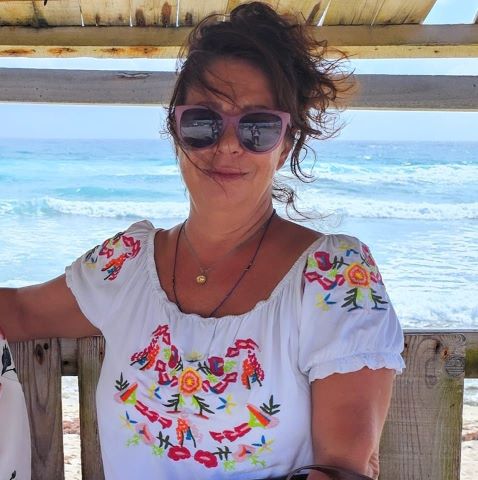
Cortnie B Duran is a writer based in Denver, Colorado, and Cozumel, Mexico. Her work appears in numerous journals and anthologies. Her essay “Where Are You Going?” was nominated for a Pushcart Prize.