
Our Late Great Planet Earth | Erin Ehsani
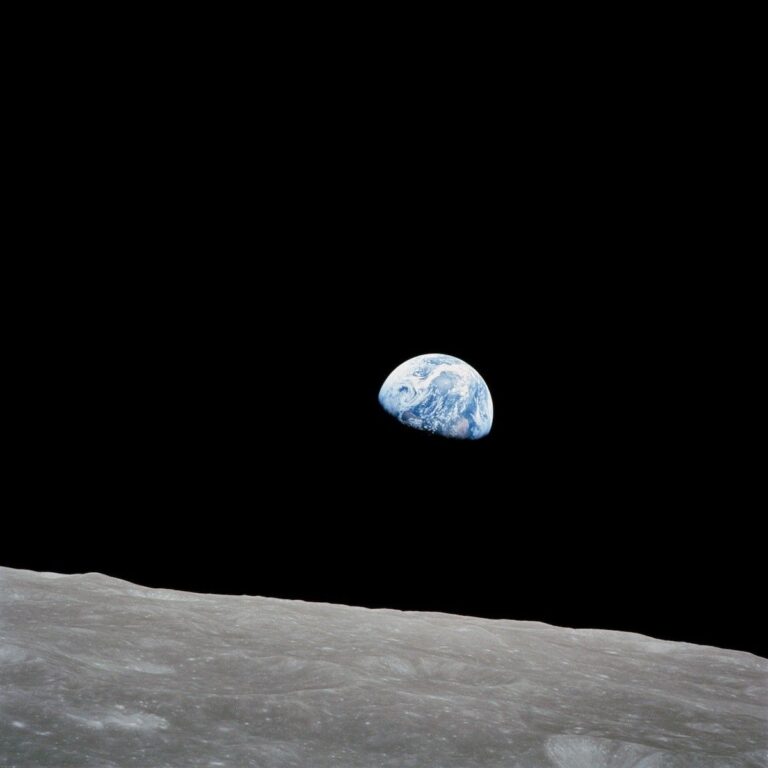
Earthrise by NASA
I was a grad student living off food leftover from campus catering events when he asked me to dinner. I’d show up to scavenge bowls of double-dipped hummus or untouched plates of dried-out chicken and green beans left behind by the business school, perhaps to prepare their students for lives of excess. It was late summer and, I still had more than a month before the loan and fellowship money hit my account, before I returned to teaching freshman comp to teenagers who arrived at the Ivy League with more formal education than I had.
He was a tenured professor who taught artificial intelligence, and who’d recently separated from his wife, whom he left back in their center hall colonial in a New Jersey suburb to move into a one-bedroom apartment in campus housing, which is where we met outside the building, where he sat perched like a gargoyle at all hours of the day, chain smoking. Hey, give me your number, he said to me, and who knows how many others, and I did because we were neighbors and because of signals happening at some other level not available to my conscious mind. It was a bright, warm day and I returned to my second-floor studio, which had once been a storage facility. I had begun preparing soup when he texted the name of an Italian restaurant nearby in Harlem and said, I don’t want to eat alone. And I remember the calculation I made at that moment because I didn’t want to waste the half-made soup, but also didn’t want to eat alone. Grad school poverty had forced me into exile from peers, potential lovers, and New York City itself, for which I couldn’t even afford a monthly MetroCard.
Every semester the students showed up with a hunger and hope that was as precious as it was enviable, and I felt pressured to maintain the illusion for their sake as well as my own. I had two semesters left before I lost my student housing, funding, and health insurance and no designs on what happened next, like a cliff I was accelerating toward without any brakes. Grad school had been a scam for someone like me, but I had been too dazzled by the chance to join the creative class to say no. Growing up poor and waiting for the messiah had taught me to never think of the future until it arrived. I’d been raised to believe Armageddon was imminent, that the Antichrist was already among us, and that Jesus was gearing up for the cosmic showdown. And even though I’d long since given up believing in a savior, Jesus or otherwise, I’d remained vigilant to signs of the end, a witness to the inevitable decay of loves and lives in a world undergirded by chaos and uncertainty. Any time I tried to imagine the future, my mind movie turned to white snow or else burned on the reel. And thus, I lived moment by moment, like a refugee trying to escape time, running from tomorrow as much as I was from the past.
I abandoned the soup, dressed, and walked to the restaurant. It was still light out, too early for a date, which this wasn’t, couldn’t be because we were mismatched from the outset, most notably in age. He sat at a table by the window, his hair silver and wild, though he wore slacks and a button down, a feral animal forced into domestication. When I appeared at the table, he looked up and smiled, already several drinks deep. I slid into the opposite chair with a strange familiarity as if we were starting in media res, or as if I was remembering something that hadn’t happened yet. He ordered a bottle of wine and two entrees like someone who could never be sated, and I got a salad knowing I’d leave hungry.
Outside the sun set while we finished a bottle, or two, drunk on each other, briefly untethered from time with its sobering realities, which would come for us soon enough, like bounty hunters from the future. For months my mind had been playing a suicidal refrain, a loop that had echoed since childhood whenever I faced uncertainty, whether the trials and tribulations of the Last Days or the end of grad school. I had decided to finish school instead of myself, though I barely had the will or resources to plan beyond each day. But I didn’t open with that.
“I want a child,” I told him, “and I don’t have much time.” I was 33, nearing the end of my Jesus-year broke and alone.
“You don’t need a man for that,” he replied. I wanted the man, too, but desire only provoked despair.
He didn’t want anyone, or perhaps he wanted everyone, but no one person after a life of dutiful monogamy and fatherhood.
“I’ve been a service provider my whole life,” he lamented. He wanted himself, whoever he was. His phone sat on the table and flashed the screensaver: an MRI of a brain with a tumor the size of a tennis ball. But he didn’t open with that. He had survived and so had I. How much time did either of us have left to live the lives we wanted?
#
“It won’t be long now,” my mother said, “and we’d better get ready.” I was five years old when my mother said Jesus was returning soon. We would not know the day or the hour of His return, Jesus had said, though the earth would send signs, like birthing pains, preparing for His coming. The End would surprise men at the plow, women at grinding, children at play, or, as some optimistic motorists proclaimed by way of bumper sticker, In case of rapture, this car will be empty. We should keep our oil lamps filled, put our ears to the earth’s belly and wait for the quickening. My mother timed the contractions, watched the news for signs, as if Jesus left secret messages to decipher. Before long, God began speaking directly to her, too, and would talk to me, if only I would listen. Pay attention to your dreams, she urged.
I had recurring dreams of being chased by a man-monster, an endless, breathless pursuit from which I could never find a place to hide. Images of a calendar, where sheets of days fluttered off, entire years disappearing in the wind, like stock footage from old black and whites. My nights were haunted by the Eurythmics, where Annie Lennox appeared as the headmistress of a reeducation school, dressed in her characteristic black suit, and I disappeared among hundreds of other children in the drab, colorless palette of communism.
It was 1983; Luke Skywalker struggled against the lure of darkness and Reagan designated the Soviet Union the Evil Empire, both actors battling for the soul of the world. Reagan prayed for those living in “totalitarian darkness” as he ramped up production of nuclear weapons while calling for the U.S.S.R. to stand down. But the Russians held on to their nukes, a boon for the military base near our town, where I felt the sonic boom from the missile tests. Alabama had once been the country’s largest cotton exporter, but now instead of the soft crop, the government exported weapons and imported engineers, military families, and scientists to work on Reagan’s Strategic Defense Initiative, or “Star Wars.”
Lasers, missiles, satellites, and rail guns were supposed to create a protective web to intercept any nuclear missile. They believed they were saving us by building more weapons, and the plan worked, though less by way of might and more by way of a story that has captivated people for thousands of years. The final triumph of good over evil by a singular hero who stops the clock, intercepts the arrow of time, and grants life without death. Paradise in eternity for the believers and warriors, hell for everyone else. For what do humans fear more than our own end, especially one of our own making? Who could save us from ourselves, if not the Messiah, or Reagan, who declared in 1979 that “We might be the generation who sees Armageddon.”
Everything was unfolding as part of God’s plan, mapped out by Daniel in the Book of Revelation, according to Hal Lindsey, a former tugboat captain turned prophet who’d been called upon by God to translate scripture into urgent, simple prose to wake folks up. The Late Great Planet Earth, published in 1970, would go on to sell 35 million copies, including the one that ended up in my hands before I could read, and the hands of Reagan, whose copy must have been dog-eared.
The Antichrist, my mother warned, would appear to many as a good man, before destroying everything. She knew something about bad men who seemed good, or good men who turned bad, for it was her creation story, and then her history, and a parable repeated to me often enough that I learned to be suspicious of anyone too kind or of grand gestures, knowing that both often cloaked misdeeds. Many years into the future I sat in a sales training at a bank with thirty other women, most of us sleepy and unmotivated, when a delivery person burst through the door with an explosion of red roses, just because, and I watched the humiliation and brief terror on the face of the recipient, and wondered how she hid her bruises.
My mother began her tales with, At first, he was wonderful or, It started out great. But then, lured as she was by the want of love or something like it. When things went sideways, how easy it then became to dream of superheroes and saviors, rescue and Rapture. A world without suffering, without the day-to-day struggles of being broke, and broken; free from the weight of history; a body and brain washed clean of disease, of longing; where every injury done to you or by you is righted, forgiven; vast rewards for reframing pain as a means to an end. This gave my mother hope, at least while the Messiah’s return seemed imminent. But at five years old and in the years since, I took no comfort in pain, righteous or not.
My siblings and I began digging a hole in the backyard of our rental house, carving out a place for an underground nuclear fallout shelter. Red dirt caked under my fingernails, body browned in the summer sun, legs covered with red pustules from chigger bites. Once the rains came, our shelter was nothing more than a muddy puddle. I wanted to survive, though the Antichrist posed fewer threats than the men who walked in and out of my mother’s life, promising salvation.
*
“I can’t feel time anymore,” he said. “I don’t know whether it’s been five minutes or five hours, whether something happened yesterday or last year.” The scalpel had severed his internal clock, yet he still moved with urgency, afraid to linger too long anywhere, always disappearing and reappearing at will. It was a believable story, part truths, part fiction, though I couldn’t be sure in what proportion.
“The surgeon said the tumor was located in the part of the brain responsible for spontaneous emotion,” he deadpanned, then smiled. He recalled the slow return to full consciousness in the year and a half following his surgery, the flashes of thoughts and images, the peculiar feeling of floating without being anchored to place or time. What parts of himself had he lost permanently, he asked and asked. Words were slow to return. Without language, his world lacked form, color, and meaning. How could he return to work if he couldn’t remember the word “dog”? He remembered sitting in the backseat of a moving car when he saw a tree turn green and he began shouting, “Green! Green! There’s green.” A Boltzmann brain blinking into existence perhaps just as the universe had formed; random, spontaneous and absurd. He said that somewhere in between the recovery of color and the names for four-legged creatures, he realized he didn’t want to be married anymore.
“I just died and was reborn and I’m not going to take that as a wake-up call?” He fed me bits of the story at whatever venue we happened upon in amounts equal to how much we had been drinking.
“I’m excited for you,” I told him, recalling the exhilaration I felt when I left my husband years earlier. I didn’t share the aftershocks of divorce, didn’t tell him about the come-down. He sat across from me in a state of near euphoria in the retelling, spirited by the whiskey he was drinking and his receptive audience.
“Everybody should get a brain tumor,” he said.
I remember watching him fidget, his hands illuminated by the votive flickering between us, while the rest of him stayed in shadow, hiding like a puppeteer. I grabbed his hands and began drawing circles in his palms, up his forearm to the crook of his elbow and back down, with a power I didn’t know I possessed at the time. This man has never known love, I thought, believing myself some kind of savior.
He was chaos, and so was I, particles spinning, generating electricity that kept pulling us together. So yes, to more dinners, another round, to deepening revelations, to the warmth of our bodies squeezed into the last seats on the train, to losing time and direction.
On a walk home to the apartment building where we met and both still lived, the night had turned cool, though I felt warm and buzzed. He stopped mid stride and asked, “Can I kiss you?” He tasted sweet and smoky, like wine aged in oak. Each encounter was a satisfying drag of something that wouldn’t hurt you immediately but could kill you slowly over time.
We lived as if the tumor would return, or I would leave to start my real life, whatever that was. We ate expensively and drank excessively and tipped lavishly; how many tomorrows would there be? At night we devoured each other with the same urgency, until breathless and vulnerable in the dark one of us would lament the impossibility of our situation. We played a game where we imagined meeting at different points in our lives, but we could never make the math work; how young was too young? When should he have left his marriage — when his kids were younger? Then, worse yet, he feared what might happen if we persisted and he survived. The hopelessness of it all intensified the desire; we had to fit in as much as we could before everything fell apart.
“This cannot end well,” he prophesied, sitting on the edge of the bed, silhouetted by amber streetlight. His back broad and still strong, a sturdy place I could lean into. “You’re going to wake up one day and hate me.”
*
“What’s the point of going to school or getting married if the world’s ending?” I had once asked my mother, a high-school dropout twice divorced, not including the fling with my father. I was in grade school and she was in her thirties, though her skin and spirit had already dulled from despair at the state of the world and her life, both of which she felt powerless over.
“If we survive Armageddon, we’ll live with Jesus for 1,000 years of peace.” That was our only hope for a better life it seemed. We weren’t good enough Christians to be raptured. Or good enough people to be helped by the church, the government, or the community. How else to endure the ache of empty bellies, the violence outside our home, and within, the nuclear threat, the widening hole in the ozone, the azaleas blooming out of season if not to believe there was a divine reason for all terrible things?
As a child I mapped sewage tunnels, caves, mountain nooks, baseball dugouts at empty schools, and abandoned buildings where I could hide when the Antichrist came to power, or when the shit hit the fan. The habit of marking escape routes burned into my brain. The only life I had ever really prepared for was one that would culminate in a catastrophic end.
*
I cannot give you what you want, he had said at the start, but I had wanted him more than that imagined life. I was young then, until time began to prune away other opportunities, like branches in a decision tree. I gave him my thirties, unaware of my own waning youth — and options — slowly eclipsed by the passing years. And how easy it was for me to disappear into his shadow, to let time answer the questions I couldn’t. Did I want a family? To make a life with someone? To make something of myself? The life I had fallen into felt more real than some future that had not happened yet.
For years we committed incrementally, sometimes with intention, sometimes by necessity. We moved in together at the five-year mark when the lease on my rent-controlled apartment ended and I was, for a time, unemployed. I became his emergency contact, and sometime later he became mine, both of us alone, together. We celebrated holidays with his adult children, who didn’t care for me, and with my friends and family, who felt ambivalent about him. We fell into a life together, and its attendant, domestic drama, like the frequency of sex and laundry. Sometimes, when I threatened to leave, he’d relent just enough, a shared reality built upon maybes, the space where anything could still happen.
“I think you’re just trying to blow things up because the rest of your life feels out of control,” I said with the kind of clarity that emerges after uncontrollable crying. It was two days before Christmas, six years in.
“I think you’re right,” he admitted. Afterwards we marinated a lamb for Christmas dinner with his kids. The next day, in the haze of his guilt, I adopted a dog from a shelter; even that had once seemed too risky a commitment.
Men have long been in the business of ending the world. Prophets, politicians, executives, and all the subordinates whose silence has been just as destructive. What is war if not a manifestation of deep spiritual anxiety, of the self in conflict with chaos? The desire to order the world, to other a people, to contain, to exclude, as if these arbitrary divisions will quiet the noise inside. Did Lindsey and Reagan believe the prophecies they used to shape American fears? Or were they, and all of us, just actors in a divine drama? But whether we’re the authors or characters of our lives, we can only live the plot as it happens.
When I finally realized that he wouldn’t have a child with me, I was 39 and decided to try on my own. Yet we both stayed, neither of us sure what it would mean if I did get pregnant. I searched donor profiles, most of them college students, and tried to imagine their future and mine. What choices would they make about their lives, having already sent their DNA out into the world like dandelion seeds in the wind? Could I give a child what they needed if my own life was precarious on the best days? Did I want to raise a child alone or alongside a man who didn’t want to be a father again? I didn’t know anything other than I needed to try, hoping the details would sort themselves out.
When I awoke from anesthesia, my third fertility doctor told me my ovaries were empty. They had not been able to find any eggs, despite having seen many on the ultrasound the week before. The nurse walked me back to the recovery area, a few chairs separated by a curtain where other women sat half-conscious with hope and despair. I sat alone, in a hospital gown and gripper socks, and shook with sobs that emanated from deep within, as if my body was crying.
Over three years I had seen four specialists who each gave me versions of the same diagnosis; I was too old, and I had made wrong life choices. “Why do women wait too long?” snarled one doctor when she saw I was a “poor responder” to treatment. The women physicians I saw were often angry and cold, whereas the men were overconfident. But when the treatments failed, they all agreed that I was at fault in some way, as if I had chosen this, which I guess at some level I had. If I had said no to dinner with him, and yes to others, or to myself, if I had started treatment earlier, if this or that, then maybe I could have had a child. We had each held out, waiting for the other to acquiesce or for the clock to run out. Meanwhile, life also happened, one or another thing that moved my “expiration date” for the relationship. But what about the things I didn’t choose and all the other ways forces act upon objects, changing their speed or direction?
I felt disaster coming from some source, whether from within or out, a self and world in crisis. Which one would give first? What if he leaves or I do, if I lose everything, if I never feel well again, if the big one hits, if the food system collapses? I felt the urgent need to start prepping, some part of me always looking for a way to survive the what ifs my mind generates. Every day for months he arrived home to random items spread out on our dining table — fish hooks, a tarp, paracord, straw water filter, none of which I’d ever used. Could I save us with flint, stove fuel, a can opener, and expired protein bars? In preparing for WSHTF, or when the shit hits the fan in survivalist speak, I opted for the gray man scenario, choosing two Osprey daypacks over anything that looked tactical or militaristic. I packed the bug-out bags with items found online through prepper forums and websites, most of which linked to Amazon affiliates. Kickbacks from Bezos at the end of the world while fires raged through California and the Amazon.
The world was burning. Despots were elected by desperate people. Bodies became battlefields. Were we all just a slow boil away from the collapse of civilization and the end of humanity? What kind of life is possible in a world ablaze?
*
“He has completely extinguished any desire I once had for marriage.”
“Wow,” the therapist noted.
“Said he would never marry me unless my mother died.”
Her office in downtown New York was dark and small but the couch was large enough that we could both fit without touching. It was our first couples session and we had not articulated any therapy goals, or at least had not said aloud what we wanted from her or each other. Whether we were there to save our relationship or end it wasn’t yet clear. We had lived our way into a future neither of us thought we’d have, letting days pile up like unopened bills.
“Why can’t we plan for the life we can have?” I had asked many times through the years. I had wanted us to enter that dreaming state where you envision all possible futures before life knocks you like a pinball to the most probable outcome. I had been there before with other partners, the late-night reveries and the unrealized dreams released into the ether before morning light. How many lives had I lived before sunrise with beautiful and broken men?
Perhaps he had agreed to therapy for the same reason I had suggested it: to set us upon a path where time advanced, or to hand over power to a third party. We left her office in silence, got on the elevator and hesitated before touching the buttons. A virus had arrived in New York and cases were on the rise, but I didn’t know what that meant for us or the world. We hailed a cab home instead of taking the subway. It was early March in 2020 and 70 degrees outside after another mild winter in a warming world.
Before we could return the following week, the city shut down. We took our go bags and fled for upstate New York. When the shelves emptied at the local grocery store, I already had rice, beans, pasta, and boxes of dehydrated camping food stored away. Alcohol for sanitizing and drinking, gloves, and masks all acquired while I had been prepping the year before as I imagined all the worst case scenarios that could hit the United States, New York, or me. What would be valuable in trade if the financial system collapsed? Would we flee by foot or car? Which bandana, which multi-tool, which knife— online survivalists debated the merits of every item for the bug out bag (BOB), the weight vs. the utility. One site advised prepping with discretion and limiting your friends, which I had achieved without effort.
At first, the prepping had been part metaphor, part premonition. But it was also hope and longing to survive whatever apocalypse might come, if only to live long enough to glimpse the other side of it, to feel something other than fear and pain. I think I’d lived my whole life like that, waiting to see what was beyond disaster, letting life move through me like a passive bystander.
“If I get exposed, I know it’ll kill me.” He had survived a brain tumor and decades of excess—booze, smoking, and whatever else he could find to deal with the lack he so often felt. That deep loneliness was palpable when I touched him, in the push-pull that I once found so seductive. The dog barked as deer nibbled weeds outside our window. Sirens screeched from the TV covering news out of New York. The ticker displayed hospitalizations and deaths in the hundreds, and before long, the thousands. It felt both surreal and familiar, trained as I once was to see every disaster as God’s will, part of His grand plan to bring order to a sinful and depraved world.
As health care workers were drafted to the wards of the sick and dying, all “elective” medical procedures were canceled, including fertility treatments. Recently he had learned he was going to be a grandfather, which surprised and delighted him. I hated him, just as he had foretold a decade ago. When we resumed therapy, it was on Zoom under lockdown, the two of us trapped together upstate.
“Can’t you make space for both his joy and your grief?” the therapist asked, as if the only way we could ever be together was to be a world apart, occupying different realities. I didn’t yet know how bad things were going to get, how grief would mutate faster than the virus, with new variants of heartbreak emerging around the world. The magnitude of lost lives, and lives lost, those unrealized versions of ourselves. I had no salve for despair.
Why wasn’t ordinary life available to me? Why couldn’t I have the very things he wanted for his own children? All the years I didn’t get pregnant I had counted as a victory, not knowing my body had already decided for me. Of course, I didn’t know until I tried to create life. This body keeping me alive autonomically couldn’t sustain life, couldn’t hold onto it either inside or outside my body in a petri dish, where my embryos stopped developing within a week, delicate clumps of cells I grieved just as hard as if I had carried them.
How easy it would have been if I could have attributed blame to anyone or anything for such a fate. My anger searched for targets: my partner; my mother; God; and all the mythological-like punishments that seemed to appear anytime I took agency. So much of our daily existence is a black box, unknowable. And thus, the afterlife was created and the end of the world and cosmic righteousness for all the lost souls longing for reason and justice and order in a universe seemingly devoid of them. Can you fault people the things they cling to in such times?
To him, science had always seemed a surer bet, the lure of what’s observable, quantifiable. He sought refuge in a world that could be expressed in code. Years earlier while he taught machines to learn, created intelligence, damaged cells in his own brain had begun multiplying and dividing, constructing a new organ that diminished his functioning, slowed his processes and memory, compelled him to behave in strange ways as the tumor expanded in his skull. Biology is baffling in a way that machines are— or were —not. Do these artificial intelligence systems, bits of code in a data center, want to live? Can they self-determine? Can we?
When the brain surgeon removed the tumor, which they estimated had been growing for twelve years, it left a hole behind, like a crater from the impact of an asteroid. To call it a benign growth would be absurd. People said he wasn’t the same person afterwards. But that’s the only version I’ve ever known. His boldest act had been leaving his marriage, but that was as far as he got. He wanted peace and simplicity, but he got me. What made us choose each other knowing we could never make the other happy?
I didn’t know how I would survive infertility, which represented to me the miscarriage of an entire life. The pandemic dragged on. I was intermittently employed with contract work. Yet he was there, and over the many months of isolation together we found a rhythm: consuming whatever viral recipe or tv show was making the rounds and working from home in loungewear.
Before long, acorns began pelting the roof and the upstate air cooled. One day that fall I woke up less sad, like the first day back after a long illness. The grief quieted and began to recede into my bones, worse on some days, but it didn’t ache all the time. The intimacy between us had waned in the years I was getting inseminated with the sperm of strangers and dosing myself with hormones. Yet one morning we found each other, the morning light falling on the bed and our bodies, in movement both awkward and familiar. The past echoed into the present, the future was an infinite canyon. The sunlight washed out the time on the digital alarm clock beside the bed.
A month later, I found out I was pregnant.
*
I was shaking when I woke him in the night, insisting he come to the bathroom. Three pregnancy tests on the counter, two positive and one fail. The confusion and shock, his eyes and mouth both wide, then a flash of joy before another wave of bewilderment.
“We’re like Abraham and Sarah!” I joked, but he didn’t recall the biblical story. We couldn’t believe or accept it was real until we saw a doctor.
As a high risk pregnancy, I was monitored week by week. At home I took test after test to make sure I was still pregnant. As the baby grew, so did my anxiety. Ten weeks, no genetic abnormalities. Twelve weeks, gender. Thirteen weeks, the risk of miscarriage dropped, and we told his family and mine, though I had wanted to wait longer. Nothing had ever felt so fragile.
“Maybe this is why we met,” he said on the drive home after one of our appointments. A moment of weakness, a vote for fate.
Twenty weeks, a New York City Hall wedding by Zoom. A virtual marriage. “I look forward to growing older with you,” he quipped in his vows. I wore a pink satin dress that clung to my rounded belly; he rented a suit; our dog was the best man.
Twenty-two weeks, a visit to the ER then released and sent home. Twenty-three weeks, a doula said, “You’re not letting yourself enjoy this pregnancy!” Week after week, blood draws, ultrasounds, stress tests, warnings about older women giving birth, reactions from strangers, friends, and family, some joyful, some unkind. Thirty-nine weeks, four days, my water breaks. I planned the birth, but it didn’t go as planned. Twenty-four hours of labor and a shot of adrenaline when our heart rates dropped. Thirty-something hours later, my son arrives, screaming before he’s even out of the birth canal. The nurse places him on my chest and I begin sobbing. “What’s wrong?” I hear one nurse ask, concerned. Another approaches and says, “You waited a long time for him.”
The clock starts. I’m just shy of 43, months away from losing my mother to a genetic heart condition that primed her for early death. I am soon diagnosed with the same condition.
Generations of broken hearts. I want nothing but time. We stop ourselves from doing math, from making predictions about his future or ours.
I do not know if the earth will be inhabitable, if democracy will survive, whether we’ll live to see him graduate high school, if college will even exist, if a nuclear bomb will destroy us after all, whether Mars will be colonized, if AI will achieve sentience and revolt. I don’t know whether actions precede thoughts, if we only make sense of what happened after the fact, if free will is an illusion. Will a Big Crunch call every atom home to the Singularity — to explode again? Or will there be a last thought from the last consciousness as the universe blinks off forever? Did I choose this life or did it choose me?
Cells stop regenerating, muscles atrophy, and hearts stop, even if love does not. I can’t reassure my son of much other than this and the comfort I find in uncertainty, which is, perhaps, a kind of faith.
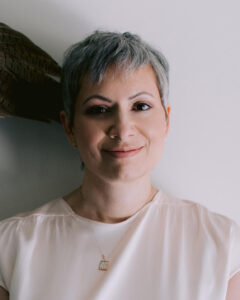
Erin Ehsani is from many places and lineages, has
held lots of jobs, some meaningful, many not, yet
some compulsion keeps her writing towards the
unresolvable conflicts within and out, where she takes
comfort in uncertainty. An Iranian-American born
and raised in Alabama, from a family of refugees and
rednecks, fundamentalists and rebels, her worldview
has been shaped by paradox and complexity. From
these multitudes emerges empathy and kinship for all
beings, feeling states, and timelines. She writes and
creates things just outside NYC, where she lives with
her husband, kid, and dog