
Praying to a God about a Father | Annie Barker
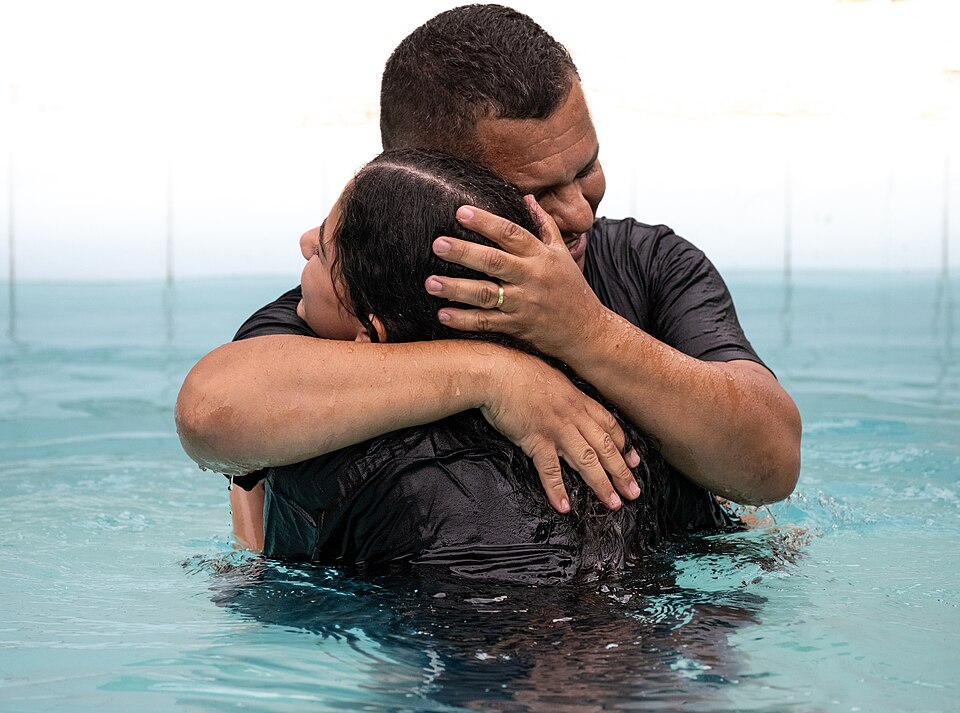
Baptism in a Philadelphia Church, Wikimedia, by Wilfredor – Own work
My baptism is more than a mere whisper of water sprinkled on my forehead; it is an immersion, the dunking of my whole body in a tank of cool water situated under a stained-glass empty cross.
I enter the tank on cue, step carefully down the white steps and stand on the pebbled bottom. The water is the turquoise of the sea glass my little sister and I hunted on Galveston Island as children. Our last trip was five years ago, but I can still see the small chunks of glass shining iridescent in the water, then dulling and graying as we lifted them out. The tank water ripples out from my body, and my long, white baptismal robe floats up like a soft cloud. Apprehension pulses through me in waves as I feel the water hugging my ribs. Years of lessons have not made me a confident swimmer.
I walk forward as the pastor begins the baptismal prayer, my legs pushing slowly against the weight of the water and turn to face the steps behind me. I pinch my nose between the thumb and pointer of my right hand and place my left hand on my chest. The pastor then places one hand on my back and another over mine and gives me a gentle push. I bend my knees and surrender my weight into his palm like I did during the trust falls my friends and I enacted at sleepovers and allow myself to go all the way under. The pastor still guiding me, I quickly travel up again, the water giving way as I ascend. Then I am out, blinking water from my eyes and taking in a big gulp of air. Dripping, my robe water-logged and heavy, I walk back to the steps, feeling around in my heart for the transformation I was told would be taking place.
Maybe if I had been allowed to float for a while in the undulating water, maybe if I had possessed the discipline necessary to rest still and deep in that moment of drowning and saving, perhaps I would have felt something, a claiming I could trust. Because that was my longing, to be claimed and cherished by a father. Too quickly, however, I am pulled out of the tank, my robe is removed, and I head to the bathroom to dress. My soul was in peril, the pastor had said, and needed saving, but I don’t feel saved. I just feel wet.
I reenter the sanctuary at the end of the service and look for my mother and stepfather. I find them at the back of the nave, about to leave. Mom, standing just behind Ken’s shoulder, looks uncomfortable but offers a weak smile. I turn to Ken, hoping for his blessing, but he doesn’t say a word, just shakes his head, turns his back on me, and walks away. My mom follows him out, her own head bowed, trapped in the tension between us.
A memory of another pool, this one much larger. I am young, and afraid of the water. Ken stands beside me, one hand on the small of my back, the other behind my knees, trying to teach me how to do a back float. I want to follow his instructions to “lie flat, like a board” and “put your head back and look at the sky,” but I’m afraid I will go under, so I repeatedly pull my chin down and bend at my hips in order to remain standing on the solid bottom.
**
I never met my biological father, and my first stepfather left me and my mom when I was a year old. Ken married my mother when I was three and tried his best to convince me he was my father. He put his name on my birth certificate and once told me, “When I chose to be with your mother, Anne, I chose you as well.” Maybe he really meant that, but I didn’t see much evidence of this in his behavior. He was often distant or angry, prone to shouting, and sometimes inexplicably insensitive. I called him “Daddy,” however, so eager was I for someone to fill that role, and tried to believe.
A talented professional actor, Ken liked to perform offstage as well. One bit took place on family vacations in the Arkansas Hill Country. Driving his brown Chevy Impala to the crest of a steep hill on an empty state highway, Ken would glance around to be sure my sister Shannon and I were awake and then lift his hands and feet in the air, letting the car coast down the other side, gaining speed as it went. “Look, no hands or feet!” he would shout, his face beaming as we shrieked, “No, Daddy, no!” We were giddy with relief when Ken finally put his hands back on the wheel. We were imperiled, then saved.
Another bit, a private one performed only once, began when Ken found me watching TV and scolded me for leaving my teddy bear in the hall.
“Daddy, I didn’t do that. I don’t even play with him anymore,” I said.
He continued to insist, his dark eyebrows pulling down and inward, his voice louder and more clipped with every repetition, that I had, in fact, done this and needed to “Go and pick it up right now, young lady!”
I walked toward the hall, head down, heart pounding. I held my breath as I turned the corner and, raising my head, saw only an empty hallway carpeted in gold shag.
“April fool!” he said, coming behind me, his performance complete and his broad smile and raised eyebrows revealing his delight.
Disoriented by the plot twist, my heart still trying to punch its way out of my chest, I nonetheless tried to perform the role I had been assigned. I exhaled loudly, offered a little shrug of laughter, and lifted the corners of my mouth in a smile I hoped matched his.
Around that same time, my half-sister, Shannon, five years my junior, injured herself on a cyclone fence while tagging along with me and my friends. Upon seeing the deep gash under her arm, the one I hadn’t seen earlier when I raised her shirt to check after she began to cry, Ken looked at me in rage, held her arm high in the air and forced me to stare at a chunk of bloody flesh hanging out of her body.
“Look at it, Anne. Look what you did to your sister. This is your fault,” he said, and wouldn’t speak to me the rest of the day.
**
Perhaps it would have been easier to believe in Ken as a father if I had grown up in a religious tradition that taught me how to believe in things I couldn’t see. My friend Boo knows she will meet her mother in heaven because her Catholic faith says so, and my husband, Scott, a cradle Episcopalian, has doubts about some spiritual things but has nonetheless chosen to believe. I have tried both things—knowing, choosing—but I keep coming back to the questions: How do I know? What do I choose? If there is a Higher Power, I just wish they would show me the damn burning bush.
We weren’t generally church-going people, nor did my family pray or talk about spiritual matters when I was a child. I am told we briefly attended a modest, low-slung Methodist church, the one across the street from the prominent Southern Baptist one with its blade-sharp steeple pointing an accusing finger into the expansive Texas sky. I attended Sunday School in this church long enough to learn the entire “Books of the Bible” song. To this day, I know the order of the Old and New Testaments better than my husband, who became a priest. This information comes in handy when I’m completing the Sunday crossword, but I haven’t yet found another use for it.
I also occasionally attended a religious service after a Saturday sleepover, taking in the unfamiliar liturgy as I sat in the pew with a friend and her family, but I found it hard to believe in my friends’ Fathers any more than I believed in my own. Nothing tangible there, and I was a girl who needed proof.
The frequency of my church visits ticked up a notch when we moved from Dallas to Oklahoma City the summer before my sophomore year of high school. Oklahoma was a “buckle of the Bible Belt” state, and it seemed like everyone there was a believer. Except me. I once casually told my friend Jennifer that I wasn’t sure there was an actual Devil living in an actual place called Hell (I knew evil existed; I just wasn’t sure it had an address).
“I’ll pray for you,“ she said earnestly, then changed the subject.
I found this response both confusing—was this something we weren’t allowed to talk about?—and a bit patronizing. Yet I secretly wished for her faith to rub off on me, even for a little while, like the stick-on tattoos my friends and I collected in elementary school.
I began attending Young Life meetings, partly for the social scene, but also because I hoped I might find the hint of a spiritual Father there. The organization promised to “invite kids to follow Christ, care for them regardless of their response, and change lives in the process.” We gathered every Wednesday night to eat junk food, sing catchy religious ditties, and listen to a presentation. It was during one of these programs that I was dissuaded of my very strong belief, passed down through teenage lore, that a boy will feel physical pain if he has an erection that I won’t help him relieve. Super useful—some might say life-changing—information, but that, along with some vague understanding that love was the answer, was about all I took from those meetings. I was left feeling that the whole belief in God thing was both too easy and too hard.
I was determined, however, so I tried baptism. This idea seemed especially promising because I was pulled into it by an emotional upheaval I didn’t fully understand. Longing, urgency, the promise of redemption—I was certain my experience of these things meant I was on the right path.
The Mayfair Baptist Church was a long, flat, cinder block structure painted a muted beige; if not for the slender cross on its facade, it might have been mistaken for a prison cell block. The large, rectangular sanctuary was framed by white walls and tall multi-paned windows, all overseen by that stained-glass empty cross. I sat in a crowded pew next to Mark, a hot Christian boy I knew, our thighs just touching, taking in the choir, the readings, the sermon.
At the end of the sermon, the pastor’s voice grew louder and more urgent as he asked if anyone wanted to be saved, to rest in the arms of a Father who would love them for all time. Yes! I thought. Pick me, pick me! and my complicated desires pulled me to my feet. I crab-stepped my way around the toes of my pewmates and walked down the long center aisle. I approached the altar rail and knelt in an open spot, the pastor laid his hand on my head as he acknowledged, “Another soul turned to Jesus, another child reborn to the Father,” and I cried with relief as I offered up my father loss and longing.
I didn’t fully understand that being “saved” required more than just kneeling at an altar. I also never imagined how my baptism two weeks later would so anger Ken. My mother would eventually tell me that although Ken had agreed to attend the service on my behalf, his body shook uncontrollably after the reading of the First Corinthians verse listing the various gifts given to the people by the Holy Spirit, a list that omitted, and thus—to his mind—invalidated, his fervent artistic calling and gifts. I would also find out, years later, that Ken’s mother, after having trouble conceiving, dedicated baby Kenneth to God in gratitude for her successful pregnancy and made it clear as he grew that she expected him to do God’s work. Ken entered college as a pre-med student, planning to be a medical missionary, but flamed out of the program after failing organic chemistry. He eventually majored in theater, broke with his church, and never went back.
I see now that Ken might have experienced his own version of my Father/church alienation. No wonder he couldn’t see me, or my longing for a gentler version of him, drifting in the depths of that plexiglass pool.
I eventually left the Southern Baptists and went back to being unchurched. I was okay with that, because the passion I had felt during that heady moment of the pastor’s call had quickly dissipated, along with any connection I had felt with a paternal deity.
**
Ten years later, I lost a third father. I was in my late twenties, living with my husband Scott and our two young children in a Prairie Box home on a quiet street in Omaha. Still nursing a spiritual void, I had returned to organized religion, joining the Unitarian church this time because I was reticent to take on the “Father, Son and Holy Spirit” trio when I couldn’t even grok the Father part. With the help of a therapist, I was also working out my feelings about Ken’s erratic moods and intimidating anger, which had continued into my adulthood, and finally got up the nerve to share them with him. I prepared a speech, including a litany of what now sound to me like boyfriend break-up lines, like “I’ve been doing some growing and changing lately,” and “It’s not you; it’s me.” Once the words were right, I condensed the speech into an outline, copied it on a five-by-seven index card, and invited Ken to lunch.
We made light conversation at first, sticking to safe topics, and as the sun slid across the oak floor and my plate grew empty, I considered backing out of my plan. But the index card was heavy in my pocket, so I dove in. I told him I had been doing a lot of thinking about my childhood and our relationship since having children myself.
“Oh?” Ken licked a speck of tuna fish off his bottom lip as he glanced up from his plate.
I told him I was grateful for everything he had done for me but had always felt something missing between us, a distance I needed time to figure out. Then the bomb: I would like to stop calling him ‘Dad’ for a while, call him by his name instead.
“Hmm,” he said after I finished, and began nodding gently. His dark green eyes were unreadable.
A flash of red—a cardinal—darted past the window. I felt the rise and fall of my chest and heard a car horn blare impatiently on the thruway curving around our neighborhood.
“Well,” he finally said, still nodding, “I hear what you’re saying. And I’ve always thought you might have some things to work out about your fathers.”
His smile was strained, but I was grateful to him for trying.
The first letter came a week later, and I was blind-sided by the force of Ken’s anger. Despite our history, I thought he had understood my feelings and wouldn’t hold them against me.
Your biological father, that asshole, couldn’t be bothered to even support your mother when she was pregnant, much less be a father to you. And her first husband, although a good enough man, couldn’t stick it out. They both left you, but I didn’t. And this is what I get in return? After all I’ve done for you, all the ways I’ve supported you, treated you like my own daughter, you insult and hurt me like this? I won’t stand for it.
I could practically feel his spit hitting me in the face.
I tried appeals—I never meant to end our relationship; I understand this causes you pain, but can you please try to understand?—but the blitz continued unabated for several months, each letter more defensive and vitriolic than the last.
In one of the final ones: I’ve been to the doctor, and he’s diagnosed me with a heart valve insufficiency. Anne, your actions are literally making me ‘heartsick.’
In another: With your mother, I felt like I was suffering from necrophilia, always trying to love a corpse. Now I feel like you, too, are dead to me.
At my therapist’s encouragement, I stopped responding. We never spoke or wrote again.
**
Not long after our mutual retreat, I began to attend my husband’s Episcopal church. Even today, I don’t know for sure what drew me there. The Trinity still seemed overly complicated, and I felt like an imposter, an unbeliever in a sea of the faithful. But I know I was still conflating the search for a spiritual Father with my longing for a kinder human one. Perhaps because I didn’t know how to reconcile with my stepfather, I leaned into the possibility of reconciling with the spiritual one whose love I had briefly experienced as a teenager.
I also carried a memory of a wild moment I experienced in Washington, D.C.’s National Cathedral back when Scott and I were living in Northern Virginia post-graduation, trying to decide what to do with our lives. Perhaps the most high-profile Episcopal church in the country, the cathedral is best known as the setting for presidential inaugural prayers, national thanksgivings, and memorials for American leaders, but it supports a local congregation as well, and its Sunday services are open to all. The Sunday we visited, we arrived early enough to find the Darth Vader and hippie gargoyles on a northwest tower and marvel at the stained-glass window embedded with a moon rock and then settled in a back pew for the service.
They had me at hello, with the opening strains of the processional hymn, during which choir, organ, and gothic arches all soared to unimaginable heights and my breath caught as I tried, unsuccessfully, to hold back unexplainable tears. I finally gave myself over to the grand expanse of it all and marveled at how these simple elements of sound and space could touch me deep in my agnostic heart. If a moment like this was possible, there had to be something behind it.
Despite this experience, I didn’t jump into our Omaha church with both feet. I prayed infrequently and addressed my concerns to an entity closer to Emerson’s “over-soul” than a stand-alone deity. And when reciting the Nicene Creed, the Episcopal Church’s communal statement of belief, I left out the parts that didn’t make sense to me, just stopped speaking when I came to them and picked up the text again after they passed.
This cafeteria-style religious practice worked, and I began to relax into a community that welcomed me despite my ambivalence, and in doing so led me to an understanding of a God that could do the same. Hazarding to believe that God wouldn’t write me off because of my doubts, I began to profess a hesitant faith, and to accept that it was all I had to offer any Father who might be paying attention.
Around this time, I met with a spiritual director, a short, slight woman with mousey hair and kind eyes whose round face floated like a moon in the shadows of her dim office.
“So,” she said as she leaned back in her chair, “tell me about your spiritual journey.”
I told my story, walked her through my unchurched childhood, my moment at the altar, my baptism and subsequent tepid affiliation with anything spiritual, all the ways I’d tried to believe in some version of the Father, my irrepressible skepticism. I told her about the longing. As I spoke, something about the intimacy of the setting unwound me.
“Anne . . . are you crying?” she asked.
I was.
She handed me a tissue and asked, gently, “So, where do you think this longing comes from?”
I blew my nose noisily and shook my head, perplexed by the question.
“I think the Father gave you that longing,” she continued. “You’re already in relationship with Him. You always have been.”
I really sobbed then, feeling the simple truth of this. He’d been in me, with me, all my life? Like Dorothy’s ability to get back to Kansas and Auntie Em?
“Yes,” she said, chuckling softly, “just like that.”
So maybe God was claiming me all along, I thought; he/she/it was just waiting for me to do my part, to find a way to cross the chasm of my doubts to the father on the other side.
Jesus says in the Book of Matthew that faith the size of a mustard seed can move mountains. The mustard seed, as I understand it, is a metaphor for a faith that is small, and so not perfect, but is nonetheless good enough.
“Oh, ye of little faith,” Jesus also says. That’s me. I’m “ye.”
**
Ken died recently, of the heart problems he claimed I caused. Shortly before his death, I had begun to entertain the idea of reaching out to him. I was aware of a new softening, a change informed by an emerging understanding of how my abandonment by two earlier fathers might have left a father-shaped hole too big for him to fill. I wanted to explore the possibility of reconciliation, but old memories held me back. There was also this – he hadn’t reached out to me in all this time, so perhaps he would rather I didn’t. He died before I could make up my mind.
Shannon, Ken’s biological daughter and my half-sister, didn’t feel I should attend his service since I hadn’t had a relationship with him for the past twenty years. I considered hopping a plane to Dallas with a carryon of black clothing, catching an Uber at the airport, and standing in the back of the gathering like a secret. But she asked me not to go, so I didn’t.
I held my own memorial service instead, timed to coincide with the public one. I entered our living room, where early morning light filtered through golden-brown matchstick shades; lit a scented candle; and sat in the same armchair I use when I meditate or journal, my version of a sacred space. My feelings for Ken were still complicated, but I was beginning to see that my father story wasn’t only about my longing and their leavings. Ken had left me, yes, but I had left him too, had pushed him away with my doubts, and at that moment it felt important to be open to the possibility of atonement. So, like with the Nicene Creed, I skipped over the parts of our story that didn’t feel right, focusing instead on the ones that did: the time he, not Mom, taught me to drive a stick, because he could be surprisingly calm when I stalled; the Saturdays he squeezed in a family dinner between two performances, his face thick with stage makeup; and the afternoon he steadied my bike as I learned to balance. As I focused on these memories, I was confronted by the realization that my preoccupation with the evidence of Ken’s failures as a father had prevented me from noticing his attempts to try to be one, and the rest of the swimming pool memory came back to me.
I am standing in the shallow end, afraid I might drown, water rippling out from the small movements of my body as I consider, prepare, then hesitate. The idea that the water could hold my weight, carry me, seems impossible. Ken stands beside me, one hand on my back, the other behind my knees, and repeats his encouragements to lie flat and look at the sky. He says other things too: “You can do this, Anne” and “I’ve got you.” As I look up one more time and feel him ready to hold me, I decide to risk it. I decide to believe that this man, despite the divide between us, just might have me. I let my hips rise, surrender my weight into his hands, and suddenly find I am not drowning, but floating unsteadily in the undulating water, resting lightly in his wide palms.
Breathing in the warm scent of my improvised memorial candle, I prayed hard as I remembered. To what deity, I’m not sure. I prayed to a god about a father, asked the universe to welcome Ken home. I acknowledged I had likely created an ideal no father could meet, and considered the possibility that he, like my fragile faith, like my connection with the other Father I still struggled to understand, had always been with me and was good enough. I surrendered, for a moment, my anger and blame, imagining these fiery feelings muted and twisted into a delicate strand of spider silk, and waited. As my meditation continued, it was my stepfather on one side and me on the other, as it had always been, but our separateness was softer in this liturgy, and we were connected by that strand of silk. As I marveled at this, the filament between us thinned, broke apart, and Ken floated away.
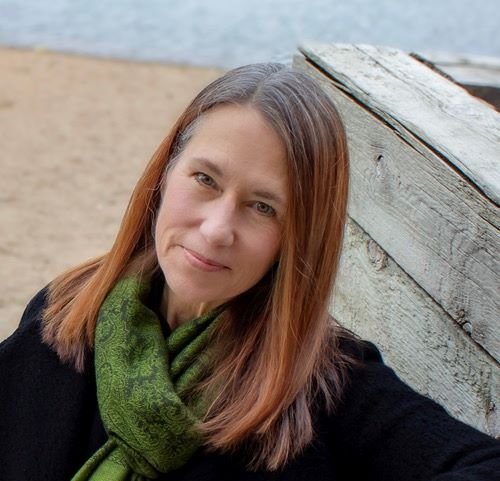
Annie Barker practices psychotherapy in Omaha, Nebraska, and holds an MFA in Writing from the University of Nebraska at Omaha. She is the Associate Editor for The Good Life Review. Her work has been published in River Teeth and Nap Lit and was shortlisted for the Writer’s Digest 2024 Personal Essay Award. She is currently seeking representation for a book-length memoir entitled Collusions: What Transpired and Who Was Responsible, in which portions of this essay appear.