
Stray | Ariana Kelly

We heard him crying for a week before we spotted him: an orange tabby cat so emaciated he looked deformed. His eyes were different colors and slightly crossed, his fur matted and greasy where it hadn’t been picked clean by mites. A chunk was missing from one of his ears, and a long, thin scar unfurled like a calligraphic brush stroke across his flank. And yet, or perhaps because of the evident beating he’d taken, this stray inspired our immediate love. We didn’t know where he’d been, but we would make sure he had landed in a home.
My husband D. and I took care of a colony of feral cats where we lived in Boyle Heights, just east of downtown Los Angeles. New ones were always passing through, scrounging for food near the grounds of our apartment building until the more senior cats in the colony pushed the interlopers out, exerting their territorial rights. LA is home to the United States’ largest population of strays, as it is home to the country’s largest population of unhoused, the temperate weather in constant tension with the economic brutality of the city. Both groups have grown exponentially in the past twenty years, presenting policy makers and better-off citizens crises of strategy and conscience. In the end, most people look away or look through, scattering a few handfuls of food or fistfuls of dollars before moving quickly onward.
We named the cats we tended by their qualities: Fancy, Friendly, Professor, Matriarch, Handsome, Tortoiseshell, and Sad. For a period, Sad Kitty seemed less sad, and then he got sick and vanished. So did Matriarch and Tortoiseshell. When a cat died, the colony appeared to reconfigure itself to accommodate the loss, each taking up slightly more space to compensate for or take advantage of the absence.
D. conferred most of the titles, but I was the one who named this mangy tabby Faulknerian. His awkward, paranoid gait, as if he were being perpetually threatened, immediately suggested to me a creature who had wandered west for the curative properties of its sunlight and potential for reinvention, as Faulkner once had, and as I did.
Although the other cats did their best to scare him off, Faulknerian was persistent, and, besides that, his crying was unbearable. It sounded human and, in its humanness, dominant, as if it would be heard and answered. The only emotion that outmatched his hunger was his fear. He was starving but too scared to get within twenty feet of us. D. and I spent another week coaxing him down from atop the fence where he perched, shivering in ninety-degree heat, until he would eat the sardines we put on the ground.
When Faulknerian finally ate, he did so with a terrifying ferocity, as if he expected the food or his life would be taken from him at any moment. If cats have shoulders, his were hunched close to his ears, as mine often were. Insecure. In secures. Not free from care. He was ready to flee or fight at a moment’s notice.
The sounds he made weren’t commensurate with his meager body, and they made us so uncomfortable we laughed. They weren’t the sounds of abandonment, as it was clear he’d never had a home, but of not knowing what a home is and feeling an inchoate longing for one. Or something. I’m not really sure he experienced any other sensation than the pleasure of feeling less hunger, which shouldn’t be undervalued as a satisfaction. It can be exhilarating to be sated by so little.
We fed him twice a day and took him to be fixed and tested for feline leukemia. He gained weight. The deep welt on his stomach healed and scarred over. His eyes, still crossed, looked less jaundiced. He liked to lounge near a statue of a terracotta soldier at the corner of the property, sidling up to our back porch around feeding time. He wouldn’t let us pet him but, over the course of six months, he flinched a little less violently when either of us came near. Sometimes, a degree of less fear must qualify as recovery.
When Faulknerian arrived, it was mid-winter, and I had just convinced D. to try to have a baby with me. We were married three years before, in a Buddhist temple by monks who chanted vows we didn’t understand, in front of our respective friends and family who didn’t know each other. When we’d met, we were both in our mid-thirties and had renounced any more romantic involvements. But when we exchanged glances at an art opening and then shared a cigarette while discussing the poets we worshipped (W.S. Merwin and Gary Snyder), the world transmuted. When we said we loved each other for the first time, a couple of weeks later, I was flying down Coldwater Canyon in my car, having just crossed Mulholland Drive on my way to Venice Beach, feeling as if the sunlight were bedecking me and my entire life. Soon after we married, we got two orange tabby kittens we named Merwin and Snyder.
It had been D. who first brought up the possibility of having kids soon after we met, but in the immediate wake of our marriage, he was more than reluctant.
“We don’t have enough money to raise a kid in LA,” he declared, “and the world is overpopulated anyway.”
When we had this conversation, it was January, but the temperature was a perfect seventy-eight degrees. We’d moved to this apartment from our place in Mid-City at my insistence, so we could be closer to the Arts District. I’d quit my teaching job for a year to write a book, but I’d sheepishly returned when I hadn’t been able to find any work less draining than school teaching.
A flock of wild parrots flew over our apartment and settled in our neighbor’s Mexican palm, squawking. The tough, fibrous leaves, designed to preserve as much water as possible, clacked against each other in the Santa Ana winds. From across the river, I could see Downtown, slightly smudged with smog. A fire had just raged east of the city, in the San Gabriel Mountains, but the air quality index for our neighborhood had returned to green. Los Angeles had more than bounced back from the 2008 recession and was now swelling with money from tech, entertainment, art, and foreign investors. We were lucky to have found a cheap apartment in an area still on the cusp of gentrification before rents skyrocketed there, too.
Our place barely fit us, let alone a child. We didn’t have family nearby to help, and childcare would eat one of our meager salaries. What’s more, my job at an elite private school was stable but also stressful and D.’s at a rare book’s library was calm but undercompensated. The first thing I wanted to do when I got home at the end of the day was to pour myself a glass of wine, then another and another. Even more practically, what kind of world could we feel assured would exist fifty, twenty, even ten years from now? Nonexistence might be a gift, particularly for someone born to people who didn’t have abundant economic resources, like us.
All of which is to say, I thought D. was right, but I wanted to pursue having a child anyway. I didn’t want to accept that for people like us, having a family would most likely strain our relationship to the breaking point, emotionally and financially, and might lead to our child being permanently disadvantaged compared to children of wealthier families whose parents could purchase extra support systems to buffer their kids from the exigencies of an increasingly rapacious world. I saw those extra support systems in action every day at the wealthy school where I taught, and I knew how much they helped. However, I didn’t want to submit to this reality because it would have meant accepting defeat. Instead, I believed that if I exerted my will—the will that had gotten me through boarding school and an Ivy League university on scholarships, then multiple high-pressure jobs—we would overcome or, as our parents had, just “figure it out.”
I tried another tactic: “If LA is too expensive to raise a family, we should move.”
We then went on to spend some of the most delightful evenings of our marriage together traveling through the United States via Redfin and Zillow, looking up where we could buy a house for 300K, 200K, 100K and falling. “Let’s quit our jobs and move to Detroit right now,” we laughed, clicking on a listing for a three-bedroom, two-bath with an asking price of 30K. “Ok,” he finally said one night, “I give up. I know I’m not going to win this one. We can try.”
Soon after we decided to try to have a baby, D. flew to Bangkok with his father, an annual trip they had taken together, to a different place each year since his mother died nearly twenty years ago from breast cancer. I texted him a picture of Faulknerian lounging in the sunlight beside our car. “Look at how much healthier he looks,” I typed as a caption. Even his crossed eyes looked less crossed.
In Faulknerian’s improvement I hoped D. would see what I always knew we possessed: the capacity to care for something more vulnerable than us. And that, in many ways, he would be the more inspired parent. I was good at getting us somewhere, but D. could take us further than I could go alone. Once in a situation, he had the ability to be more selfless, spontaneous, and responsive than I had. It was D., not me, who discovered what the guidebooks didn’t reveal about the places we traveled, including the city we called home. He showed me the LA humming just below the surface of LA, the Los Angeles of tunnels, underground art collectives, and liminal boundaries where the urban wilderness meets the natural wilderness.
D. didn’t need more than what we already had, easily able to live on scraps, while I was always hungry for more––more money, more space, more opportunity, more experience. It was an appetite that had motivated me to escape the hardship my parents experienced, but one that I often couldn’t satisfy and so would temporarily seek to escape, usually with alcohol, but also with exercise and work.
Over the next several months, the world looked freshly electrified, as it did when D. and I first started dating; even the trace amounts of grass poking up from the cracks in the concrete sidewalks became talismanic. I read the slightest changes in my body as potential signs of pregnancy, disappointed when my period returned reliably each month. I began to look with envy at my friends who said they had gotten pregnant by accident, regretting that I’d always been so careful. After six months passed, I made an appointment at a fertility clinic, a mausoleum-type building in downtown LA whose waiting room was decorated in muted mauves and grays.
The doctor, a pretty woman in her mid-forties, drew my blood and did an ultrasound to see how many remaining eggs I had. Her office was austere but elegant, with a picture of two young, impossibly beautiful children on her desk. “Well,” she said, “these aren’t the eggs of a twenty-three-year-old, but they can still do the job.”
She suggested I wait to receive the results of my blood tests and, if my hormone levels were low, I could ease into fertility treatments by taking a hormone supplement that might stimulate my egg release. I went through a battery of tests, all of which came back within the normal range. Finally, after the sixth normal result, she suggested that D. get tested. Because he never came to these appointments—since this was something he really didn’t want to do, I didn’t want to force him to attend—I operated more as a third-party administrator than a spouse, relaying information. I went to the doctor to get his results by myself, and I learned that probably because of the treatment he’d received for cancer in his late twenties, even if we had the most invasive and expensive form of IVF, our chances of success were only 80/20, probably worse. I sat in front of this average-looking, mid-career man in his mid-forties who gazed at me sympathetically, his jowls and eyes drooping in concert, and started to cry uncontrollably. In all my imaginings, I had never imagined that I simply wouldn’t be able to have children.
“80/20 is not zero, not by a long shot.”
Faced with a situation that was largely out of my control, I grew even more forceful, more willful.
At home D. looked at me helplessly, with the sincere expression of someone who had never believed he would have children. Nevertheless, like Faulknerian when he arrived at our apartment, I would be seen and heard. None of this was supposed to happen to me—not being married to a man who changed his mind about having kids, not then, when I finally forced this man to have kids, finding it impossible to conceive. “I want to go ahead with the treatment,” I told my doctor on the phone. She said to come in as soon as possible because there was no longer any wiggle room. I was thirty-eight. The time to act was now. I went in the next week and listened to her outline an “aggressive plan of attack,” distrusting her intentions despite myself when I learned how much it would cost and read how many couples spent hundreds of thousands of dollars to no avail. We didn’t have that kind of money. I spent hours on the phone with my insurance company which, while good on many issues, was abysmal on fertility treatments, covering twenty percent of what would cost thirty thousand dollars at minimum. Unlike my education, this was not something I could get a scholarship to cover.
“What if I got a donor,” I finally suggested to D., because even I started to quail at the thought of what the treatments would do to us financially and emotionally. “That way I could get pregnant, and it would only cost us a thousand dollars, not thirty, and it would definitely work.” We were sitting in the small living room of our small apartment, as we had been when I’d first brought up the idea of having a child. The city was going through a prolonged heatwave, and the wall-unit air conditioner we’d only allowed ourselves to buy the year before hummed laboriously in the background.
“If you do that, I’m out.”
I couldn’t blame him. If our roles were reversed, and I was the one being asked to accept a donor egg, I would have presented the same ultimatum.
I couldn’t blame him, but I did anyway.
Faulknerian’s reprieve lasted a year. In late December he started crying again. He stopped eating. He sniffled and appeared to be running a high fever. He lapped up bowl after bowl of water, the relief of the liquid running through his organs trumping the Olympian effort it took for him to swallow. Alarmingly, he let us pet him, which suggested how sick he really was. Within a few weeks he was so frail, frailer than he was when he arrived, that he allowed D. to pick him up, put him in a carrier, and take him to the vet, who, after a few palpitations and blood tests, said that his kidneys were failing and that there was nothing we could do short of spending thousands of dollars on feline dialysis, which would only keep him alive for a few more months. It was as if his improved domestic situation had blunted his survival instinct and allowed illness, ever vigilant, to find an entry point. In retrospect I would feel similarly, as if I’d finally let down my guard enough to become vulnerable—even hopeful—only to find that it was a bait and switch: no matter how hard I’d worked, what schools I’d attended, I didn’t have enough psychologically or financially to give my child what had been given to me. We came home from the vet and carefully placed Faulknerian’s feverish, slight body onto a patch of shaded grass beneath a rose bush. On top of his emaciated body his head loomed large, a balloon on a string.
It is a privilege to care for something that might ruin you. It’s an honor we confer on very few subjects: a child, a parent, a partner. Not a stray cat. Not something so vulnerable but ultimately useless for advancing our ends, whatever those ends may be. A stray cat is a lonesome breeze through the universe. A stray cat is a tremor but not a complete pause in thought. A stray cat is a small step on a long road, but its suffering can level us all the same, if we allow it to be what it is: of equal value with all creatures great and small.
In the last days of his life, Faulknerian slept almost continuously. The other cats hovered around him without disturbing him. I liked to think they were keeping a tacit vigil, and perhaps they were. He shivered through the day and night, and D. fed him Cat-Sip with an eyedropper while cradling him against his chest. But this was hospice care, and when we described to the vet over the phone what he looked like, he suggested the best course of action, for him and us, would be to put him to sleep as soon as possible.
When D. came home from putting Faulknerian down, he parked the car in the driveway and leaned his head against the steering wheel. In a passive-aggressive rebellion, I’d claimed that I couldn’t take the day off work to accompany him, because he had never volunteered to accompany me on my many doctor’s appointments. Next door my Swiss neighbor Fabienne looked through her kitchen window, saw D. convulsively weeping and immediately went out to comfort him. I know this not because I saw it but because D. told me about it later that day, a tacit rebuke for me not being there either to put Faulknerian down or to comfort him after. I seemed to be experiencing my emotions on a sixty second delay because I had the same impulse to soothe my husband but only after I’d worked through my irritation at this overt display of his feelings—why can’t he ever express like this when it comes to us, to the child I want, to the sorrow I feel—after I imagined Fabienne hugging him with compassion. Like my mother, D. was able to extend more generosity toward animals than humans; animals do not intentionally cause us emotional harm, but no matter how unimpeachable a person is, they will always be guilty of multiple transgressions. In living we hurt.
Soon after Faulknerian died, I gave up on getting fertility treatments. I got as far as the preparation, refraining from drinking wine and coffee for a couple of weeks, walking around with eight hundred milligrams of baby aspirin flowing through my blood system to reduce the risk of inflammation and create a better environment for the embryo to grow. I was scheduled to pick up the first round of shots, which I had learned how to administer on my own by watching YouTube videos, two weeks after D. left Faulknerian’s dead body at the vet’s office.
And then, the dream of having a child spontaneously aborted within me. I never picked up the round of shots. I convinced myself it was unnatural. The willfulness that had carried me through childhood, adolescence, and young adulthood was no longer adequate, perhaps because it wasn’t accompanied by real hope. I had used pessimism as a coping mechanism for too long and, consequently, had stopped believing. I didn’t have the resources or the stamina to fight for something I wasn’t even sure would be a good thing to have. Could I do whatever it took to provide for someone else, someone who hadn’t asked to be here, in a world growing rapidly harsher and less hospitable by the day? Why bring a child into a world as perilous as ours if I wasn’t certain I could do so with an abundance of optimism? I no longer had the blind faith in my own abilities and what those abilities could achieve that had motored me through the first decades of my life. Likewise, I had stopped believing that D. and I could handle the stresses of being parents and accepted the likelier reality that, as happens to so many, the pressure would turn us mean and resentful toward each other. It already had.
This wasn’t a moment of surrender but of being vanquished. I felt that I’d failed to do what many of my female friends had succeeded in accomplishing, most with several children. It was a mystery to me how they did it, until, years later, I began to realize that they had started cultivating fertile grounds for a family in early adulthood, choosing stable partners who could provide, choosing professions that would remunerate them for their efforts. Years later, however, I also began to realize most of those decisions had not been made consciously. The friends I had who went for high-paying professions came from families for whom this was the custom of the country. They didn’t know they had to do it to survive, they just expected to be where they were because of who they were. I’d done none of that life-preserving or life-perpetuating work and had consequently been pulled under by an economic riptide that began around the turn of the millennium and is currently pulling people out much farther than I ever ended up.
When I told D. about my decision, he was unmistakably relieved. Now we could go back to normal. We could live the life that was within our means to live. It made him generous with his feelings and willing to engage about a subject he’d never been able to really talk about before. “Look,” I said, pulling up a site about foster adoption in California. “Maybe we could investigate this as an option.” Together we scrolled through rows of children’s headshots as we had once perused houses, pausing at the expressions we both agreed looked least haunted, most like the expressions we would want our child to have. But you can’t buy a diamond-in-the-rough human like a fixer-upper house. What business did we have thinking about fostering or adopting a child who had already been to hell and back when one of us was ambivalent about the idea on a good day? We soon stopped looking.
D. and I resumed our relationship as if the past year hadn’t happened, existing in an uneasy peace facilitated by the habit that becomes instinct. But something integral had changed. After I returned home from work every day, I was greeted by the sight of five or six cats lolling in the sunlight on the driveway. By this time everyone in our apartment complex took care of them. In the sun they looked sleek and well-fed, distinct from the growing homeless population in the city that had long since surpassed the borders of Skid Row. Like spreading waters, tent cities ballooned in every available space in all but the richest neighborhoods like Beverly Hills and Bel Air. Many homeless now, however, were not living in tents. They were living in very nice SUVs and station wagons purchased when prosperity seemed a birthright, and which became mobile homes when they defaulted on their real ones.
I liked to sit with the cats for a while before going inside, petting the ones that agreed to be petted, playing with those who liked to be played with. While D. napped, I crept back and forth between the kitchen and the living room, trying to refill my wineglass as quietly as possible, lapping as thirstily and furtively from it as Faulknerian had drunk from the bowl of water we kept perpetually filled at the end of his life. If D. heard me, he was either too kind or too non-confrontational to say anything about it. I didn’t want to rely on alcohol, but without it, life seemed unbearably wan. In the evenings we lost ourselves in the freak show of the 2016 election season, watching endless news cycles followed by satires of the news. We read commentaries ridiculing the complacency of the Obama years and Hilary Clinton’s neoliberalism while questioning Bernie Sanders’ electability. The rabidness of our friends’ political discourse further cemented our withdrawal, perhaps because it was coupled with most of them having recently bought houses, capitalizing on while also deriding the economic chaos of the past half decade, a course of action that was not available to us. We closed our social media accounts on the day of the election, sickened by the performative “I voted!” posts. Rather than waking us up to the political realities of America, much like Covid did, the news confirmed what we already knew to be true and what had implicitly killed any chance of us trying to raise a child together.
Two weeks before we were supposed to go on a trip to Minneapolis we had planned more than a year before, D. and I separated, on my instigation. I told D. while we were sitting in the living room—the same room in which we had discussed having a child—that I wanted to end the marriage, that I didn’t want a trial separation, that I didn’t want counseling. I was sitting in a chair facing him and two windows that looked out on another house—a multigenerational home that would soon be sold to investors, latticed with bars to dissuade intruders. He sat without moving or making any expression at all as I laid out my case. At the end he said he knew me well enough to know it was useless trying to change my mind.
Since the Minneapolis trip was paid for and we were masochists, we decided to still go. We spent a long, strange, tragic week walking along the Mississippi River, admiring the factories that had been turned into lofts and art galleries, eating meals in neighborhood restaurants, immersing ourselves in a future we wouldn’t be experiencing together. We walked across the bridge where John Berryman committed suicide to the Walker Museum, where we meandered wearily through an exhibition of the Black Mountain School that paid particular attention to the textile art of Annie Albers, an outstanding artist always overshadowed until now by her husband, Josef Albers, the founder of the Black Mountain School. We wandered into another wing of the museum and found a room where people were throwing illuminated white balloons into the air. Another conceptual art piece with what possible relevance to my life now?
Mid-way through the trip, I turned forty. Rather than let the day pass unremarked, as I intended, we ate a nice dinner. D. found a farm-to-table restaurant buried in a residential neighborhood with craftsman houses and beautiful gardens. It was the kind of place I enjoyed, and D. despised. We sat outside eating our vegetable bowls and avocado toast in silence that had once been companionable but was now only melancholy.
When we came back to Los Angeles, we lived for the remainder of the summer sleeping in separate rooms divided by sliding doors that didn’t close completely, bent over our laptops, ordering furniture for our new lives. Eventually, D. hung a scarf from the ceiling to close even that small gap between the doors, effectively sealing off the last access we had to each other. We spent money separately in a way we’d never been able to spend together, several packages from Amazon arriving daily: curtains, plates, bedding. Years later I came across a passage in a book by the philosopher Stanley Cavell, who wrote, “It is as though you know you are married when you come to see that you cannot divorce, that is, when you find that your lives simply will not disentangle.” In the material ease of divorcing, I wondered if we’d truly been married, or if we’d really been fostering each other until now. On our fifth anniversary, I got up early and drove to watch the surfers at Venice Beach, and D. went to Vegas. We shared one car and so throughout September, I drove him to the far reaches of the city and outside it, to look at apartments in areas where he could just barely afford to live alone.
When we had moved the last boxes of his books into his new place, a small studio near Skid Row, I wept on the back porch as we hugged each other goodbye. The thought crossed my mind that I was making perhaps the biggest mistake of my life, but I pushed it away almost as soon as it surfaced, closed the door, and immediately poured myself a glass of wine.
Later in the afternoon on the day the vet put Faulknerian to sleep, D. and I sat outside together on our back porch. In the shade, the temperature had dropped fifteen degrees within the hour. It was as if the atmosphere’s migraine had finally passed. Looking straight ahead, D. described holding Faulknerian in his arms, wrapped in our oldest, softest bed sheet, while the doctor administered the life-ending dose of pentobarbital. On the wall behind him had been an image of an impossibly cute puppy, romping in the sunshine. As he spoke, I remembered an old photo his father had given to me, of D. at the age of twenty on the Seattle waterfront looking at the Puget Sound with a faint smile, his once full head of hair blown back by the wind. This was the first trip he and his father took together after his mother died from cancer. While his father worked to supply the health insurance, D., just eighteen, had acted as her hospice nurse, attending to her for the last nine months of her life, then spreading her ashes in the Headlands. Sometimes, no matter how hard we work, how much we want it, we can’t entirely recover.
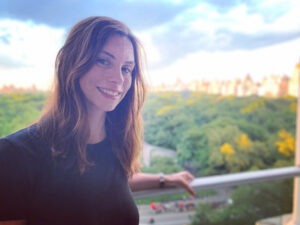
Ariana Kelly graduated from Yale University with a B.A. in Literature and from the Bennington Writing Seminars with an M.F.A. in Creative Nonfiction. She is the author of phone booth (Bloomsbury, 2015), and has essays, poems and reviews out or forthcoming in Cleaver, Under the Sun, The Threepenny Review, The Atlantic, Poetry Northwest, Bellingham Review, Vol. One Brooklyn, Hobart, Salon, Lit Hub, the LA Review of Books, and elsewhere. Her essay “Challenger” was selected as a notable piece in the 2020 Best American Essay Anthology, edited by Katherine Schultz. She is a 2023 recipient of a Jack Hazard Fellowship, awarded to help finish her manuscript, and was runner-up in both the 2023 Annie Dillard and Indiana Review Nonfiction contests. Her memoir is titled LAY ME DOWN LIKE A STONE