
Originally published November 5, 2024
The night I first heard Trump spit out the “p” word on the Access Hollywood tape, my legs clenched mid-stride, holding me firm between the kitchen and living room. Frozen and framed in the doorway, I saw the television remote just a few feet away. Heat rose from my chest and pulsed through my arms and fists, but they stayed stiff against my sides. I needed to stop his voice and that word’s constant replay and repeat.
The carefully locked memory of the rape I endured at age 17 rushed through me. I was trapped in a full-blown flashback, reliving the feel of the sweaty, muscular man smashing his face into mine. His throaty whisper of that word rang in my ears, mixed with Trump’s thready bragging tone from the television. Their voices sucked the air from the space around me. My knees bent, and I slumped hard onto the floor against the doorjamb. And like Trump out of sight on the bus stretched across the TV screen, I was back in my car that night, hidden from view, pinned beneath the man on the blue vinyl seat.
I’d held my breath when he first forced his tongue in my mouth. I focused my gaze on the radio knobs that became eyes on an imagined face that I silently begged to help me, to make the man stop, to make him finish. The radio knob face couldn’t help. I closed my eyes, thought of my 7-year-old niece’s giggly laugh, and heard her laugh as loud as I could to cover his huffing sour breaths.
The drone of Trump’s voice startled me back to my crouched place in the doorway just as he stepped off the bus to greet a young blonde woman. I clumsily jolted from my spot and reached for the remote to turn off the television. My thumb worked itself over and between the small rounded buttons as I stared at the dark, blurry blob of my reflection on the TV screen, trying to erase the orange-haired freak’s image from my mind.
I forced myself to stand, unsure of what to do. I paced the short hallways in my apartment, still clutching the remote, trying to walk off the flashback. ‘He can’t become president, he can’t become president,’ I shouted, stomping with each word, trying to smash the words into reality.
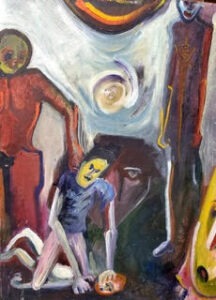
I called my sister. Yes, she heard him say it. Yes, she saw him step off the bus. She agreed he couldn’t win now. I hung up, relieved, sure we were right. Still pacing, I entered the spare room, where I kept my paintings. The series I titled “Monsters” was in the corner but close enough to reach. I picked up the rape picture and stared at the man’s face above mine, my neck and legs twisted in exaggeration. I’d tried painting and talking away the memory for 38 years with mixed results. Trump’s voice brought it back in vivid color.
I rushed down the stairs from my second-floor apartment and unlocked my bike. I pedaled around the green suburban neighborhood, passing too many front yards adorned with Trump signs. I remembered the headline from years before that Trump’s first wife said he raped her but then changed her story.
I felt clammy and sick to my stomach. I squeezed the bike handles tighter, trying to stop seeing Trump’s face or the man’s from that night in my car when I was 17. I pedaled faster, keeping my eyes forward to avoid more Trump signs. Then his blonde ex-wife’s face popped into my head. I wished she hadn’t dropped her rape charge. I remembered how I’d needed a therapist to tell me that just because I didn’t say no, it was still rape. I felt all the guilt thinking that I’d asked for it because I was too scared to yell out.
Back in my apartment, I paced again. The news was all Access Hollywood. I waited for someone to say he was out of the race. A few congressmen said they wouldn’t endorse him; some were unsure. I bit my nails and pulled and twisted the end of my t-shirt. Some people interviewed said they would still vote for him. I couldn’t stand it. I knew I should call my sister or friend, but I couldn’t move from the fuzzy, anxious space between the past and present. I drank sleepy herbal tea and tried going to bed early.
As I lay in the dark, I remembered the night again. It was my first date with a man I’d met at a bar in New Jersey. I invited him and his friend to a party. I thought I’d have more control if I drove and if we were with people I knew. But in less than an hour, he began to whisper lude words and phrases into my ear.
A wave of panic shook me. He and his friend weren’t fitting in, and I felt responsible. I told him I didn’t feel well and wanted to take them home. It seemed the safest thing to do: get them out of the party and get me away from him.
The ride to their neighborhood was uncomfortable. They laughed together but didn’t talk to each other or me. I was relieved to reach the corner where I had picked them up earlier that night. But the man didn’t get out. He stayed in the passenger seat, let his friend leave, and waved him off, laughing.
“Go up the hill,” he said, with a smirk, and pointed to the steep city street ahead. I hoped so much to get to the top and drop him off. I looked out the window, glad to see some people still walking around. We were about 2/3 of the way up the hill when he pulled a large switchblade from inside his denim jacket and flicked it open. In a second, he began waving it out the open window and screaming the “n” word over and over at the African Americans walking up the hill.
I free-fell inside while driving. The car was moving, and my hands were on the steering wheel, but I was disconnected.
“Turn here,” he yelled, waving the knife toward an alley near the hill’s top. He was laughing again.
I turned quickly, like an automaton, frozen inside myself, but felt the tires roll unevenly over potholes and rocks on the alley road cloaked in a deep gray haze.
“Stop here,” he said, pointing to a dark square behind one of the old store buildings.
I pulled into the shadows, and he was on me quickly, pushing my seat back and down. I lay in silence beneath him as he whispered the “p” word in my ear, letting him do whatever he wanted. I felt that I deserved the rape because I drove the man home and because I didn’t say no or stop. After the man finished, he laughed, exited the car, and slammed the passenger door.
I drove home, folded over the steering wheel, aiming the tires between the streetlights lining the 6-mile trip. I showered as long as the hot water lasted, pouring the whole bottle of rose bath oil over my pelvis and legs. I did not sleep. The next day, hiding in bed, my eyes shut or open, I saw only the scene from the night before. Like a movie on replay, I saw his face, heard his voice whisper that word, and smelled his breath repeatedly. And over and over, I laid there and didn’t fight back.
When my mom opened the door and asked why I was still in bed, I told her I felt sick. I stayed in bed that whole Saturday and again on Sunday. I stayed home, hiding in my bed until Wednesday, and then went to school like a zombie, moving through the halls and classrooms, telling everyone I had the flu. I stayed home again on Thursday and Friday. My head and stomach were not right. Saturday, for most of the afternoon, I lay with my knees pulled up toward my chest under the covers.
I couldn’t stand upright when I stood to go to the bathroom. My lower stomach spasmed, and it burned when I peed. I had to tell my mom.
“Is it worse on the right side?” she asked from the dark of her bedroom, whispering so she didn’t wake my stepdad.
“All over real low,” I said, bent over with my arms squeezed against my pelvis as if someone had kicked me.
We didn’t talk on the way to the ER, but I watched as she held and turned the steering wheel, in control and calm. In the waiting room, she patted my arm and told me again about the time she had her appendix taken out. How they never called the doctor in those days, but her mom knew it was severe and took her to the hospital. Her words helped dull the pain until I went to the little exam room.
It was a blur with the nurse and the doctor touching my belly high up under my breasts and all around to the lower places. I winced and pulled my knees up higher when they pressed down there.
The doctor said it was in my pelvis and that I needed an exam. He opened my legs and pushed my feet into stirrups. I couldn’t breathe. I twisted the sheet with my hands and somehow shut a door between my head and body. Under the bright lights, the nurse and doctor looked inside and pushed things into me. I closed my eyes and fell back into the dark black pit of my car’s front seat from that night. I opened my eyes again and was in the white sterile glare. I opened and closed my eyes to see the man’s sweaty bearded face or the white coat.
“When was the last time you had sex?” The doctor asked.
“Last Friday.” I heard myself say.
“Did you use condoms?”
“No,” I said, talking like someone I didn’t know, someone with guts.
“I think you have Pelvic Inflammatory Disease, probably from Ghonorea or Chlamydia,” the doctor said. “It can cause severe damage to your uterus and scarring that can prevent pregnancy.”
I floated in the penetrating bright white, picturing my niece, remembering her as a baby, thinking about how I took her to school when I was in the fourth grade for show and tell. The nurse turned me over. She told me they needed to give me needles for the infection, one on each side of my butt. The pain shot right through on both sides, joining with the ache in my pelvis. I scurried further into the hiding place in my head to get away from the pain.
They left me alone to get dressed, and while I struggled to pull on my jeans, my mom opened the curtain. Her eyes and mouth made lines in her face I’d never seen before.
“Oh, honey, are you okay?” She asked, and the creases on her face faded.
“I’m sorry,” I said, starting to cry, feeling the door open between my head and body. “I didn’t mean for it to happen.” After I explained the details of the night to her, she confided with me that after she separated from my father, a man on a first date had forced himself on her. She, too, felt too scared to resist and let it happen. She pulled me to her and covered me with her arms in that way, which always made me cry harder. And with the strength of her arm around my shoulders, we left the hospital.
After hearing Trump on the Access Hollywood Tape, I wanted that same hug from my mom. I needed the comfort of her arms to hold me, to tell me everything would be alright. But Mom had died in 2013. She could do nothing to protect me from Trump or the threat of his words that he could do whatever he wanted. I would have to live with the gut-wrenching fear, the immense sense of dread, the same way I did when I was 17 after the man raped me only 6 miles from my house, fearful he would show up one night in the dark and again push his body onto and into me, and again whisper that word in my ear.
Over the weekend, I watched the news cautiously, hoping to hear that Trump had dropped out. But by Sunday, it appeared that he would survive the scandal and the new allegation of video footage from The Apprentice with Trump saying the “n’ word. “I wasn’t surprised and didn’t dare hope it would reduce his supporters. Feeling powerless and frightened, I withdrew and hid from the news and headlines,
Trump’s dumbfounding win and four years in office forced me to remember a traumatic event from my past and to live in a triggering present. I became terrified he’d weasel another win in the 2020 election and couldn’t breathe fully until well after his factual loss and horrific behavior during the January 6th insurrection. Relief came eventually, and for a time, I believed the worst days were over.
When rumors and support for him running again in 2024 strengthened, despite his immoral and criminal activity, I braced for the worst. He’d won before and could win again. I had to accept that I lived in a world with people who loved and adored him and where the words he spoke and deeds he’d done didn’t matter.
The rape lasted fourteen minutes and left me with decades of physical, emotional and psychological scars. Trump’s four years in office and current run exhaust my sense of what’s real in the world and with the people around me. As November 2024 nears, I am coaching myself to breathe deeply instead of holding my breath. I will not hide. I am registered to vote and will exercise my right.

Grace Culbertson is an occupational therapist who works with children. She earned a BFA in Painting early in her life, and her writing themes are often depicted on the canvas. This is her first publication in Under the Sun. She has written many poems, several personal essays, and two memoir drafts she hopes to develop.
