
The Body is a Temporary Gathering Place | Cindy Bradley Talks to Andrew Bertaina
Originally published May 16, 2024
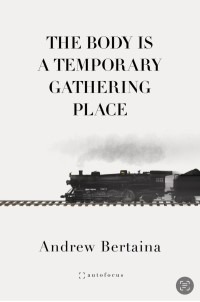
Andrew Bertaina’s The Body is a Temporary Gathering Place tackles themes of time, desire, disappointment, family, parenthood, life and death. With his uncanny insights and lyrical prose, Andrew poses questions and seeks answers in the spirit of the lost romantics, mesmerizing readers along the way. Having a conversation with Andrew about his new collection was a delight.
Cindy Bradley, Editor
Cindy Bradley: Andrew, it’s an absolute pleasure talking to you about your essay collection The Body Is A Temporary Gathering Place. You cover a lot of ground, from childhood to midlife, from California to DC, with trips to Europe in between. I have to say, as a native southern Californian who’s been transplanted to Fresno, CA, your description of your last summer in Chico, CA and how it was like any other summer, which translated to “blazingly, soul-scorchingly hot. It was the sort of heat about which people out east say, ‘It’s a dry heat though,’ which is why I dislike almost everyone out east.” had me nodding and laughing out loud. You nailed the unspoken sentiment of everyone in Central California with that line.
Andrew Bertaina: I am a native Californian, and I liked writing that essay because it’s a little portal into the landscape and place that shaped my identity. The rest of the essays take place on the east coast, but I like to think about the way that all that natural beauty of CA is still stored inside of me. Whether it was the live oaks, the ocean, or just working in my mother’s garden, my love of nature was really hard-wired by my time in California.
Beyond that, the essay deals with my relationship to romance, which was pretty comical for my first nineteen years of life! I was terrified of the opposite sex. Thus, it’s kind of an interesting springboard into a collection of essays that is often about the difficulty, failures, and struggles of maintaining a romantic relationship. In a way, it’s almost hard to believe the two selves linked across time are the same, and I think that’s something I explore in all the essays.
CB: I’m a huge fan of essays that incorporate a strong sense of landscape, where place becomes its own character. You do justice to both coasts! The Body Is A Temporary Gathering Place is divided into three sections, with the first section exploring time in all its myriad nuances. Even the collection’s title references time, as the body is a “temporary” gathering place, alerting readers that nothing is permanent. Here are some lines that I highlighted: “It is time for us, still kicking and screaming, to go home.” from “A Plane Crashes Out Over the Atlantic,” and in “A Field of White,” you write “Oh, what a waste I make of time.” and “And time continues to be whittled away, carving away at me as well, hollowing out my insides, making its way toward bone.” We’re aware of the passage of time, the conflict of time: wasted time v. time well spent, what you’re doing with your time v. what you’re not doing/should be doing. The struggle is real, and as a writer, you find a hefty portion of the struggle involves time not spent writing. As many of these essays focus on a time in your life that has passed, have you since discovered the elusive key to time well spent?
AB: I wish I had found the answer with what to do with the well of time, fleeting though it may be. My children were very young in a lot of the essays in this book, and I think time is so precious and so banal with young children. You are embodied in time in a way I’d never felt before, for better or worse. Thus, when you have a free twenty minutes instead of a free forty-eight hours, it changes your relationship to time. It’s easy to become obsessed with spending it well.
I’ve actually read a few books that were helpful in thinking about time. One book, Four Thousand Weeks: Time Management for Mortals, was extremely helpful for my mental state. Basically, he argues that not only do you not have time to spend on the things you want, you don’t even have time to spend on your top ten things. Thus, you need to accept your limitations. Maybe it’s part and parcel of being middle-aged, but I found the idea of accepting that I was never going to get it all done was a useful way of calming down a bit.
As for writing, it will always loom as something I could do more, but I think that’s true of a lot of things. I could play with my kids more. I could finally read Proust. I could hike Half-Dome. But I can’t get to it all, best to have some humility.
CB: There are more lines on time that really stood out to me. In “The Thin Ribbon” – “I have seen time inverted in my children, lived backward…” In “Time Passes: On Unfinished Things” – “I would like this essay to be about time. And since I can’t expand it to include everything I’d like to, I see now that the best mode is compression.” What readers come away with is that everything is fleeting. What do we do with these moments that aren’t going to last…in “This Essay is About Everything” you ask, “what are we to do with the hours that fill our lives?” How are we to find meaning? What is it all for? If this is the thing? Is this?” There’s a real thread of an existential crisis that runs through this collection, isn’t there? Can you speak a little more about this?
AB: I think there is definitely an existential crisis running through this book. I think it’s fair to call it a book of midlife crisis. But I’d also argue that it’s a book about trying to figure out how to live, which is the plus side of that sort of dread. In a way, that long journey was both about discovering what I wanted and becoming more content with the fact that there was no real answer. I often say that life is meaningless, which means it’s meaningful; we get to determine the latter part.
But I think my brain is also just wired for a lot of stimuli, and I was underfed for a long time, so it took a bit to start working toward contentment. I still can easily drift into a sort of existential dread, but I have ways of getting out of it now: meditation, walks in nature, gardening, which I didn’t have for many years. These small little threads have helped me to make the fragments into a whole. In a way, my younger self would find it maudlin, meditation and flowers as some sort of salve for despair, but it turns out I’m more basic than I thought.
CB: Yes, you’re absolutely right, the collection is a book about midlife crisis. And as readers, along for the ride as you navigate the dips and peaks that is life, you speak to many of our own angst.
You have lovely uses of light, like “the orange light of an early morning sun sets the oaks’ bark briefly afire” and on a trip to Spain, “found an orange tree behind a chain-link fence and photographed it, thinking the way the light was passing through the fence, illuminating the cracked earth and the dusty limbs of the tree, was somehow a work of art…” and “now that I miss the dappled light flickering across the water of Lindo Channel.” In “Departures” you write that “The dappled light in Bidwell Park is not just the dappled light of any park, but the finest dappling of light that I’ve ever seen in my life. You would want to dapple everything in this life, trust me.” So good! As someone who gravitates towards the ways light is painted, I really appreciate reading depictions like yours. I’m curious if you find yourself drawn to images and reflections of light in both your reading and in your surroundings?
AB: It’s true! I describe light often. I sort of wish I did it less frequently, lolz. However, it’s not a lie. I often find myself staring at leaf shadows patterned on the ground or morning light on the fresh orange blooms of our honeysuckle. Truly, it’s quite gorgeous. In a way, it’s merely the act of paying close attention. The world, whether it cares about us or not, is full of a lot of beauty, which I think we kind of ignore. I’m as guilty as anyone else. However, when I start writing, I start paying attention, which is like a form or prayer.
I was recently listening to a Marilynne Robinson interview, and she said you can attune yourself to anything, so why not attune yourself to the beautiful? That’s an approximation of how I feel about the light.
CB: I agree, noticing light and shadows is the act of paying attention. And it can be so sentimental and romantic. I’m reminded of Anton Chekov and his brilliant “Don’t tell me the moon is shining; show me the glint of light on broken glass.” You show us a kaleidoscope of light on an indulgent moon and I hope you continue attuning yourself to the beautiful.
This collection is drenched in longing – Shades of longing permeate the pages, peek in and out of words and sentences and paragraphs. In “On Trains” from your second section “After Montaigne,” you write “I’ll never forget the enchantment and fear of that day. We ached for arrival and absence, yearning for the train’s whistle and fearing it…” You capture the contradictions of the moment so well: fear and enchantment, arrival and absence, how these conflicting feelings can exist in the same moment. “On Trains” details a time in your childhood, but this ache, this longing, traverses the years from childhood into adulthood, from teenage fantasies to the first kiss. You capture the sense of longing that so many of us feel, and that sense of longing never really goes away. As readers, we drown in words like “I’d like to wander then, through the folds of memory back to the place where kissing began, take another turn around that oval-shaped walkway beneath a sky scarred by stars, pause beneath the majestic oaks bending into one another, then our bodies, then mouths, everything moving in concurrence, like a symphony, like the beginning of something I’ll never quite grasp again but always yearn for.” What is it about longing that is never quite satisfied?
AB: I’m reminded of an essay by Philip Lopate, Against Joire de Vivre. In it, he argues that to be satisfied, to be joyous, would be to let go of the hunger he still has for living. Longing is just part of the human condition. It’s fun to long. It can also be corrosive. I also have a horrid memory. The only way I can access it is through strong emotions and because essays are contingent on reflection, I find myself calling forth my past life by longing for it. Andre Aciman has whole essay collections about longing. I’m in good company as an essayist.
However, longing can also be corrosive. It’s hard to find yourself always wishing the present moment away, and I spent a lot of my thirties doing that. I mean, I think it’s probably because I was a bit unhappy. It’s all there in the essays!
But I do think the longing and yearning can also teach us something. It’s an attunement to our inner hearts. Now, the hard part is to figure out whether your longing is lying to you or not. Like Lopate though, I don’t want to live without a little bit of longing, meditation or no.
CB: You a truly a contemporary romanticist. You’re chastised by your former wife for looking at the sunset instead of the road, question “whether the countryside is always romantic, and we just don’t take the time to see it, or if the countryside is rarely romantic and it is only the train or the vacation that makes it so, i.e., are we merely creatures of perception who live by illusion?” I have a sneaking suspicion that many readers will feel like you’ve snuck inside their heads and read their minds with ruminations such as this one.
Then, in “On 35,” you admit that you possess a romantic temperament, which you define as meaning that you’ll find no greater disappointment in life than in yourself. Yet you also acknowledge, after listing some of your perceived failings, that you’ve cultivated “one useful skill…a sense of the aesthetics, an eye for the beautiful.” Yes, you certainly have, whether it’s pausing to admire “purple wisteria climbing a stone wall, a field of wildflowers bending in the wind, skeins of light on water, water reflecting the sky, the trees, and if we listen closely as we look, the sounds of birds in the thrush.” I want to live in these places you describe. Don’t you? And don’t you find that even if we can’t or don’t live in these places for countless reasons (including maybe we do but just don’t see it), that writing about worlds such as these brings them alive, even if it’s only temporary, if it lasts for the time it takes for the reader to read your essay and imagine the English ivy growing up the limbs of a tree mid-winter.
AB: Absolutely! As I said, writing is an act of paying attention. As Simone Weil said, “Attention is the rarest and purest form of generosity.” I’m just trying to pay close attention when I’m writing. And I think one of the things I’ve always tried to accomplish in my writing is breaking through the very real barrier of reader and writer. I’d like to pay close enough attention, evoke enough of the sensations of beauty, of sadness, to try and reach the reader on the other side.
My favorite books to read during these difficult years were always essays, always essays about struggling to manage divorce, children, and the writing life. But we can’t just survive and endure all of the myriad of things the world throws at us, we need to find pleasure as well, something worth saving.
CB: You write so well about the joys and trials of parenthood, particularly the challenges of single parenthood. Mornings stretched thin watching children playing, attending your five-year-old daughter’s tea party, alongside stuffed bears and vacant eyed dolls; comforting your son as he sobbed his fears of dying. You have a couple of lines that really stood out to me: “Raising children is not beautiful but banal and tiring. I love them. But I am undone by them” followed by a litany of their demands, insistencies, and “I am undone by constant need for water, for shows, for candy, for me, for me, for me.” It really is relentless, isn’t it. All parents can relate.
And the descriptions of your children are wonderful! You write that your daughter is never still, your “days turn into battles of wills reminiscent of Moby Dick and Captain Ahab…Perhaps she is the captain and the whale. Perhaps I am only the boat.” and that your son has “taken to stories with no real point, movement, or discernable end, a born essayist.” Do you find it at all difficult to write about your children, or is it easy for you?
AB: I have a story about that. My daughter, thirteen now, decided to read my essay, “On Baths.” In the essay, I describe hearing her tell a story and just wanting to end because I was so tired. She said, “I thought you loved my stories?” So I’m already experiencing some twinges of regret for how parenting comes off in the book. I think I’ve accurately captured what you’ve describe above, the relentlessness of parenting. It’s just a sea of wants and needs. That’s fair.
However, this is merely a particular collection of essays. I have several other essays, which aren’t in this book that write more clearly about the joys of parenting. I hope they appear in a book at some point as a counterbalance. I think parenting is one of the hardest things to capture because it’s so all-consuming that it didn’t make any sense to me until I was doing it.
Also, I’m less apt to write about my children as they get older. We’ve gone through something challenging of late that I probably won’t write about at all. I think that as my children age and become more autonomous, I need to respect that. Of course, as in all things and all essays, I reserve the right to change my mind!
CB: You do a remarkable job of depicting parenthood. In fact, I’m really impressed by the way you write of parenting young children, which we typically see from female/mom writers. It’s refreshing to get the male/dad’s perspective.
“The Leopard” is such a beautiful finish to your collection. The essay is about many things, and one of those things is bringing the existential crisis at the core of your collection full circle with incorporating Don Draper from Mad Men into the essay. You relate to Don through your midlife crises and your shared unhappiness and meditation practices. You write about how “At the end of Mad Men, Don reaches the ultimate terminus, the state in which I grew up, California.” and reaches “the gold rush of life.” and reflect that “there is something of those California days left inside me, as inside Don, a place I can quietly go” while holding on to the notion that life, in its kaleidoscope of colors, is after all, dear. This sense of peace is so well-earned. Kudos to you on a leopard changing its spots and taking your readers on a beautiful journey of self-discovery and realization.
AB: Thank you so much! Yes. The essays do conclude on a happier note. I did actually hit the proverbial rock bottom right at the start of the pandemic for reasons I include in the essay. Then I had to begin the process of digging out. When I describe mediation, I don’t mean twenty minutes a day. I mean I was doing it for hours a day, crying often, dredging up all the things I felt I’d gotten wrong in the last decade.
I certainly still have my fair share of struggles. I always will. However, I sorted out some ways of quieting them a bit, establishing some healthier routines to tamp down the internal chaos that had driven a lot of my decision making for a while. Again, no perfect answers. Life just got a little more liveable.
CB: The pandemic was not kind on so many levels, but it did serve to shed light on what was no longer working in our lives, to connect so many of us to what was missing, or something deeper we might not have known we needed. I’m glad it served as a conduit for you to transcend your challenges and find a sense of peace.
Our readers enjoy hearing about a works publication journey; can you tell us how The Body Is A Temporary Gathering Place found its way from manuscript to publication?
AB: I sent my manuscript to the wonderful editor at Autofocus Books, Michael Wheaton, and he helped build a collection from the large amount of material I sent him. I was lucky! He’d published two essays of mine, and I knew he was running a press, so I sent it his way. Because he’s a generous editor, he sorted through three-hundred plus pages of work to find the right collection of essays.
I had sent the collection to other places the previous year, mostly press contests. I was a semi-finalist at one press, but I didn’t really know what the market was for essays that don’t have a hook essay, something that’s gone viral. However, I’ve loved essay writing and taught it for many years, so I also believed in the work.
Let’s all just create more of a market for essay collections!
CB: Yes, let’s! I second, third, and fourth that! Andrew, you’re a writer who navigates between fiction and nonfiction seamlessly. Can you tell us about any new projects you’re currently working on?
AB: I tend to work in both genres because I have a very active brain, hence the digressions and longing. But it also means that I can only work on what I’m interested in. Mostly that’s fiction, but I occasionally have an essay crop up, and they tend to be longer. Everyone should be working in all the genres. This is my hot take.
I’ll have a collection of flash fiction coming out with ELJ Editions in 2025, and I have also been working on a CNF memoir essay that relates my love life to the wonderful Before movies by Richard Linklater. As you noted above, I’m a romantic, and I think the first movie, Before Sunrise, planted a seed in my head for what I wanted from life and romance. Otherwise, I just work on what entertains me! Otherwise, I’d have stopped writing.
CB: I love your hot take and look forward to your flash fiction collection! You just mentioned one of my favorite movie series of all time. Richard Linklater’s Before trilogy films are phenomenal on every level: the dialogue, the storytelling, the themes, the light…so good. You write of encounters in Europe that feel very Linklaterish and with your dreamy, passionate slant this will be an incredible essay.
And now, a few quick-fire questions to round out this delightful conversation:
Where is your happy place?
Probably on a long hike with my wife and four children or maybe at the brewery afterward.
Montaigne has written an essay about your life. What’s it titled?
He already wrote one titled, “That Our Mind Hinders Itself.” Feels fair :).
Fiction or Nonfiction? Writing/Reading?
I read more fiction than Nonfiction of late. But I read in all three genres. People tend to suggest more fiction than essays. The tyranny of fiction must come to an end!
What would the soundtrack to The Body Is A Temporary Gathering Place’s be?
If only I knew more classical music! I think I’d probably say I make use of the retrospective narrator a lot, so let’s just go with the ten-minute version of All Too Well. For my snobs, make it Hallelujah Junction by John Adams.
Current obsession – could be anything: food, drink, song, tv show, book?
We recently watched the movie, Drive My Car, a film by Ryusuke Hamaguchi. It’s so spacious, so quiet, and it has this really surprising and tender ending. It was art that took its time, and I wish we made more space for that. Otherwise, Jon Fosse’s Septology, which is the best book I’ve read in a few years. I love that it unabashedly asks the deeper questions about God, art, and love. I’m not entirely sure why those deeper things feel so foreclosed in American publishing, but I’m an ideal reader for that type of stuff!
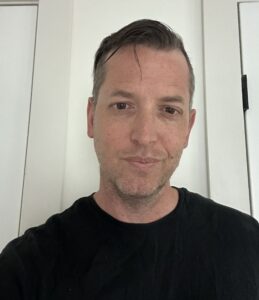
Andrew Bertaina is the author of the forthcoming essay collection, The Body Is A Temporary Gathering Place (Autofocus Books), and the short story collection One Person Away From You (2021), which won the Moon City Short Fiction Award. His work has appeared in The Threepenny Review, Witness Magazine, Prairie Schooner, The Best American Poetry, and his essays have been listed as notable 3x in Best American Essays. He currently lives and works in Washington, D.C.