
The Marker| Jane Bernstein
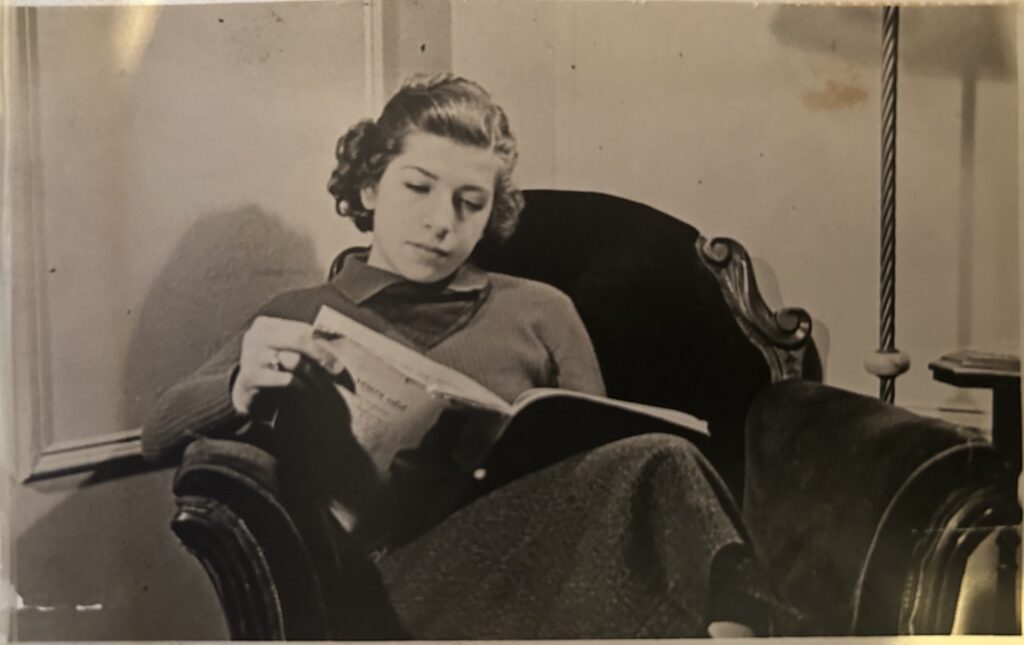
Photo courtesy of Jane Bernstein
My cousins came to visit me at my apartment in New York one summer afternoon, two buoyant brothers I rarely saw. They’d spent the last couple of days driving through their old neighborhood in Paramus, New Jersey, catching up with family who still lived in the area and paying their respects to those who were buried in the huge Jewish cemetery there.
“And you know…” said the younger brother, hesitating the way one does before an awkward revelation. “There’s a marker for your father, and one for your sister, but there’s nothing for your mother.”
“No!” I laughed uncomfortably. “How is that possible?”
I set some cheese and crackers for my cousins and listened to the details of their trip, but I kept thinking—no marker? I was the one who’d taken care of my mother’s funeral arrangements, and I’d done it alone, so there was no one to ask or to blame. The thought of her lying in an unmarked grave reminded me of all the ways I’d failed her. I also felt ashamed: I had bought this sunny little pied-a-terre on the Upper West Side of Manhattan with money my mother had left me and heard her scold me from the grave. Ingrate! Is this how you repay me?
A while later, walking my cousins to the elevator, I said, “I’ll call the cemetery on Monday.”
Neither said a word: it was as if they’d forgotten the revelation…
As they disappeared behind the closing doors, I wondered: Would I? I didn’t make yearly visits to the cemetery, as my parents had. I no longer had a mother to demand that I uphold this tradition. Why not just let it slide?
*
My mother had been healthy throughout her eighties, physically able and sharp. Until the last months before her death at ninety-one, she did all the New York Times crossword puzzles in ink, top to bottom, and she trounced me in Scrabble nearly every time we played. But toward the end, she was broken, as if she could no longer bear the weight of the past tragedies in her life: my sister’s murder by a stranger in 1966 when she was a college student in Tempe, Arizona; my father’s late-life decline into dementia. All the extended family members that had made up her lively social circle were gone. Everyone. I loved my mother and did not want to quarrel with her anymore and quarreled with her until the very end, even after she said, “I’m an old woman. Leave me be.”
Whenever I called to ask how she was, she said, “You don’t want to know.”
“I’m asking, aren’t I?” I always replied, trying to squelch the tinge of irritation from my voice.
“I wish I was dead.”
There was no reason for this to jolt me–it was what she always said—and yet it did.
She was ready, too. Her paperwork was all in order. She had a medical directive and an up-to-date will that named me, her only surviving offspring, as executor. The burial plot next to my father and sister had been paid for long ago, and in the green fireproof box where she kept her important documents was the name of the funeral home that would take care of transporting her body from Pittsburgh, where both of us lived, to the cemetery in Paramus that I called the City of Dead Jews. It was an immense grid, with gravestones, markers, and mausoleums, all engraved with the names I knew well—Moskowitz, Goldman, Aronson, Suppowitz, Altman, Weiss, Cohen, Brodsky, Levy, Feinberg, Bernstein, Bornstein, Berenstein, Brownstein, on and on, as far as the eye could see.
Years before, the synagogue in my parents’ town had bought a section of the cemetery and sold plots to members. Relatives on both sides of our family had bought several of them. A tall headstone that read “Fair Lawn Jewish Center” marked the section. All the deceased had flat markers, set into the ground. Laura was buried here, and so was my father. A space had been set aside for my mother.
“There’s no room for you,” my mother had bluntly informed me at my father’s funeral in 2000. Not that I’d wanted a burial plot, much less grasped the inevitability of my own death. Even so: no room for me?
“We thought you’d be buried with your husband,” my mother said. She hadn’t liked my husband and knew I had sound reasons for leaving him. Nonetheless, she saw our divorce as my shortcoming. Her words had stung, but I eventually came to view this exchange as darkly humorous: no room for me, even after death!
My father’s funeral was a simple graveside service, led by a rabbi supplied by the cemetery. The rabbi had said a few Hebrew prayers to the dozen or so mourners gathered, and a heavy shovel was passed from person to person so each of us could scoop a shovelful of dirt into the hole. Then we had lunch in Englewood. So, when my mother died nine years later, I’d made the same arrangements she had for my father. I’d even booked a private room in the back of a restaurant, just as she’d done.
Now, alone in my New York apartment, a dim memory began to take shape. A few months after my father’s death my mother had asked me to take her to the cemetery, and I’d driven her there from Pittsburgh. He’d died in April, and it had been fall when we’d made the trip, hadn’t it? When I counted the months, I knew what that visit was for: the unveiling.
Around six months after a burial, or when the earth has settled enough for a headstone or marker to be put in place, Jews gather at the cemetery a second time for a memorial service. I couldn’t remember where we’d stayed, only that it had been colder than I’d expected, the kind of windy fall day that makes your eyes tear. It must have been October, maybe mid -semester break, when I had a day off from teaching.
The memory expanded. I’d driven slowly on the narrow roads that divided the huge cemetery into grids, unable to find our section, and then. . . we’d bickered, hadn’t we? Nothing too dramatic. I was sure of that. More likely my mother was angry, and though I knew this was the way her sadness manifested itself, I recoiled from her. Eventually she recognized a tree, and then the tall Fair Lawn Jewish Center stone, and we parked the car and walked to the place where my father’s marker had been set into the earth.
That raw wind. Just the two of us, standing in silence.
My mother was Jewish to the core, and also proudly agnostic, with “no use whatsoever” for religion or prayer. I stood beside her, stiff, mute, different from the way I was with everyone else. Maybe we broke the silence by searching for stones to put on the marker to indicate that we’d visited the site. And then what? She could not speak about my sister or her murder. Had she paused at my sister’s marker, and said, “What a waste”? Had she shaken off my attempt to take her arm? “I’m not a cripple.” Maybe not, though she’d spoken these words many times. Whatever happened, I could not tamp down the knowledge that I was no comfort to my mother— not then, not for many years afterwards. I did what she asked on that October weekend: drove her to the cemetery and stood beside her. But I did not support her.
I did not support my mother because I was a bad daughter. This is what I thought, sitting in the apartment I’d bought with her money.
I did not support my mother because she could not be supported. I also thought this.
Another memory: It’s dusk, a year or so after my father’s death, and I’m treading water in a pond in Wellfleet, Massachusetts, with my daughter Charlotte. It’s just the two of us on a perfect evening. The water is warm, the sky streaky from the setting sun. I’ve rented a cottage for a couple of weeks, and my mother has driven up with Roz, the big, good-natured mother of the cousins who’d visited. Roz is happy to lounge on a chaise, read, smoke, chat or nap in the sun, while my mother keeps calling out to me—because the paper towels are running low, because she needs a tissue, because the lawn chair is wet. Every few minutes I hear my name, broken into two syllables, ringing in the air, and if I do not respond right away, she calls, “Help!” in a thin, high voice. I want to be a perfect host, as imperturbable as Roz, but instead I am tense and snippy, pretending not to hear or saying, “Then sit somewhere else.”
I’ve tried not to burden Charlotte with any of this, but treading water in that lovely pond, the ache of my failure shoots through me—I’m being such a bitch to my mother, who has suffered so—and I say, “I wish I could be nice to Grandma.”
“Ma,” Charlotte says, “she’s a really difficult person.”
It meant everything to me that my daughter, who loved her grandmother, could say this. I felt seen. Understood.
Even so, my heart hurt.
*
I called the cemetery a day after my cousins’ visit. Maybe a stone with my mother’s name was in storage, and management had been waiting for someone to claim it, I thought, listening to the phone ring.
A woman answered. When I told her about the missing marker, she asked for my mother’s name.
“Ruth Bernstein,” I said, expecting her to say, Ah, at last!
“Let’s see: we have four Ruth Bernsteins. And you are—Sylvia, Estelle, Jill, or Jane?
“Jane,” I said.
“What you need to do is contact a monument dealer. Tell them you want a flush grass marker. Give them the location, the when, the what, the why. They’ll know what to do.”
I jotted down her instructions, thanked her, and hung up.
I googled “monument dealer” and saw there were lots of them, all over the country.
A great fatigue came over me. I felt weighed down, as if by all these stones.
I didn’t call any of them.
*
No one had spoken at my father’s graveside except the rabbi, who did not know him and whose Hebrew prayers most of us did not understand. My dad had been such a nice man, delighted by a sunny day, a double-decker sandwich, or a walk through the neighborhood with the dog. He’d been beloved by family and friends, and by my mother, who was dry-eyed at the brief service, her heartbreak hidden beneath her brittle exterior. Later I regretted that I had not thought to give a eulogy. I’d been too consumed with attending to her, albeit in a mute, wooden manner.
When my mother died, I knew I would speak at her grave.
Hours after her death, I found a pen and paper and sat alone in my favorite chair. I had no idea what I might say.
Who had she been? Her doctor had asked me that question when she began to decline. What had she been like before my sister’s murder?
I began to write about my parents visiting me when I was a freshman at NYU. They often stopped by on a Saturday, having come into the city to see an exhibit at one of the museums or to check out a new restaurant. My mother was always beautifully attired, in a silk dress or tweedy suit with a label pin and gold necklaces. She and my father had begun to travel to Europe twice a year. Travel was the best part of her life, she would tell me later, when I asked what had made her happiest.
That year, after twenty-two years as a homemaker, she’d taken a job as a bookkeeper at a tool-and-die shop in a nearby industrial park. It was hardly a glamorous position, but she liked the Jewish couple who owned the company, and they must have been ecstatic to have her as an employee. Though my mother had never gone to college, she’d skipped two grades in school and was extremely quick. She read voraciously and was a superb cook. She didn’t just sew; she made fully-lined suits. She didn’t just knit; she made intricate cabled sweaters.
I stopped writing. These memories, I realized, were from the year after my sister’s murder. They were evidence of her verve and toughness, her life force. She had not given up, even after her daughter’s murder.
As a teenager, wrapped in my own private grief, I never wondered how she managed to do this. It was only later, as the mother of two daughters the same number of years apart as my sister and me, that I asked myself this question that I never could ask her. How did you go on, Mom? How did you wake in the morning and face the day?
*
I returned to Pittsburgh in time for the fall semester. Soon after I settled in, I took my mother’s green fireproof box from a cabinet in my home office, to see if I could find a bill showing that she had paid for a stone. Outside the casement windows is a massive gingko the squirrels use as a playground. I watched a squirrel catapult himself from one branch to another. Then I opened the metal clasp of the box. Inside were death certificates for my mother, father, my former husband, my children’s birth certificates, the warranty for my first Nikon camera, and two tiny baby bracelets they’d used at Brooklyn Jewish Hospital, when my sister and I were born there. Both had blue beads and letters that spelled out “R. Bernstein.” There was an envelope from a mortuary in Arizona. After my sister’s murder, my parents had flown there to identify her body and bring her home. I guess they had to pay the bill.
I sat on the floor. I could not do this. I could not go through these papers.
I put everything back into the box and returned it to the cabinet.
*
We were alike in certain ways, my mom and me. Both of us loved books and plays and word games. But from a young age I was introspective, whereas she, a scrappy first-generation American Jew, did not believe in an inner life. She had great scorn for “dreamers” and “navel gazers,” and girls like me, whose fervent need to be understood demanded fluency in a language my fiercely intelligent mother did not possess. To say “Please understand how I feel,” always provoked an argument, no matter how soft or urgent my words. She accused me of looking for trouble, blaming my problems on her. Because I was as stubborn as my mother, I kept asking her to understand who I was and what hurt me.
Once, after watching home movies from my childhood, Charlotte said, “You were always jumping up and down.”
Yep, I thought. That was me, forever saying Look at me! Look!
My mother was the youngest of six and pretty much ignored, or so I gleaned. As a result, she had her own noisy need to be seen. She yelled at home and in public and viewed her outbursts as proof that she wasn’t “phony-baloney,” like the nice mothers I dared to admire. She yelled at my father and readily gave a piece of her mind to incompetent salespeople or anyone whose politics were at odds with hers. Wearers of American-flag lapel pins got her going at full volume (“Fascist!”), as did the ultra-orthodox of any persuasion. (“I hate all fundamentalism!”) Also, those who disagreed about the best route to a particular destination, dared to be late, or did not immediately heed her command.
When my mother yelled, I cringed. Sometimes I hid. But her yelling hardly mattered when it came to our differences. What mattered was that we were unable to help each other when we needed it most.
I recall a Sunday afternoon when my daughters were ten and six, the younger one with developmental disabilities and seizures not yet controlled. I was alone in the kitchen, washing or slicing or plating food for my parents and in-laws, who sat at the dining room table, having just finished a meal I’d prepared, and my mother was intoning, “Where’s my coffee? I want my coffee. Where’s my coffee?”
After my father was moved to the memory-care unit of an assisted living facility, I took my mother to dinner and the movies most every week. This was in Pittsburgh, where my parents had moved a couple of years after I’d begun to teach there. Art, theater, and the ballet no longer interested my mother, but she still liked the movies. Her taste was eclectic: subtitled foreign films, heist movies, stoner comedies. She loved The Big Lebowski.
I tried to be on time when I picked her up at her apartment, but at the end of the day I had a rush of tasks–leave campus, pick up my daughter from her afterschool program, wait at home for a caregiver to arrive—and I was often running a few minutes late, which she hated. “How about waiting in your apartment until I buzz,” I suggested. “Please?”
Every week as I pulled up to the curb, there she was: standing beneath the awning of her building. Glancing at her watch. In driving rain, with a clear rain bonnet on her head; in snow, pushing up the sleeve of her burgundy wool jacket to check the time. On these evenings, she got into the car without a greeting (“With you, I bite my tongue,” she often said) and stayed silent as we drove the couple of miles to Squirrel Hill and circled the block until we found a parking spot near the theater.
The screening room was always half-empty when we arrived. I didn’t care where we sat. All that mattered was that we stayed through the credits. I tried to explain to my mother that I was interested in the cast and crew, the songs and locations, though what I most needed was a couple of minutes in the dark before I could reenter everyday life. But when the cast list began to scroll onscreen, she stood and announced loudly, “Let’s go.”
I tried to be nice. “Please, Mom,” I begged.
I asked in an irritated way. “Is it such a big thing?”
Every week she stood and said, “Let’s go.”
Every week I dug in, like a cat with its claws in the upholstery, refusing to move.
Why couldn’t I have just accepted that taking Mom to the movies meant I wouldn’t see the credits? Would it have killed me to let it go? Years of therapy has helped me understand how futile this struggle, how absurd it was for the two of us, Old and Older, to be playing out these scenes, as if they were part of a vaudeville routine.
Why couldn’t she just sit for another minute so I could watch?
Away from my mother, I knew what was beneath these trivial spats: what my mother needed was for me to do as she asked, now, without question, and what I needed was for her to acknowledge some tiny speck of who I was. I also knew that if not for my sister’s murder, I could have laughed about these absurd tussles and not have been left with so much sadness.
*
A monument company in the state of Washington guaranteed the lowest prices and would ship anywhere in the continental U.S. Why not? I thought, imagining that after the stone was engraved, it could be shipped to my house, where someone would help me heft it into the trunk of my car to take it to the cemetery. Charlotte and I had done something like this after our dogs had died two weeks apart. We’d gone to a quarry outside Pittsburgh, picked out the stone we liked, settled on the design and inscription. Later, a strong-armed person put it in the trunk of her car, and a second person helped her set it in the woods.
The marker for my mother could not just be plunked down beside the others, I learned. A rubbing had to be made of the other family markers so the stone and the lettering would match. Then the ground had to be prepared, and a foundation laid for the marker. Not cheap! After hearing the price, I again asked myself what would happen if I failed to do this, and the answer was: Nothing. Nothing would happen.
On a phone call to Charlotte, I raised this question: would I ever really go to the cemetery?
“We’ll go together,” she said.
Some of the heaviness lifted, enough for me to call the cemetery office again and see if they could recommend any local monument companies. The woman I’d spoken to before gave me three names. I called the first.
A flush grass marker? Sure, no problem. They’d send someone out to the cemetery in a day or so to take a rubbing of my sister’s marker so my mother’s would match. If I expected the work to be done this season, however, I had to finalize the order soon. Once there was a frost, the ground would become too hard for them to dig.
A copy of the rubbing arrived in the mail a couple of days later, along with the invoice. My sister’s stone was “Vermont barre gray granite.” For my mother’s marker to match, I needed to supply the engravers with my mother’s Hebrew name, her parents’ Hebrew names, and the time of her death. I didn’t know my mother’s Hebrew name. I didn’t even know Hebrew.
I emailed a few of my cousins and three responded with a flurry of cheerful messages about names and traditions. No one knew my mother’s Hebrew name. Possibly she had only a Yiddish name, which was often the case among Eastern European Jews in the early twentieth century. Either way, Hebrew letters would be used on the stone. I was haunted by the fear that I might give the monument company the wrong information. My mistake, etched on my mother’s stone for all eternity!
*
Every morning, I sat at my desk, looked at the rubbing of my sister’s marker, and waited for the squirrels outside the window to entertain me. I dithered, as my mother would have said. Oh, she hated people who dithered, who left everything to the last minute, who dragged their feet, as I was doing. I looked at my sister’s name, the dates of her birth and death, the Hebrew letters, and a bolt of pain shot through me. Then I listened to my mother castigate me from the grave, as if still annoyed that I was five minutes late for our movie date.
The weather changed. The fan-shaped leaves on the ginkgo fell and carpeted my driveway and yard in yellow. One morning when I walked across the lawn to get the newspaper, the tips of the grass were white with frost.
I called the monument company and talked to Michael, the man who’d done the rubbing of my sister’s stone. I told him my mother had died years ago, and the work order for her marker had been on my desk for weeks.
After I’d finished apologizing, he said he had customers who called about people who’d passed away twenty years ago. “Then they freak out if the order is a week delayed.”
I lowered myself into a comfortable chair, as if chatting with a friend. “It was my fault,” I said. “I forgot about the unveiling.”
“The unveiling is a tradition; it’s not a religious thing. You do it, you don’t do it, you do it ten years later.”
I hesitated. I had unearthed so much over these last few months, and now to go forward made me feel as if I was burying my mother a second time.
“Okay,” I said at last.
We settled on an inscription in Hebrew: Ruth, Daughter of Abraham. This is traditionally carved into the stone when the deceased’s parents’ names are not known.
Beloved wife and mother. Yes, for sure.
When we were finished, Michael said, “You know the installation can’t be done until spring when the earth thaws.”
“Spring would be perfect!” I leaned back in the chair.
The semester was over by the start of May. I could drive east and pick up Charlotte in Brooklyn, and the two of us could go to the cemetery together, just as she had suggested. Already, I could see the day unfolding. My daughter would find the Fair Lawn Jewish Center plot easily, because she could do such things. I’d park the car on the side of the road, and when we got out, she would link her arm through mine and walk with me until we reached our family’s markers. The bright sun would be high in the bluest sky, and I would think of my mother who burned so bright. My mom, who shared her favorite books with me—Silas Marner, Wuthering Heights, Jane Eyre—who opened our house to the extended family and made fabulous holiday meals, who so adored New York. I yearned to say, Ma, I bought an apartment! Standing beside Charlotte, I would close my eyes and let myself feel my eternal regret that I’d been unable to give my mother what she needed. Whether or not that was possible didn’t matter: the regret would always be with me.
Then I would turn to my sister’s stone. I would see her name, Laura Ellen Bernstein, and the dates delineating her short life—1945-1966—and though more than a half a century had passed, the grief inside me would burn hot and I would cry without shame for all that was lost. I would cry, which I could not do when I was with my mother, since she could not cry. Then I would cry because I wasn’t the daughter my mother needed, and my daughter would cry, because she cried often and easily, which to me was a sign of excellent mental health. Then, limp and exhausted from all the sorrow we’d released, we would look for stones to place on each marker, and I would say, “I wish I could have been nicer to Grandma,” and Charlotte would say, “Ma, she was really difficult.” And maybe we would go to Englewood to eat.
Jane Bernstein is the author of five books for adults, a YA, a children’s book, a few scripts, and a good number of essays, her favorite form. She has a story in the current issue of New England Review, and in an upcoming issue of The American Scholar. Her grants and awards include two National Endowment Fellowships in Creative Writing and a Fulbright Fellowship. Jane is a professor of English and a member of the Creative Writing Program at Carnegie Mellon University. She’s delighted to once again see her work in Under the Sun.