
The Sadness of Certain Years | Andrew Bertaina
“I believe that time isn’t a linear movement from the past into the future but rather a continuous present that begins over and over again.”
Hadar Mitz, Duration
Once, when my life had fallen apart and hadn’t taken a new shape yet, I drove from Slovenia down the coast of Croatia listening to The 1975 for hours—sunlight gleam, the Adriatic, an amorphous sadness—such that when I hear the band years later I am transported across the Atlantic and into the life I’d had on that lonesome coast.
I was in love then, with two women or none, depending on your definition of love. I’d become involved with them during the years my marriage had crumbled, when I’d suddenly found myself open to the world of romance, of connection, of sex, a world that had been denied me by dint of shyness, religion, and marriage at twenty-three.
As I drove down the coast of Croatia, fifteen years later, I was under the impression that even as I was finally experiencing the life I’d always wanted—the thrill of desire, the slow cadence of temptation, passionate kisses, secret rendezvous— I was somehow also not living that life, that I’d missed out on it because I was in my late thirties and not sixteen or twenty-five. I was living on the wrong timeline, which made it feel unreal, as much of my life did back then, as though everything was happening to someone else.
My lover loathed The 1975. She said I misunderstood them; she said the songs were about drugs, addiction, heroin, not the disappointment of midlife. But I wanted to tell her that everything—a sunset over the Julian Alps, a child’s 2 a.m. cry, an old movie starring Jimmy Stewart—was about the disappointment of midlife. Since I was away from her, I was free to misinterpret.
The lyrics played, “You used to have a face straight outta a magazine / Now you just look like anyone,” which encapsulated my experience then. Everything I’d once felt—the bright rush of love on a cove in Santa Barbara at twenty, my soon to be wife and I riding a long wave of the Pacific into shore, the electrical allure of a first conversation on a stone bench in D.C., contrails of planes, glittering Potomac–—had passed away, buried by my disappointment, which is perhaps why I found myself traveling, running away from my life to try and discover it.
I’d spent the first two days in Slovenia, gloriously alone: sipping coffee at a small, dark café in Ljubljana, the streets cool on that May morning, workers hauling bits of brick across streets broken as shattered dragon’s teeth. After coffee, I walked the quiet streets, took pictures of the green statues that adorned the famous bridge, above me, the mist burning off to reveal the hilltop castle.
I hiked up to the castle and looked back on Ljubljana—its series of ornate bridges spanning the Ljubljanica, dark snake of river, the feeling of being transported into the past, another Europe, one I’d never seen, never could. The places haunted by Musil, by Tolstoy, the authors I adored.
That night, I walked emptier streets than I’d ever seen in a European city I’d visited, ghostly cafes, empty chairs on a balcony overlooking the slow-moving river. The cities I had visited before were thronged with obnoxious tourists like me, people who thought sitting in Les Deux Magots brought them closer to Hemingway, when really, like everything, it brought them closer to death. Families mobbing museums. Boring married couples with guidebooks like mine, Rick Steve’s happy face on the cover. And scads of people in their twenties, getting drunk, dancing, living their lives on the right timeline.
The purple afterlight. Lights flickering on at the bridges. Dark rise of mountains. The feeling of empty space, of a desire to take up smoking and philosophy instead of traveling and yearning. I found a café recommended by some guidebook and sat in a corner by myself.
At dinner, I chatted with my handsome young waiter about my grandmother’s family who’d emigrated from nearby ninety years ago. My whole family had asked if I’d visit them on my trip, use the emails and phone numbers my uncle had so assiduously tracked down four years prior. I was told they were wonderful people, thrilled to meet relatives. I didn’t want to see them at all. I didn’t travel to reconnect to my past. I traveled to pretend it didn’t exist.
I asked the handsome waiter for the local juniper-based drink, Dragon’s gin. It tasted of pine, of old cabin closets. I drank it quickly and then asked for another, then another, then another. There was a pretty blond woman who never looked at me whom I imagined was keeping pace with me. I imagined we’d make eye contact, pour our hearts out late into the night, because I have always been stupid and maudlin when I drink.
She left without ever looking my way. I tipped the waiter and emptied out onto the streets good and drunk. I walked by the moonlit river, cold and happy for a time in the country of my ancestors.
The next morning I’d driven out to see Savic Waterfall, which falls 78 meters down the steep limestone into shockingly green waters. The water splits in the pool, heading into two subterranean streams that feed into the majestic, pine-lined Lake Bohinj, which I’d hiked earlier. The mist fell across my skin, and I shivered midday in the quiet green gorge.
I was invigorated by the aloneness, away from children and my lover or lovers. Since I was a child, I’d been constructing myself for other people, trying to guess at what they wanted from me. When I was alone, I could be myself. It was almost unbearable how much I felt. No wonder I hid so much of myself. I was too much. I felt too much. I was reckless, had always been reckless, and I’d learned to hide it. Now my life had broken, and I was discovering it again, my idiocy.
I had gotten adept at ruining my life, reading people quickly, carefully, turning myself into whatever shape they wanted. Part of the reason I’d started sleeping with someone was because they wanted me to. It was reason enough. I wasn’t all that interested in myself, only the versions other people wanted.
I hid underneath as a subterranean river, and the only time I revealed myself was in long conversations or long essays where I explored longing, desire, the places I wanted to travel to, God. I longed for the life I wasn’t living; I longed for the self I couldn’t be. All that yearning irritated everyone, including me. The refusal to be inside the life I’d made.
Of course, as soon as I was alone, I found being alone unbearable. I needed to bother people with my insights. Look. Look. Isn’t this a glorious waterfall? Did you know these rocks are limestone? Look at those swans; I think at just the right angle you can photograph them and the Alps.
Five years before my trip to Slovenia and Croatia, when I was still married, I’d seen a picture of Lake Bled, diamond of lake cupped in mountain’s shadow, and I’d told myself that I wanted to go there. I’d yearned for it as for a lover. It felt like a place that had always lived inside me, something hidden that I needed to discover.
For most of my life I had thought myself incapable. I’d married an extraordinarily organized person, which meant I rarely had to do things—taxes, bills, trip planning, meal planning—I existed in a kind of delayed adulthood, unable to break into life. My inabilities, which I perceived as vast, held me in a kind of prolonged stasis.
Years later, as I stood on the shores of Lake Bled, I took picture after picture of the Assumption of Mary Pilgrimage Church, for it wasn’t an abbey I was seeing, but a church, out in the middle of the lake, its largest tower, framed by the snowcapped Julian Alps beyond, somehow just as awe-inspiring in life as it had been in pictures, a kind of fracturing of my habitual pessimism, real life suddenly interceding.
And I felt myself returned to self. A version I didn’t know existed, one who could conjure the world—buy a plane ticket, board a train, a bus, pack the right clothes, decipher the parking meters in a foreign country, end up exactly where he wanted. It felt like a miracle.
***
Every essay needs a beating heart at its center, a question the essayist is trying to solve. But what if the riddle remains unsolved? What if the beating heart of the essay is the mystery of being? Of selves that seem so distant from now they might as well have been a phantasm.
***
I drove into Croatia prepared for disappointment. Before I’d left, everyone had said Croatia was the place you had to see, its beaches, its pristine coast, the green waters. But because I am a habitual contrarian, I found myself unable to imagine Croatia could possibly come close to topping Lake Bled or the mountains in Slovenia. In fact, the whole raison d’être of the trip had already been achieved: I’d stood on the shores of Lake Bled. Nothing could top it. I’d never dreamed myself into Croatia. There would be no version of myself I desired to find there.
During those years in between my first and second marriage, an interregnum of profound confusion and later, a reckoning, I took pictures of everything: ruined architecture, cloud formations, triangles of sky. I could almost see a metaphor in these photos—space, emptiness, ruin—the sort of thing that would bring the thematic elements of an essay together. After the marriage I only loved ruins or beautiful things. Certainly, I could find the metaphor. But the truth is, I’ve never understood myself in the moment, and I barely do now.
As I drove on a small highway, I passed a grand manor house, nestled behind the high grasses of a field and though I’d never have pulled off if I had company, I slowly guided the car into the gravel, intent on exploring the house, intent on exploring myself.
With another person, I’d have pointed out the manor, told them how keen I was to explore it. Then, fearing that they weren’t excited or not excited enough, fearing that their yes had not been enthusiastic enough, I’d have driven past. Then, for the next twenty miles, I’d talk about the manor house incessantly. I’d lament that we hadn’t gone inside, tell them how I felt like it was an opportunity we’d never get again. I’d say, “We’ll never drive by those ruins again.” But here I am, years later, exploring the ruins of myself.
The manor house was swathed in waist-high grass, white and purple flowers, tangled thickets. Song birds flitted through nettles. Yellow blurs. Cloud shadows on the ground. I wondered if I was trespassing, wondered if someone would come out with a shotgun waving and shouting in a foreign language, firing rounds into the grasses; wondered if I was still fast as I had been as a child.
But as I got closer, I realized the house had been abandoned. Half the roof had been torn away. Pigeons roosted in the remains of the window, and I listened to their gentle coos. I thought about going inside, but then I thought a rafter might fall on me, or a pigeon might attack me. I remembered that I am scared of everything.
Long ago, the glorious house must have looked across a long field of grass, windows ribbed with light. But now it was ruined, beams exposed, rafters bisecting the space where the roof had been, as some giant whale carcass on a forgotten beach. I circled it, trying to get a picture, to capture the quiet ruin, which reminded me of my own life that I was trying to abandon during those years. Or perhaps I was just trying to really live. I hadn’t figured out which I intended. But the pictures didn’t come out. They were blurry, indistinct. Pictures are no approximation for lived experience, like an essay written years after an event. But I still remember it now, years later—rafters, birds, the blasted architecture holding up blue skies.
***
Sometimes, even in my much happier life now, I miss that ruined house, that drive down the sun-filled coast. I yearn for the sadness of certain years.
***
I walked out of the yellow field of dried grass past locals gathered round a fire, where an unidentifiable animal turned on a spit. The strangers looked at me, faces in shadow, hard eyes, the animal’s flesh burning between us.
Back on the road, I kept listening to The 1975, “I don’t want your body, but I hate to think about your body with somebody else,” and I sang along, thinking about the truth of the lyric, about my ex-wife, my children, and the woman who was my lover, and the other woman who sometimes texted me with whom I was probably not in love now that I think of it.
When I read about love affairs like mine now, years after the trip, it’s almost always from the female perspective, Annie Ernaux and her Russian lover; Tove Ditlevsen leaving her husband for an opioid-addicted doctor. And I understand myself in the past through a different lens. Back then, I viewed these relationships as something I was entirely responsible for. Now I understood that there was desire on their part too, as rich and deep as mine.
Of course, I failed them. But during those years, I was busy failing everyone—God, myself, my mother.
Over the course of a few torrid weeks the previous year, I’d slept with several people in quick succession. Friends, strangers, living the sort of existence I felt had always been denied me. Or had I denied it to myself? Was a body anything more than a body? Was sex worth pursuing? My mother reads my essays, perhaps she does not want to read about her son, even middle-aged, having sex. What it might be to write with the freedom of Ernaux or Knausgaard?
I’d been raised in a Christian home, had gone to a college that had chapel three times per week, the sort of place where I met weekly with a group of young men to discuss our spiritual lives. We talked about the shame of our desires. We talked about accountability, about how we sometimes wanted to see a breast. We pledged to get married before we had sex. We learned a shame that I don’t think I’ll ever unlearn.
The car passed out of central Croatia and opened out onto the coast, the blue green Adriatic, the islands filled with light, which reminded me so much of California, of the long drives I’d taken down the coast during college when I had been young and full of hope. I left the main highway and drove into a small town, Zadar, famous for its sea organ, an underwater series of pipes and a resonant cave that turn the incoming waves into something deep, sad, lonesome, like the song of a whale reverberating through water.
In Zadar, I walked the sun-bleached streets, sat in a café and drank a coffee, marveling at the white-hot sun, the old ruins of Roman architecture, fragments that remained, which reminded me of my own past, playing Centurion: Defender of Rome when I was twelve. It was an RPG where you played as a Roman Emperor, slowly expanding the empire into places like the Dalmatian coast, fighting or parlaying, turning them into a part of the Republic as the Romans had done during the Illyrian Wars.
I played with the idea in my head, trying to find a purchase in Croatia, the idea that I’d somehow helped conquer these lands as a child of twelve and thirteen, playing at being the Roman emperor. And now I was there, sitting in a bright café, seeing the ruins of the imaginary life I’d helped make possible. On Twitter, there is a brief debate about how often men think of the Roman Empire, conquest and empire, and I forgive them. It’s everywhere.
I looked over the small square, white brick, the spire of Saint Donat Church, all reflecting the dazzling sunlight. I looked at my phone, trying to decipher what were Roman ruins and what came after. I had no eye for architecture, just yearning.
In every city I traveled to in Europe, I always found myself looking for Rome. Just as in every city I travel to, I find myself looking for the life I might have had there.
I walked behind the square to find the old Roman forum, a dingy column where once people had been chained as an act of shame, a row of bricks that millennia ago had been a row of shops. Each time I see the ruins of Rome, I am disappointed in how small they are, how meager the remains of the dead. It’s as though I expect Rome to appear before me again two thousand years later, it’s bustling streets and squares.
Disappointed, I walked toward the long promenade by the sea, which is framed by squares of flowers, row after row of pansies, which I usually loathe. Home Depot flipper flowers, but which there gave a vibrant tenor to the stark white light and turquoise sea beyond. For once, I thought of nothing, just the beauty of the sea, the warmth of the light on my skin. Finally, I reached the long white steps, half-taken by the sea, hiding the sea organ.
In the aftermath of WWII, the whole of Zadar was thrown back together hastily, and the sea break was only a long, monotonous wall. The sea organ, designed by architect Nikola Basic and opened in 2005, is designed as a replacement for whatever beauty had been lost during the war.
I sat on the white steps and listened to the plaintiff sounds of the organ, as though the ocean, too, concealed a collective sadness. In the distance, where I thought the sea would extend forever, a line of islands appeared, which ruined the feeling I’d been trying to cultivate, that we were all of us alone in our ugly lives which we had created but could not escape.
***
I don’t have much interest in essays where things happen, where conclusions are drawn about where humanity is headed. I am a writer of confusion, of bafflement. I am interested in the way the breeze feels off the Adriatic, in how a love affair is remembered, in the books people have read, the dreams they have dreamed.
An essay is supposed to turn the personal into the universal, to bridge the gap between self and other, between land and sea, bridge and castle. I leave that to the reader. But I’ll say it’s easy to picture the universal for me—two thousand years before, an old Roman citizen, retiring to the sea to cultivate his memoirs and sadness, to get away from the troubles of hearth and home. He must have stared out at the same sea, must have felt its sadness too.
***
Each night, I’d call the woman I loved, and tell her about my day, the statues I’d seen, the beauty of Zadar, of Dubrovnik, of Split. And she’d listen for a while, hearing the excitement in my voice, which I knew she hated, the way my voice told her how much I loved the distance between us.
***
During those years I always said that I wanted to live more deeply in my life, to be attentive to it—the bees in the air, the flowering blooms of phlox—but I found the living unbearable. I had left behind a version of life I’d been planning since I was young and romantic, that of a very in-love husband and father, attentive to the children, to his wife. And though that hadn’t been the truth of my life, which is why I’d left it, I had never allowed myself to mourn its passing. Thus, every time I tried to leave my life, I failed. I kept trying to build something new without clearing away the ruins.
It was only when I left my life entirely behind, put an ocean between it and myself, that my great unhappiness became clear to me—the thread of my life had unraveled.
I arrived late in Dubrovnik at the house where I was staying on the cliffs above. Far below me, the twinkling lights of the city fell across the dark space of the Adriatic.
In the morning, I walked the walls of Dubrovnik, following the Stradun from outside the city center and into the heart of the UNESCO World Heritage Site, the center of the Old City, Gothic and Renaissance architecture, Baroque churches, all in the steep valley of the city. The vertiginous walls made the city center feel like a spot for a secret rendezvous, small bars and shops all existing in a perpetual shadow. And yet, that intimate feeling was complicated by the mobs of tourists letting off from cruises, flooding the downtown—everyone trying to snap pictures, to grab a beer or a coffee, to make Dubrovnik their own. They were just like me, except they were not me, so I found them annoying.
So, I left the Stradun and hiked up the steep side streets to walk the eighty-foot-high old walls which wreathed the city. From high on the walls where fewer tourists gawked you could almost imagine yourself elsewhere, individuated, not a tourist walking around looking for some chintzy souvenir, a memory of a thing despoiled, but a tourist walking the walls in search of an authentic experience. That you’d never find it wasn’t the point. The point was the seeking, the knowledge that at least you tried something unusual, even if it failed.
I pretended to read the guidebook, pretended I understood directions enough to identify the buildings below. I watched two women in white hats posing for pictures, one after another. The women were young and in Croatia, so I desperately wanted them to talk with me. Beyond them, the white Dubrovnik Bell Tower, the red-tiled roofs and the sea. Rising breeze, salt- smelling sea, almost fetid. I was desperate and alone. I crept back into the Old City and wandered side streets in search of a cliffside bar I’d read about.
When I got to the bar, I ordered a beer and sat overlooking the choppy seas, flat grey light, mist flowing off the sea. It was a miserable place to have a beer, but I wanted to enjoy it anyway, to take a picture of the beer and the sea.
***
I had left my marriage, taken up with someone else, a person who promised a new version of the self I’d wearied of. But I was still carrying that husk around. And I wasn’t sure I wanted the new version of life either. Everything was contingent then, balanced on a narrow precipice, like the strip of land running along the shores of the Adriatic. Like Hvar, out in the distance, where everyone was drinking and sunning themselves while I had a cold beer in sea drizzle.
Truthfully, it wasn’t so much that I could not decide on what life I wanted, but rather, I wanted to escape it entirely. What I wanted was not to be myself, but to be Croatian. I didn’t want to be taking a vacation along the coast. I wanted to be living inside another life, speaking a different language, falling in love with different women. And the only way I could pretend to inhabit this other life was to travel, to pause occasionally, snap pictures of the grandeur—a row of purple flowers limned in sunlight, the crumbling remains of a palace filled with preening peacocks, the amber light of a beer against the backdrop of the sea in a cliffside bar, a woman in a white hat I didn’t yet know, having her picture taken by a friend.
Late that evening in Dubrovnik, I would meet the women from the picture earlier in the day, the very women I’d been certain I needed to talk to. It was as though my life had delivered a premonition, so when I ran into them on the street, I asked them if they’d walked the entirety of the city walls in Dubrovnik, and we wound up spending the evening drinking and talking about the intimacies of our lives—our partners, our sexual desires, our hopes for the future—in that strange way of revelation that can happen between people you will never see again when something like freedom makes its way into the conversation, which is always what I ached for.
After I parted ways with my new friends in Dubrovnik, I called for an Uber and stood at the roundabout waiting to be carried from the sea of lights into the hills beyond. Then I walked up the stairs from the street and through the gate of a stranger, where I paused and looked into the dark expanse of the Adriatic.
Years before, back when my wife and I had still been married, we’d both loved a Charles D’Ambrosio story called “The Point.” In it, the child narrator describes his theory of the black hole, a great expanse, not unlike the Adriatic, which opened up in midlife and that everyone was then almost always falling into, a sort of dizzying spin of complexities, of despair, of failed marriages. And the job of the child narrator is to guide those drunks home, to keep them from falling into the deep black hole of midlife. But the drunks always wanted to go there, always wanted to unmake their lives. The sea was endless.
***
Time is supposed to clarify our lives. But when I think back on that trip, a film remains. What was I searching for that week on a sunlit coast?
***
Before I left the States, everyone had said that I must visit the islands to properly experience Croatia; it was the thing to do, to spend the day drinking in Hvar, lazing on the beach with a drink. Of course, I decided the last thing I’d do was spend the day drinking in Hvar, a common tourist. I was in Croatia to court my sadness. Hvar was no place for that. There, I might find happiness on some beach, day drunk among all the other idiot tourists.
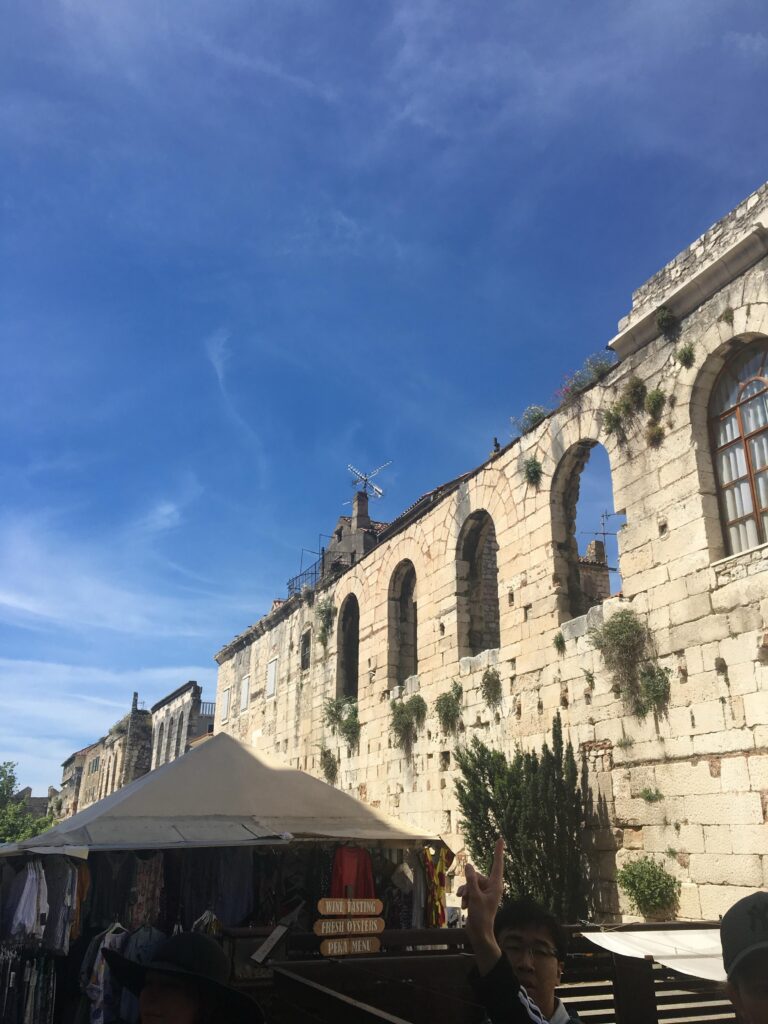
I drove from Dubrovnik down to Split where I walked the streets, stopping to take pictures of ivy crawling through crumbling brick windows, glass long gone, whose remaining half arch framed a sun-whitened sky.
I took a walking tour through Split, climbed a mountain to walk among the ruins of a castle where peacocks wandered. I took a second walking tour, which wound up being almost exactly like the first. I stopped listening to the tour guide. I thought about how loathsome everything was, how I could never get a handle on my life. That only I would somehow book the same walking tour twice, creating the very sort of mundanity I’d been trying to avoid. Same castle. Same explanations. Same peacock’s tails. Same life.
Diocletian’s Palace, which was built in AD 293 as a retirement home for the Roman Emperor, had been the place I’d wanted to visit in Split, the reason I’d thought of going there instead of Hvar. Of course, now that I had decided to skip Hvar, Hvar was all I could think of, those islands in the glittering sea, the chance of meeting a stranger, getting drunk and sharing the details of my life, the lover, the texts, the divorce, the children. All of which I’d passed up to take the same walking tour twice.
On the tour, I’d learned that I was already inside the thing I’d come to Split for. The Old City was set inside the ruins of Diocletian’s Palace. I’d been wandering around inside of it all day taking pictures of small purple flowers on the wall, listening to a violinist play in a crumbling courtyard. I’d already experienced the thing I’d been so desperately waiting for.
***
Every essay is an attempt, a fact stated so frequently in essays as to have become banal. But viewed uncharitably, all human activity is banal—making love, writing letters, petting a sun-warmed cat. As I was writing this essay, weeks after drafting, I saw pictures of a friend traveling through Portugal. I zoomed in on a singular photo, a castle, a view of the city below, peacocks strutting through grassy remains.
I realized I had accidentally transposed the trip I’d taken to Portugal with my second wife, years later, onto the trip to Croatia. The peacocks and castle I described above were not in Split, but Portugal. How had I misremembered? And it also makes me wonder how much of this essay has been true? Just a great film of memory.
The greatest of essayists, Michele de Montaigne, revised his essays over and over, changing his mind across twenty years. This is less an essay of the past than an essay of the present, remembered into the past. Back then, all I cared about was leaving the present, finding some imaginary future I’m now inhabiting as though my life is transposed backward and forward at one time, one overwriting the other, past and present meeting, as two rivers falling below a waterfall, separate and the same.
***
On my last night in Croatia, I spent the evening in a bar with locals, people who had clearly been coming to the same bar for months, years, decades, and I was the lone stranger, happy to sip a beer and watch their happiness unfold, insinuating myself inside it for a brief spell. But as I sat at the bar giving off the vibe of a lonely American traveler, I received a drink from the bartender, and he pointed to a woman seated at the other end. From her, he said. And I toasted and drank it before trying to slip back into the warmth of their conversation and my anonymity, which I desired and hated.
I wanted to be alone with my sad thoughts, alien to the world. After all, it was this very exclusion from the heart of life that was at the root of my sadness during those years. I kept feeling as though I was observing my life instead of living it, everything at the same remove I was now experiencing at the bar, and the shot from the stranger complicated that version of the story I was so fond of telling myself.
And besides, there was another woman in the bar, a dark-haired woman, who was the one I wished had bought the drink for me. And I imagined another version of my life, one where she would be the one who bought me the drink, she the one who wanted to talk to me. And even though this had happened often enough in my life by my late thirties, I told myself that it never happened, that I was always sitting at the bar wishing I was talking to someone else.
I got a second shot from the woman at the bar, and I moved down a few seats to talk to her. Even if she wasn’t the woman I wanted to be talking to, she was the woman who wanted to talk to me. And I have always desired in myself what others desire from me.
She was a ship’s captain, and she told me how hard it was to be a female captain in Croatia, and I loved listening to her, trying to jigsaw together a life entirely unlike my own. But as she spoke, her words began to slur, and I was no longer able to construct anything meaningful. We had the barrier of English; we had the barrier of too much alcohol. Soon enough, she fell off her stool, and she was whisked away into the night by an old friend, another man who had probably been going there for years, taking her home when the alcohol and sadness pulled her into the black hole of midlife.
And even though I hadn’t wanted her, still, I imagined how I could have been him, that she’d bought me the drinks, and he was now living the life I was supposed to be, an old Croatian sailor who always went home with the ship’s captain when the sound of the sea organ came for her.
But I had broken through the veil and was now included in the drama of the bar, a stranger to spice up their everyday lives, their night after night of drinks. I had become the curiosity I’d been looking for. For a night, I was able to play at being a part of Croatia.
As the night wore on, I chatted with other locals, people who’d lived in Split for decades, whose mothers and fathers had also lived in Split. Everyone was middle aged. I talked to the dark-haired woman I’d been staring at all night; she lived on a nearby island with her husband, who was much older. She had a son, seventeen, and she told me that she hoped he would leave the island, leave Split. She said that something was different with the new generations, that the life she’d been living and the life of her mothers and grandmothers was passing away. Everyone agreed. Something had been lost. It was time to move on.
And when our conversation ended, I watched her walk out into the night with her friend, a woman who owned a bookstore, a woman who said she’d loved to stock a book of mine if I ever wrote one, and I thought about the sort of person who would one day write a book, which was one of my great hopes then just as my great hope had been to leave with the dark-haired woman from the bar who lived on an island with her husband and teenage son. But I couldn’t enter that life either. Wherever I was, I found myself yearning to be somewhere else, with someone else.
On the last day of the trip, I drove north from Split and back towards Ljubljana, where I’d flown in. The whole country was covered in a swath of rain. The beauty I’d experienced on the drive down—the ribbon of the sea, the echoes of the sea organ—were gone. The sky was dark. Everything was ending anyway. It was time for all of us to go home and start clearing away the rubble before we moved on.

Andrew Bertaina is the author of the essay collection The Body Is a Temporary Gathering Place (Autofocus 2024) and the short-story collection One Person Away from You (Moon City Press Award Winner 2021). His work has appeared in The ThreePenny Review, New Letters, Prairie Schooner, Witness Magazine, and elsewhere. His work has been anthologized in The Best American Poetry, Best Microfiction, and was listed as notable in three editions of Best American Essays and as a special mention in the Pushcart Prize anthology. He has an MFA from American University and more of his work is available at andrewbertaina.com.