

Tricky Passages | Nancy Chapple
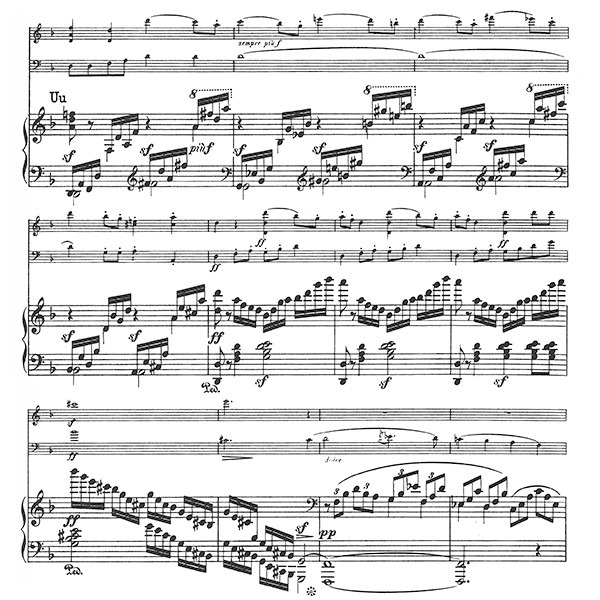
Most weekday evenings, Melik and I took practice rooms and applied ourselves to learning the pieces our teachers had assigned us that week. I’d decipher Alban Berg’s Piano Sonata chord by chord, and Melik would visit me, having had enough of his trill exercises on the violin. Soon we’d be kissing. But not on my piano bench, because someone might catch sight of us from the hallway. One of us would press the other against the wall, body against body. As we were the same height, we could switch smoothly from leading to responding, no discussion required.
During the day, between classes, drinking coffee while perched on the low white leather couches in the conservatory lounge, one of us needed only whisper a room number—“142,” “135,” “315”—to set the other trembling with excitement.
In the fall of 1984, Melik and I were master’s students at the Manhattan School of Music. We’d both signed up to play chamber music, and were allocated to a trio, together with a cellist from California. Within weeks, without much deliberation, Melik and I had become a couple.
During the day at music conservatory, we had orchestra and ensemble rehearsals, lectures, seminars, private lessons. That meant we usually practiced our instruments between seven and eleven in the evening. I’d sit by myself in a small room; others were practicing in rooms to my left and right, and sometimes above and below. I’d spent the evenings during my bachelor’s program in the same way.
Alone in practice rooms, we were occupied with our own lonely thoughts. For me: Tonight I have just got to crack this passage in the Debussy prelude! or Let me test whether I’ve memorized the first three pages of the Beethoven Allegro. Sometimes it was more a silent cry of frustration: How the hell will I ever be able to play these jumps across three octaves in the tempo Chopin was imagining? The worst was when I could hear my immediate neighbor jauntily flowing through the hard parts of a piece I myself was just starting—a Chopin Ballade, a Rachmaninoff “Moment Musical,” the fast movement of a Scriabin sonata. As I attempted to break the work’s technical challenges down into digestible bits, some unknown person was thumbing his nose at me from next door for even trying.
The practice rooms had double doors to muffle the sound, each with a small, high window. There were never enough rooms for the number of students enrolled, though singers and flutists and trumpeters could perhaps practice at home in their bedrooms. There were few pianos not yet dilapidated by sixteen hours a day of edgy, driven repetition. Thus, besides actually working at pieces, we students would roam the corridors, searching for a room—perhaps a better one—that had just become vacant.
Occasionally, fortunately, my practicing went smoothly for hours on end. I did love exploring new repertoire, gradually sensing what the composer must have intended with the notation in the score.
Until I took up with Melik, my boyfriends had had backgrounds similar to mine, differences only in the nuances.
My family is not exactly old money. There are no museum patrons among us, no one had a coming-out at a debutante ball, no summer houses were passed down through generations. There’s no tradition of attending Ivy League universities. But my great-grandparents and others before them were born in the United States, and most of us have attended college. A couple have passed the bar exam, and others became professors. Our cousins on the West Coast had horses, while we on the East Coast took music lessons. There were trips to Europe.
When I met Melik, there were two other men on the fringes of my life. Perry, three years older, had been my boyfriend in college. He’d recently started working as a lawyer. Once I, too, finished college, I joined him in his Greenwich Village studio apartment—we’d been planning the joint move to New York for years. Yet I was soon disenchanted, bored that our conversations repeated themselves, under-challenged by the dynamics between us. Within days after starting my master’s, I found an ad on the conservatory bulletin board that a professor’s family living kitty-corner from the institution was looking for an au pair in exchange for room and board, and I quickly moved in.
Perry remained tenacious, calling and reaching out. With a little distance, he hoped I’d change my mind and return to him.
Perry’s family was outright wealthy. His father owned and managed a couple of companies, and his parents, together with an architect, designed the house he grew up in. They’d paid for his university and law school, and bought him a car for the latter. His ease in splurging on little luxuries made me uncomfortable—though if asked, I couldn’t have said whether I felt indignant or envious.
The other man on the fringe was more of a chimera: a jazz pianist who was studying musicology. I’d met him during a college semester in Austria. He and I spent a number of intense nights together in Graz. Since my return to the States, I’d been writing Franz impassioned letters. He sometimes wrote back. But he was with another woman, and far away in Europe.
Franz’s father was a respected doctor. After Franz’s grandmother died, his parents installed him in her large, old apartment, complete with a Yamaha grand piano.
Neither Perry nor Franz talked about the money they’d grown up with. The privileges it enabled were simply present in their lives. They underlaid our relationships as well.
At age twenty-two, I’d already been living for five years in dormitories and apartment shares in Oberlin and Graz and now New York. I rarely visited my mother and stepfather in Providence.
Melik, twenty-four, still lived at home. Four years earlier, his family had emigrated to the United States from Armenia, ostensibly to develop Melik’s musical talent. His father, an engineer by training, worked in construction in the city, as did his younger brother; his mother was a homemaker. His parents struggled with English; his mother in particular was barely able to communicate with authorities or neighbors. Melik was the mainstay of his family.
I wasn’t aware of judging Melik for being a new arrival to the States, for not having expendable cash, for using expressions in a funny way, for remaining close to his parents. He was making himself into an American as best he could. It amused me to watch the transformation take place before my eyes.
Melik missed Yerevan, the city he’d left with his family when he was twenty. When their visas for America came through, he’d just started discovering the Armenian capital’s theaters, its cafés, its life of the mind. I was delighted that he was already convinced of the greatness of Shakespeare. I did laugh though, when he insisted that the Bard sounded better in Armenian than in English.
Once, he told me how he and his friends had listened to The Beatles in the 1970s, several years after they’d split up. (I too discovered them only after their breakup—are classical musicians fated to be behind the times?) They were fascinated by the song “Back in the USSR”—which they understood to mean “Fuck[in’] the USSR,” an ingeniously concealed dissident message for teenage Armenians sure of one thing: they hated the Soviet Union.
Melik had habits unfamiliar to me, habits I found somehow charming. On winter mornings, for instance, he warmed up the family’s two big used American cars (probably Chevrolets) for many minutes before setting off in one from Queens to the Manhattan School, while his father and brother drove to work in the other.
Between Melik and me, everything was much easier than with predictable Perry or faraway Franz. He was refreshingly free of neuroses: uncomplicated, possessed of an endearing sense of wonder about life. Melik enjoyed as well that I was openly comfortable with our sexuality.
I took care of two daughters for the family I lived with, and soon a baby son as well. They let me place a rented grand piano at the end of their living room; most days, after getting the girls off to school, I could practice on it for several hours. My bedroom with its own bathroom was nestled between the family’s rooms in their apartment in neo-Gothic university housing. At first, I sneaked Melik in, ensuring that he headed across the street to the practice rooms before the family woke for their morning routine. After a number of weeks, it seemed fine for him to stay overnight occasionally.
He was also soon accepted as a daytime visitor, one who bantered with the little girls and made funny faces to amuse the baby. The kids thought he was great—a bit stricter than I was, but very attentive. He was probably imagining our having children of our own one day.
When Melik told his mother he’d be staying with me sometimes, she expressed concern. I doubt his parents approved of sex before marriage. I imagine they assumed we were courting, and that an announcement of our engagement was merely a matter of time.
Melik brought me to Queens to meet his family. His mother served delicious home-cooked Armenian food: sautéed meat and finely chopped salad vegetables and fried okra, as well as rice pilaf, all on steaming platters on the low coffee table. Everyone squeezed in on the faux leather couch and armchairs. In the bathroom, I was astonished to see the laundry, including Melik’s familiar striped T-shirts, in a big bucket in the tub with a wooden stick protruding. “Yes, we’ve finally just about saved up for a washing machine for my mother!” he told me proudly. Back around the table, everyone smiled and nodded. As we could hardly understand one another, Melik interpreted for us.
Unfortunately, our trio was not ambitious enough as an ensemble to rehearse until we’d created a seamless, melded sound, as, for instance, great string quartets do. Melik and the cellist tinkered around to align their intonation, but it wasn’t enough. Nor were we three extraordinary soloists engaged in a brilliant colloquy. All in all, we were merely okay.
One problem was Melik: he had a good rhythmic sense, and there was a natural musicality to his lines. But though he could breeze through many of the passages, he smeared some of the high notes. And he didn’t apply himself to improving. With a sweet shrug he accepted that some phrases might go well, others less so.
I couldn’t play my piano parts in our trios perfectly either. My Mozart chords were not always smoothly voiced, the melodic line soaring above the rest, the other fingers just supporting it. In a fast movement of Dvorák’s Dumky Trio, I sometimes landed on a wrong note after a leap across the keyboard. But I could not accept my inadequacy. Late nights in the practice rooms I worked fiercely, almost desperately, fearing I’d never develop a surefire method to master the technical challenges. My regimen was a result of my upbringing. I felt guilty if I didn’t practice sufficiently, felt I wasn’t meeting my potential. I feared I wasn’t taking advantage of the education my parents had provided me.
As our two-year master’s program progressed, I continued to correspond with Franz in Graz, and then Berlin. When he wrote me back, he sometimes sent along books or sheet music—recent “discoveries”—so I did the same in return. I also met Perry occasionally in Manhattan. Once he stopped by the conservatory to say hello, and he and I sat on the low lounge couch. Melik walked by on his way to a rehearsal and smiled at me. The two men checked each other out. No sooner was Melik around the corner than Perry whispered, “What’s with the white shoes?”
Melik liked to wear his white tennis shoes together with polyester pants or jeans and a Lacoste shirt, its collar standing up. His T-shirts sometimes slipped out of the waistband; the jeans were not Levi’s or Lee’s or Wranglers. His tennis shoes were generic as well. Buttoned-up polo shirts, which, I’d come to understand, his mother ironed, covered up his hairy chest. Perhaps he picked up his fashion sense from professional tennis: he worked for years as an usher at the US Open in Queens.
I thought Melik’s look had a certain panache, though it was like no one else’s I knew. Why did my ex-boyfriend’s opinion, I wonder now, ring in my ears so strongly?
Perry wore suits for his work as a lawyer defending the city, keeping his tie on until clients and bosses had left for the day. Off work, he wore what we’d both worn at college: Levi’s jeans, sweaters in dark colors, nice shoes (his more elegant than mine). The items were deliberately chosen: not cheap, but never showy, a kind of uniform that said he had money, had attended a good college, but didn’t take himself overly seriously.
By 1985, Melik had stayed over many times at my au pair family’s apartment. We saw his parents occasionally, including once when Melik and I performed a schmaltzy piece by the composer Komitas for Genocide Remembrance Day at a Second Avenue church.
The time came to introduce him to my patchwork family, to my mother and two sisters, my stepfather and stepsisters. They lived in a suburb of Providence, in a house they’d bought together after they married. In my eyes, their house felt randomly furnished, belongings from their respective first marriages jumbled together; no renovations undertaken to make it their own.
We traveled up to their house, and dinner was served at the long mahogany table. My mother plied Melik with questions about his musical studies and plans. He acquitted himself well, polite and gracious to my mother and stepfather, solicitous of me. Given the rather stilted table conversation, Melik may have found the whole situation stiff and unfriendly. (Decades later, I’m reminded of the Easter dinner in Annie Hall with Annie Keaton’s well-off Gentile family, the grandmother imagining Woody as a shtetl Jew.)
My eighteen-year-old sister took me aside and said, “Your new boyfriend’s such a peasant!” She enjoyed getting a rise out of family members. I’d always bantered with her, steering gently in another direction when I could. Was she talking about the way he spoke? Fluently, but with vowels that didn’t sound typically American, and no “th” at all. Was she talking about his clothing? It couldn’t have been his manners, I was quite sure.
I did know, of course, that he didn’t have film star looks. When he approached me from a distance, I saw that he was hardly my height, beginning to go bald and growing a potbelly. (Glances at his father confirmed that both baldness and potbelly would progress.) But peasant?
Melik was the first in his family to become an American citizen. He was very proud, so I too saw it as a real accomplishment. “That’s so wonderful, darling!” I told him.
But as the master’s program drew to a close, as our final recitals approached, the question of whether Melik and I had a joint future became more nagging. He knew I felt no drive to settle down. He knew better than to ask me to get engaged. In addition, I had a dream I wasn’t prepared to give up for the sake of our relationship: to move to Europe.
Maybe I didn’t excel enough to take Carnegie Hall by storm, but what was to stop me from making great music where it was composed? I wanted to try my fortune as a classical pianist on the continent. In addition (this component of the dream probably consumed more of my emotional energy), I wanted to show up on Franz’s doorstep in Berlin, no matter that he was living with a girlfriend. Maybe he would finally commit to us. I looked into further studies, and applied for a scholarship.
Melik was fascinated as well by the beautiful European capitals. But he knew he had to stay in New York, close to his parents. They needed him. I encouraged him to read more complex books in English, hugged him when he received his new passport, discussed splitting the year between New York and Germany.
I had no master plan, no job offer pulling me across the Atlantic. I was simply set on moving.
Melik and I decided to spend a long spring weekend on Cape Cod, walking on the beach, eating seafood. In our little motel room, I exploded when I discovered an economy-size can of spray deodorant in his suitcase. I heard myself saying, “That’s so completely tacky! It’s impossible! Kinda like some of your clothes . . .”
Where did that come from? I’d never criticized him before.
We tried to go out for a romantic dinner on the last night, but conversation fizzled. I kept up the cold treatment on the long drive back to the city.
“Are you really that upset about the deodorant in my suitcase?” he asked as he drove. “It’s just something my mother bought because it was cheaper!”
I continued to stare out of the window on the passenger side. I shook my head to express disapproval, but didn’t utter a word.
“You said you were proud of me—what’s going on?” he asked.
Looking back across four decades, I observe how unaware I was that I’d internalized judgments about taste. My snipes were mean-spirited. Of course, Melik was only partially cognizant of the brand cachet I’d been absorbing all my life, simply by virtue of living in the United States, watching advertising, listening to the comments around me. Of course, his immigrant family didn’t have much money to spend on extras in the years right after their arrival. Now, I can hardly picture sitting next to lovable Melik for an entire five-hour drive, feeling smug about my criticism.
But I did want to wean him of his emotional dependency on me. Being his only girlfriend ever was too much responsibility. I encouraged him to acquire more sexual experience, declaring that I didn’t want to be his only lover. I thought our separation—or breakup—would be easier on him if he were less fixated on me alone. On a tour with an orchestra, he had a romance with a soft-spoken violist from the South. Tour over, he told her the liaison was also over; in his recounting, she was disappointed.
It’s only now that I can acknowledge how the unspoken (and sometimes spoken) messages about social class I’d imbibed my whole life shaped my conduct and my certainty that I did not want to marry him and have children together. At the time, I would have defended how he was living the immigrant version of the American dream, becoming a citizen, working his way up the economic ladder. I didn’t notice any duplicity in the way I was able to base my own life decisions on assets accrued over generations.
I did know implicitly, right from the beginning, that I could fall in love with Melik and enjoy the time we spent together—and yet I would never have been willing to introduce his Armenian family in Queens to my family as future in-laws.
I moved to Berlin, where I found work teaching English and accompanying musicians. Though Franz was glad to see me and our attraction continued to flare up when we met, he had no intention of breaking up with the woman he was living with. He did not see me as his great love.
When I visited the US the following summer, it was lovely to see Melik, so open to me, no reserve in his demeanor. He and I decided to give a long-distance relationship a try. He sent me letters, printed in lowercase on untidy pages, lots of misspellings. I taped photos of him to the wall beside my bed. I knew that his first languages, Armenian and Russian, had very different scripts, and that his English was not bad for a third language. But ultimately, I rolled my eyes, placed his letters aside, and set out to explore the city.
When a Berlin law student started to woo me, I took the photos of Melik down from the wall.
Throughout my forty years in Europe and two German husbands, Melik and I have stayed in touch. We meet every few years when I stop over in New York, usually for breakfast at a diner in Queens beside the elevated train. It’s an unpretentious place where the waitresses know him. He shows up in a big car. The Armenian woman he married two years after our final breakup was the daughter of family friends in Yerevan. War was raging in Armenia over Nagorno-Karabakh, then a devastating earthquake hit. They said she was lucky to get out. They own a house north of the city; its new garden patio was featured in the local newspaper.
He and his wife have three almost grown kids. Every time we’d meet, he’d ask me when I was going to settle down, by which he meant—have children myself. In my second marriage, I could almost hold my own, telling stories of my step-daughter.
Melik became a “cable guy,” selling TV and telephone packages to small businesses. His ease with himself and ability to banter with his customers, themselves often born outside the US, have made him a good salesman. He seems bemused by how kind fate has been to him. At this point, he tells me, he practices his tennis stroke more than a Bach Courante or a Kreisler encore. But I still sit down at the piano, returning to favorite works or embarking on new ones. Even after all these years, I’m still trying to master the tricky passages.
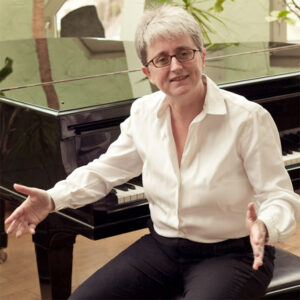
Nancy Chapple is a Berlin-based American who in her thirty-eight years in Europe has worked as a translator and interpreter, classical pianist, and co-director of a small, international business. She has recently published memoir at Caustic Frolic, BULL lit mag, and synkroniciti, op-eds in The Seattle Times, and a spoken word and piano essay on Shostakovich’s Preludes and Fugues in the Decadent Review. In the 2010s, she created and performed two one-woman shows: memoir interwoven with live piano renderings. She has also published essays in German at Berliner Gazette and Hard, a volume of short creative nonfiction pieces (“tiny truths”) in 2013. Her creative endeavors are presented at www.aptwords.ink.