

Waist Deep in the Mist | Paul Haney
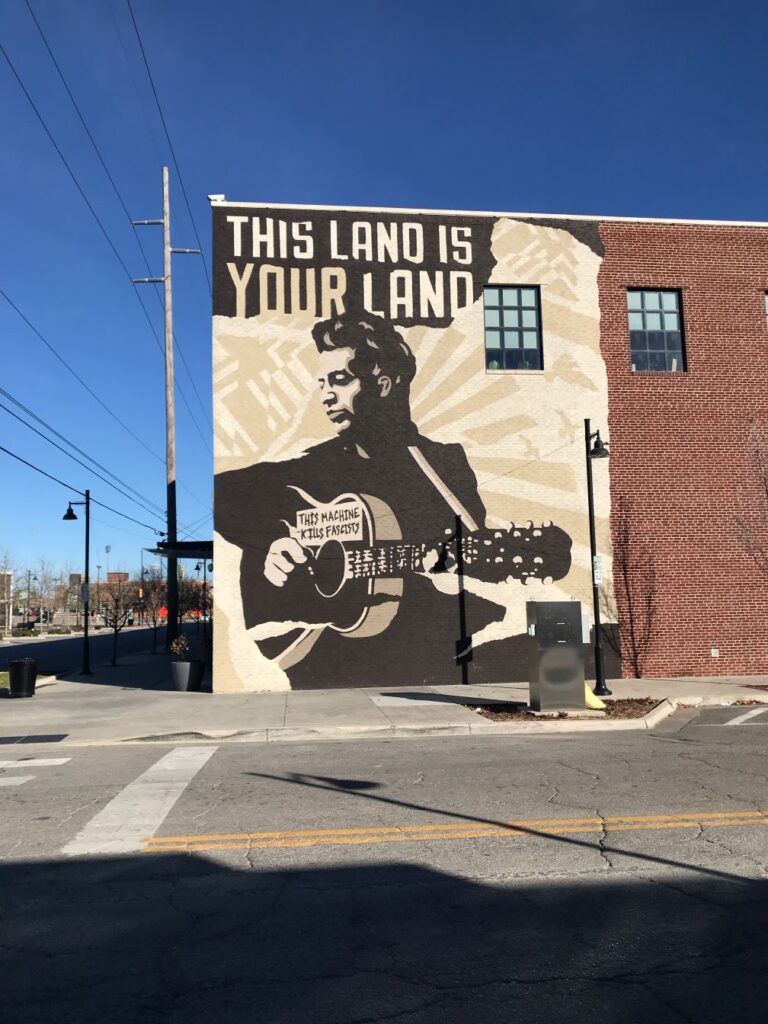
Guthrie Mural by Paul Haney
New Year’s Day in Tulsa, just past noon, you stand shivering before a mural of your hero’s hero, Woody Guthrie, his guitar emblazoned with the slogan “This Machine Kills Fascists.” Plastered over his head: “This Land Is Your Land.” You wonder, whose land? The thriving Black community decimated by white racists just blocks from here a century ago? The indigenous nations who lived here first? You just spilled from a cab with your hiking pack, so surely it’s not your land, except that you’re standing here now beneath a swirling gray sky. Tilting with the weight of the bag hoisted across your shoulders, you huddle into your red jacket, Native American embroidery across the back. The design—a fiery sun rising over a green river valley; an array of feathers blue and gray—makes you nervous, as you don’t claim any Native heritage. You don’t even claim all the parts of your own identity you know to be true.
You know they know. Everyone who knows you knows—gay, bisexual, queer. Still, you played the straight guy last night in Orlando, you and your hometown buds all throwing down like undergrads in your early thirties. Throughout the night, at a childhood friend’s house party, you rambled to the crowd about your impending research trip to the Bob Dylan Archive while chugging more keg beer than you’d meant to. You crashed on a futon, your alarm going off in the early morning when you staggered awake, hurrying to make your flight. On the plane, head pressed against the window, you soaked your bedraggled self in Dylan’s late-era—1997’s Time Out of Mind; 2001’s “Love and Theft”—so the songs will be fresh on your mind tomorrow in the archive. When you hit the freezing jetway in Tulsa, you realized you left the jacket you brought from your Boston apartment back in Orlando, the last place anyone would need it.
What a great start to the year.
From the Tulsa airport, you took a cab to the nearest Goodwill and found this red replacement, suspiciously cheap, the only one that fit. With time to kill before you could check into your Airbnb, you took another cab to the Woody Guthrie Center, closed for the holiday. Now you’re on the sidewalk and, with freezing temperatures predicted all week, the jacket’s fleece lining is proving surprisingly warm.
Otherwise, the Tulsa Arts District streets are empty. After the congestion of Boston and Orlando, you find yourself amid a strange urban quietude. Coupled with a billowing hangover, everything feels eerie, distant, like Dylan intones in “Cold Irons Bound”: “waist deep in the mist / Almost like I don’t exist.” That almost is important: the part of you still here feels every ache and chill, every flicker of the breeze.
On one of those frigid draughts comes music, soul music, from two blocks away. You follow the sound to Spinster Records.
“Come on in, dude. Welcome,” says the clerk as you open the door. “What’re you getting into today?” A college-aged guy with frizzy hair grins from behind the counter. Nice smile, bright eyes. Records line the walls and racks stretch into the back and up a staircase.
“Just hit town,” you say, the store’s heat thawing your cheeks. “I’m here to do research at the Bob Dylan Archive.”
“Way cool,” the guy says. “Want a beer?”
Though you’re not used to store clerks offering you drinks, you’re suddenly desperate for the hair of the dog. He pulls a Coors Lite from the mini fridge.
You thank him, pop the tab, and take a slug. The lager goes down like water compared to last night’s IPA. You tell him your name. His is Gabe, and he’s a journalism major at the University of Oklahoma.
“For music,” Gabe says, “Tulsa is the best place in the world.” He names some local legends: Leon Russell, J.J. Cale, Bob Wills. Just two months earlier, he says, Dylan played in Tulsa, a show he reports was “so good.”
You smile and nod, especially when he says he’s going to put on a Dylan record, and that you should make yourself comfortable on the couch upstairs.
Beer in hand, you mount the stairs and find a red couch among the used racks. As you sling down your bag, Dylan starts singing, but you don’t recognize the song. You’ve listened to every Dylan album; you’ve spoken with authors and archivists; you’ve made it almost all the way to the archive, and here’s a track you’ve never heard—something fluid and bluesy from the early ‘70s, if your ears don’t deceive you.
If you don’t know this song, can you even call yourself a Dylan scholar? Can you even claim to be a fan?
This anxiety, you realize, is part of the hangover, and the hangxiety lifts with the beer and the rest of the record. Later, you’ll search a couple memorable phrases and identify the song as “Watching the River Flow,” produced by Tulsa’s own Leon Russell. But when you return to the counter, you don’t tell Gabe about the unknown song, just like you feign recognition when he names a bootleg track—“Teenage Dream”—as his favorite. No, you act the expert—and you try, in your own feeble way, to ask him out.
“Do you know of any shows this week?”
“Yeah,” he says, and names a couple venues.
“You going to be at any of them?” By which, you’re hoping to suggest, the two of you should meet up.
Gabe shrugs. “I’ll be around.”
Then you see, Gabe’s friendliness is a posture—an attitude—not an invitation. He’s not going to be your guide, or your guy, and as that understanding settles in, two young women push through the door.
“Come on in, dudes,” Gabe says. “What’s going on?”
You slip out behind them, feeling uplifted if ultimately rejected. And there on the sidewalk, another rejection smacks you from the night before, back in Orlando. You were taking a break from the party, leaning on someone’s car. Midnight had passed. The smell of gunpowder hung in the air. A friend from high school walked by—more of an acquaintance, really. She said goodnight with a wave, jangling her keys.
“How about a New Year’s kiss?” you said with a slur. “You know, for good luck?”
She stopped and looked at you, searching. Without a word she kept walking to her car.
Performative masculinity. The fig leaf of heteronormativity. Exactly the ideals you meant to leave behind.
*
You find your Airbnb in a drab concrete building a few stories high near a pizza shop, a barbecue restaurant, and a donut bakery. The third-floor loft is perfect: full kitchen, walk-in shower, dark bedroom.
Perfect, that is, for hosting men.
In Boston, you’ve started coming out to your closest friends while pursuing covert dates and queer hookups. Those activities have brought you as much pleasure as fear, even if the writerly, academic circles you belong to offer a world of liberality. In those environs, where overt straightness is most abnormal, you finally came out to yourself, and now you’ve grown impassioned, eager—horny. Over five nights in Tulsa, you hope to wrangle up some fun.
While showering, unpacking, putting on fresh clothes, you swipe and chat. Meanwhile, you check your directions to the archive and realize it’s four miles away. You’d planned to walk there each day, or take a bus, or use a bike share, but not at that distance, and not in this cold. You’ll need a rental car after all. There’s an Alamo a few blocks over, and as you head there in the waning afternoon, you swipe through men with a freezing thumb. After securing your four-door compact, you shop for raisin bran, almond milk, bananas, and some local craft beer, phone handy as you block messages from men who don’t appeal. To those who do, you try to present yourself as suave and desirable. Here for the week, you tell them: no strings attached. Back at the loft, on the leather couch, you stretch out with the Dylan archive on your mind, but all the while you’re curating your own archive of pics, chats, and profiles.
In the morning, you drive north through a hilly, dormant landscape and park in the lot between two structures—the Helmerich Center for American Research, which houses the archive, and the sprawling Gilcrease Museum. Beyond, the Osage Reservation occupies a rural valley with the Arkansas River snaking through.
You’re half an hour early. Car’s heat blasting, you’re so antsy you don’t even take out your phone to check the apps. Each minute that ticks by deepens your concern that four seven-hour days, with a break for lunch, won’t be enough. When Mark, the archival librarian, appears as promised at 10 a.m., you hustle from your car.
A slight guy around your age in black-rimmed glasses, black jeans, and a hoodie, Mark leads you through a glassy entry hall, over to a locker where you stow your belongings, and into a reading room where two long wooden tables stretch over beige carpet beneath halogen lights, rolling chairs all around.
So bright and antiseptic. So unlike Dylan.
Four collections share this space, and at the far end of the room are offices behind glass walls for the librarians. All the while Mark talks about copyright—how the “Dylan camp” recently sprang into action because a researcher posted findings to a message board. Dylan’s people are poised to pounce, and Mark is caught in the middle. Before handing over any manuscripts, he calls it his duty to “put the fear” into you.
Just what you need: more fear.
The copyrights belong to Dylan, and he and his people only want the archive used for scholarly projects. You’re writing personal essays, a memoir, immersion journalism, all rooted in Dylan, and all of which could be construed as a kind of scholarship, even without citations and a reference page. Lately your writing has circled around the creative process of Dylan’s late era, when he lifted lines from countless books, obscure poems, old-timey songs—even a New Orleans tourist brochure. During that time, 1997-2006, he shifted his lifelong habit of borrowing from other texts and melodies into hyperdrive, reinvigorating his career. You find it mesmerizing how he transforms a source text into something new, reinventing as he goes, and you’re here to find clues about how that process works. In any case, now is not the time to discuss what qualifies as scholarship. You’re too close to the pages for that, too anxious to get your hands on them, so you simply affirm to Mark you understand, take your seat, and ask to begin with Time Out of Mind. Mark slips through the metal door in the room’s far corner, returning with a box.
“Here’s ‘Mississippi,’” Mark says, sliding over a manila folder of papers sheathed in Mylar before dashing back to his office. Door open, he types while he talks on the phone. From the copyright infringer he coaxes apologies; to the Dylan camp, he offers reassurances. Point taken, you train your focus on the five handwritten pages in front of you: the notes, lines, and lyrics that eventually became “Mississippi.”
First attempted for Time Out of Mind but not appearing until “Love and Theft,” “Mississippi” is one of your all-time favorite songs. Since its release your senior year of high school, you’ve relished its languid arrangement, melodic blues, and scratchy couplets balancing desire with demise. “Only thing that I did wrong,” Dylan sings in a resigned drawl: “Stayed in Mississippi a day too long.” Now a glance at the manuscript pages reveals Dylan culled the lyrics you know by heart from a much larger mass of words. No final draft appears; rather, four smaller pages—yellowed at the edges, splotched with smoke and ash—and a near final draft on unlined printer paper. Before you lies the messy evolution of your favorite song.
You make your best guess at the chronology and find, in the early stages, Dylan seems to spill his thoughts indiscriminately across the page. Over time he picks out workable phrases and lines, couplets and eventually verses. As the lyrics take shape, he jots alternate phrases in the white space. He rarely crosses out, instead including potential substitutions in parentheses. Often, he cordons off sections with slashing and curving lines for digressions and minutia. Sometimes prominent names and their phone numbers appear—like Al Kooper’s here in “Mississippi.” You’ll come to recognize these hallmarks of Dylan’s writing as you work through the folders.
Over the course of the “Mississippi” drafts, Dylan lights upon a second person “you.” Initially, Dylan tries to flesh out that “you” as a beautiful woman, drawing a link between the stagnant, often suffocating nature of time and the snugness of the woman’s dress. He traces in language her physical features, but despite his best efforts, he can’t quite get her down. The frustration eventually leads him to pen a stanza that, on the album release, shines:
My powers of expression
Thoughts so sublime
Could never do you justice
In reason or rhyme
This humblebrag situates the speaker’s lyrical prowess alongside a helping of humility. In terms of the beautiful “you,” the speaker has overextended himself. Time and the body don’t readily mix, though within that struggle lies poetic inspiration, as evidenced by the pages.
The margin notes are especially difficult to read, Dylan’s tiny handwriting a scrawl of jagged lines and open loops. In the “Mississippi” margins, though, you recognize a few lines from a different song: “Tryin’ to Get to Heaven,” which references not Mississippi, but Missouri. An abbreviation Dylan used could reference either state. You wonder which state he meant, and you even pose the question to Mark when he brings you the next folder.
“We could call him,” Mark quips, which means, of course, you can’t call him, and even if you could, he wouldn’t say. You decide, then and there, for the rest of the week, to keep your insights to yourself.
*
The daytime imperative to keep jotting notes gives way, in the evening, to another urgency: to make use of this Airbnb. It’s not lost on you that, in this town of strangers, you can swipe for women too. Whether bisexual still fits your true desires, or simply describes your sexual and romantic history, is hard to say. And why stop at bi? Why not pansexual? Omnisexual? Why not make a choice and be gay, just like you made the tortured choice to be straight throughout your teens and twenties? The more you interrogate any sexual category, anyway, the more it falls apart. All you know is, for now, you want men. And you can have them without anybody having to know.
In Boston, you never seem to run through all the profiles on Tinder within ten miles. Here in Tulsa, you’ve already exhausted all the guys within twenty-five. You’ve made a dozen matches, with some chats in progress. These men are thirsty. Many live in the country but are willing to drive into town. On Grindr, you see some of those same men, and they see you, or at least your unveiled headshot. They always ask for more: body pics, dick pics. It’s a sleazy, slimy world in those messages, but sometimes the sleaze is exactly what you’re after.
That night, you connect with a guy a couple miles away. Sleek face, neat beard, slim build. The conversation progresses through greetings and pictures, and you find yourself inviting him over. He’s there in minutes, pacing the block as you peer out the lobby window to see he’s older than expected, bonier, features more sunken. You lock eyes, and he gives an inquiring wave. With a nod, you open the door.
A cold nicotine musk trails him inside. On the elevator, while you talk about the weather, you keep appraising him, this situation, whether you want it, want him. By this point though, it feels rude and risky to turn him away.
Inside the apartment you offer water, beer. He declines. You share comments about the place, the view. He can almost see his own building from here, but then he’s standing in front of you, kissing you, undressing you. It’s all too much. You turn from his mouth but he goes down on you, and you might as well get this over with so you back into the bedroom where he simply devours you. You finish all over him and he finishes all over himself and you help him with the towel but otherwise grow quiet. He seems to take the hint because he’s dressed and then he’s gone.
*
A sadness accompanies you the next morning to the archive. Sadness over giving yourself half-heartedly to a stranger, and sadness for the stranger, too, so stealthy and swift. You know the stereotype of the lonely queer, and you hope your own future holds more than covert missions for anonymous sex.
In the reading room, Mark whisks around in his black attire, feeding you one folder at a time. Next on your list: “High Water (For Charley Patton),” the apocalyptic centerpiece of “Love and Theft.” You attempt to put the pages in order, to retrace the process from inception to completion, all while straining to read Dylan’s scrawl. With each folder, your notebook fills while your understanding of Dylan’s writing process grows.
Dylan splatters lines across the entire page. Verses emerge more solidified with each subsequent draft. He often goes back over his work with a different implement—black ink over blue, pencil scribbles between inky trails. He seems to carry these drafts on tour, too, sometimes using hotel stationery: New York City, Tokyo. In his 2004 memoir, Chronicles, Volume One, Dylan describes “a certain consciousness of madness at work” in his songwriting. Here in the archive, you see what he means. Each song contains an avalanche of words—not just whimsical rhymes that spring to mind, but an excavation of the mind itself, a voluminous riff on a feeling.
That excavation dredges up Dylan’s self—his personality—but also what he’s read, what he’s listened to, where he’s traveled, all heightened by the felicities that occur when a writer packs language so tightly together.
Through a commitment to the creative process, Dylan brings these songs to life, then breathes new life into them on record and on tour. Such is the project of his career. Your own project, meanwhile—that of your selfhood, your queer identity—likewise requires a full commitment to unfettered exploration. Last night was a step, at least, toward self-discovery. But largely, for now, the fetters remain.
*
Later that night you slip on your red jacket and stride several blocks from your Airbnb, past the Woody Guthrie mural and through the arts district to a place called Bicycle Bar. Sweaty hotdogs spin on racks inside a heater. Sultry music throbs for the few patrons here on a Wednesday evening. That Woody Guthrie motto—“this land is your land”—adorns the register, and a rainbow flag hangs over the entrance. Even so, you’re wary about meeting this guy, Ben, from Tinder. Not because you fear hostility, but because when you’re on a date with a man, onlookers can tell you’re queer. Your queerness still feels dicey, unstable, especially in these unfamiliar grounds. You continue to find safety in your music-loving, beer-guzzling, straight-passing self—the one you’d put on for the party in Orlando. Learning now to embrace your queerness is discomfiting. Even if you know most people are too busy thinking about themselves to look or care, public acts of queerness still freak you out.
Ben saunters in, tall and freshly shaven. He wears a backwards ballcap, long-sleeved T-shirt, skinny jeans. You shake hands and he slides onto the stool beside you, seeming relaxed as he orders a beer. From your chat on the app, you already know Ben’s a graduate student in Ohio studying urban planning. He’s from Tulsa though, home for the holidays.
“And you’re working in the Bob Dylan Archive?” he asks. “Why’s that in Tulsa?”
“To be near Woody Guthrie,” you answer. “Dylan’s hero.”
Ben nods.
“And because this billionaire supposedly bought Dylan’s collection for twenty million dollars.”
“Ah yes,” Ben says. “George Kaiser,” and he tells you about the oil magnate pouring money into the Tulsa arts scene.
You love talking to academics, so full of information. Ben doesn’t know much about Dylan, but he’s interested. And he’s ready to talk transportation, infrastructure, green energy, though his focus is water drainage. These topics carry you through another round and over to a saloon with a grand wooden bar. Men throw darts while busty women perch at high tops. Ben finds two stools amid the crowd. You admire his confidence, his nonchalance, especially as he orders whiskey shots with your beers, and even more so when he leans in for a kiss.
His lips are soft, his hand on your thigh.
You ask, “Should we go back to my Airbnb?”
Ben ushers you into his parents’ Cadillac SUV and drives the few blocks. Parking is easy. Within minutes you’re inside, boasting that a one-bedroom apartment like this, in downtown Boston, would cost a fortune.
Ben peeks into the bedroom. “Not an apartment, actually. A studio, because the bedroom would need a window.”
God, the knowledge on this guy. With Native American heritage, he even identifies the design on your jacket as Osage. You half expect him to reprimand you for appropriating his culture, but instead he scoots up next to you on the couch. You run your hand along the back of his neck, along his hairline, up under his hat which pops off and he frowns. His hairline is receding, but so what? He says, “should we go to the bedroom?”
You get him out of his shirt and run your hands along his muscles.
“Damn,” you say. “You’re sexy.”
“You are too.” Now you’re both out of your clothes, kissing, groping. He’s only the sixth or seventh man you’ve been with, including last night, so you’re still feeling your way around, revising your approach. When you finally fall back sweaty on the bed, it’s well past midnight. He spoons you from behind.
“Just so you know,” Ben whispers, “I’m going to come again before I go.”
Soon you’re back at it, throwing off the sheets. And then he has to run, because his parents need the car. He slips out as the morning sun begins to fill the loft with light.
*
Thursday in the archive you’re worn out, but happy. You jot fewer notes, and you linger over your grilled chicken sandwich and sweet potato fries in the museum cafe. After poring through Dylan’s late-era manuscripts for two and a half days, you’re not sure how much more you can deduce about this creative process you started puzzling over at least a dozen years ago, back in college.
As an undergrad, while reading Adventures of Huckleberry Finn, you came upon a line—“the wind was trying to whisper something to me, and I couldn’t make out what it was”—and recognized it from Dylan’s “Lonesome Day Blues.” That same semester, you realized he also borrowed from The Great Gatsby, whose title character exclaims, “‘Can’t repeat the past? Why, of course you can!’” That line shows up in “Summer Days,” from the same album, “Love and Theft,” which includes quotation marks around its title assumedly in reference to Eric Lott’s 1993 nonfiction book, Love and Theft: Blackface Minstrelsy and the American Working Class. Those borrowings are one thing, hardly coy coming from Twain and Fitzgerald. But when an English teacher traveling through Japan in 2003 picked up Junichi Saga’s 1989 biography, Confessions of a Yakuza, and found lines Dylan later used in its pages, accusations flew.
“Wussies and pussies complain about that stuff,” Dylan shot back to Rolling Stone’s Mikal Gilmore in 2012. “It’s an old thing—it’s part of the tradition. It goes way back.” Then, folding in those who called him “Judas” in the ‘60s: “All those evil motherfuckers can rot in hell.”
“Seriously?” Gilmore exclaimed.
Invoking the “folk tradition,” Dylan doubled down: “I’m working within my art form… It’s called songwriting. It has to do with melody and rhythm, and then after that, anything goes. You make everything yours. We all do it.”
And Dylan has kept doing it, with scores of sources woven into his lyrics, his memoir, his artist’s statements—even his Nobel Lecture, which includes passages cribbed from SparkNotes as it recounts the plots of Moby-Dick, All Quiet on the Western Front, and The Odyssey. In all cases, the borrowings go unattributed. But Dylan keeps producing essential work, so what’s the problem? Although you recoiled in your early twenties, you’ve come to view the ethics of Dylan’s borrowings as a non-issue—a function of modern copyright law encroaching on an age-old creative process.
What fascinates you more is how Dylan incorporates these source texts. Even the album version of “Mississippi” contains phrases cribbed from a book of poems by Henry Rollins, the hardcore punk rocker: “It should start to get interesting right about now,” for one, and “You can’t come back, not all the way.” Before arriving in Tulsa, you imagined there might be word banks, or arrows, or literal pastings in the manuscripts, yet the borrowed phrases look just like the rest. The archive doesn’t reveal how Dylan transforms scraps from other texts into song.
Daniel Lanois, the irritable producer who imbued Time Out of Mind with its swampy sound, once said that when Dylan read him the lyrics to the album, Dylan felt “the record was written.” The songs just needed rhythms and melodies. In that light, these manuscripts are the album in progress. Yet it’s virtually impossible to know why some lines make it to the next page—or next song—and others don’t. You don’t have access to the tune in Dylan’s mind. You can only refer to what he released. As much as the pages reveal, they don’t portray the musical proving ground inside Dylan’s brain.
With questions of Dylan’s borrowings proving uncrackable, over lunch, your thoughts shift to Dylan’s drafting process, and whether he’s always revised so intently. Back in the reading room, you ask Mark for selections from previous decades. In pages from 1985’s Empire Burlesque, you find Dylan undertaking immense revision, even for a synth-heavy album that stands as one of his most maligned. The ’70s show less process work, though you feel a jolt when a lost verse from “Tangled Up in Blue” portrays the speaker contracting a venereal disease. In samples from the ‘60s, there’s even less rewriting. Despite Dylan’s reputation for spontaneous genius, he’s always revised. He just seems to have done so more concertedly as his career has progressed.
On 60 Minutes in 2004, Dylan told Ed Bradley his early songs came to him “right out of that wellspring of creativity,” as if he’d been a spigot for some eternal flow. “I can do other things now,” Dylan said, “but I can’t do that.” Those “other things” must include the linguistic collages he now constructs, brainstorming and borrowing with abandon. Whereas Dylan once “gazed into the gray mist with tear-blinded eyes and made up songs that floated in a luminous haze,” as he wrote in Chronicles of his ‘60s output, he later developed a different, more arduous method, one that brought him Grammys, an Oscar, number one records and accolades galore, all past the age of fifty.
Youth’s energies dissipate with age. What once worked instinctually doesn’t work anymore. There’s no way for you now to pursue life as a straight man, engaged in straight relationships, one day culminating in a straight marriage. In the confines of straightness, you no longer exist. Yet in the gray mist before you hovers an enticing possibility: that of rewriting yourself into a broader spectrum of being. Dylan’s reinventions must lead the way.
*
It’s 10 p.m. when you pull up to Tulsa’s Mercury Lounge, a charcoal-painted club. Inside, a dozen people mill around in the dim light. These men aren’t the kind you’ve been swiping for on the apps, trim and furtive. They wear jeans and work shirts, scruffy beards and ponytails. The women wear brimmed hats and sparkly tops. Beer pitchers and plastic cups crowd the tables. The jukebox pumps Otis Redding and a bartender yells, “Welcome to our bar. It’s gluten free.”
Do you look like the gluten-free type? Now you’re self-conscious, and you wish Ben were here. Mark is nowhere in sight, even though he mentioned this show earlier as one he might attend. Gabe, the record-store clerk, isn’t here either, so you won’t be tempted to flirt with the undergrad. Beyond this roadhouse crew, the only other people in the place are two guys sitting on the other side of the bar sipping pints and vape pens. You take a stool between them, order a local IPA, and watch the band set up.
Otis morphs into the psycho sounds of Danzig and Reverend Horton Heat. You’re tempted to check the apps, but you’re not hosting tonight. It’s late already, and you have one last day in the archive. More accurately, your night with Ben has, at least for now, quenched your thirst.
Two women glance at you from across the bar. You know what you’re supposed to do—go say hi, see what clicks. You’re well acquainted with these kinds of people. Drinkers. Music lovers. Bullshitters. But it’s your own bullshit you’re still hung up on. The desperate drunken plea for a New Year’s kiss. The whole knotty ball of coded behaviors you’re still performing so that no one will call you a loser or a fag.
At 10:32, the frontman says, “It’s ten o’clock Tulsa time,” and the three-piece band eases into some honky-tonk. The drummer sets a two-step beat. The bass player plunks his thick strings. The guitarist twangs out a solo, fluid and mellow, just enough hitch to catch your ear. They stutter-step into Stevie Ray Vaughan, shuffle into J.J. Cale. The two women peer back at you, cups empty. Maybe they’re wondering if you’ll buy them fresh drinks. You’re wondering what Ben thinks about the Tulsa sound.
With an itch toward your phone, you want to see what Ben’s doing. But you know, after last night, you both need time to regroup. This is the cooling off period. Still, you wonder if the cooling off won’t last longer than your time left in Tulsa.
And then what? Long-distance dating? Video chats between Boston and Ohio? Visiting each other’s cramped apartments, roommates and all? You can’t even muster the courage to bring men home in Boston. How would it work to fly one in from the Midwest?
That’s when you realize, there on your barstool, this far-flung anonymity isn’t bringing you freedom—it’s hemming you in. You’re no more free to pursue happiness with your fellow queers than you are to walk out of the Bob Dylan Archive with the “Mississippi” manuscripts tucked under your arm.
The Dylan Archive, the dating archive. Either way you’re just rummaging around. Getting to an open, honest relationship with any individual is going to take coming out, staying out, letting everybody in. It’s going to take an overhaul of who you imagine yourself to be.
*
On your last day in the archive, Mark’s dressed up in slacks, a suit, and a tie. There’s a group coming he refers to as “the people from Tulsa,” and he sets you up at a computer against the wall. Soon you’re wading into some thirty takes of “Mississippi” from the various recording sessions while the green afterimage of Dylan’s scribbles float across your eyes. After three days of transcribing, you welcome the change.
Early recordings from Oxnard, California, feature a rudimentary melody and Lanois’s voice providing encouragement between takes. Claiming too many distractions too close to his Malibu home, Dylan relocated the sessions to Miami in January 1997. Between them, Dylan and Lanois brought in a swarm of musicians. In the tapes, Dylan keeps tweaking the lyrics while the percussion struggles to find the beat and a hyperactive accordion buzzes in. Ten days later, they try “Mississippi” again with even more instruments: a steel guitar, an organ, a shaker. They attempt the song as a dirge, a shuffle, as country blues. The rise-and-fall of the bridge takes shape, but Dylan complains that the arrangement is too upbeat. Five days later, the group mellows out, Dylan still tinkering with the words. Lyrics from “Tryin’ to Get to Heaven” sneak back in, along with some apocalyptic imagery. The struggle is palpable, along with the determination to get it right.
In the end, they don’t get it right—at least not for Time Out of Mind.
You know, of course, the song eventually did turn out for “Love and Theft,” with Lanois gone and Dylan producing under the pseudonym Jack Frost. Meanwhile, the librarians are laying materials across the tables. Old papers in plastic sheaths; artifacts in clear, protective cases. Mark hauls in the tambourine that inspired Dylan’s “Mr. Tambourine Man,” as big as a large pizza, and the leather jacket Dylan wore when he “went electric” at the 1965 Newport Folk Festival. After arranging the items, along with photos, postcards, and manuscript pages, Mark heads back to his office, and the People from Tulsa come through mid-afternoon. Their docent, a peppy guy with a white shirt and tie, talks them through the artifacts. You slip off your headphones as he points to Paul Revere’s permission slip to move about Cambridge before his famous ride, papers from the George Washington estate, documents pertaining to the Emancipation Proclamation. While the group surveys the tables in sports coats and dresses, you click on another track, returning to your task.
The band has just crashed into another take when one of the tour guests exclaims, “What the hell?” She huddles over those Dylan manuscripts, forehead scrunched as she reads aloud a bewildering line about discolored teeth.
“He’s Bob Dylan,” the docent chimes from across the room. “He can write whatever the hell he wants.”
On cue, Mark springs from his office. He gestures to the lyric sheets from the ‘60s replete with “coffee stains, cigarette burns.” In an aside, Mark says, “Dylan’s writing process has stayed consistent through the years.” You nod, knowing he’s kind of right.
When the group clears, Mark welcomes you to have a look. Photos from the Rolling Thunder Revue. Postcards from Allen Ginsberg. Dylan’s ‘60s wallet containing Otis Redding’s business card and Johnny Cash’s phone number. The oversized tambourine and, of course, the leather jacket.
It’s smooth, its edges trim, its collar high. It would be too small on you, though Mark could probably wear it. That garment helped Dylan usher in a new phase of his career, and with that thought you turn back to your station. You slip on the headphones and flip back to your first day’s notes—that lyrical problem of the “you,” the beautiful woman with the too-tight dress. After struggling to summon her in draft after draft, Dylan lands on a solution. In the final version, he puts the clothes on himself:
My clothes are wet
Tight on my skin
Not as tight as the corner
That I painted myself in
You’ve always loved that verse, Dylan calling attention to his body, which never garnered the fame of his voice or his brain. But now you see, in a world of despair, with a “sky full of fire” and “pain pourin’ down,” the speaker faces not just outer conflict, but inner reckoning. External pressure catalyzes his internal transformation, but only because he’s open to the process. The outer can cling ever more tightly to the inner, until it sits on the surface of the skin. Through sheer will and persistence—and despite painting himself into a compositional corner—Dylan manages to put the clothes on himself. He comes to wear his own song.
It dawns on you then, the lesson you came here to learn: if Dylan’s error was staying in Mississippi a day too long, yours has been staying silent about your queer sexuality for that long and more.
For now, you’ve got writing to do. And even if the Dylan people will eventually, as expected, withhold permission to quote your archival findings, the truth you generate will transcend that request. You’ll come out, marry a man, buy a house and start a life, Bob Dylan ever wailing from the home stereo. You’ll tuck that Osage jacket—sun burning, feathers flying—in your spare closet, even if it never fully feels like yours. Their land will never be your land, not exactly. Yet as time piles up, the jacket’s crimson sheen will remind you that your own stores of persistence are enough—have always been enough—to rewrite yourself, over and again.
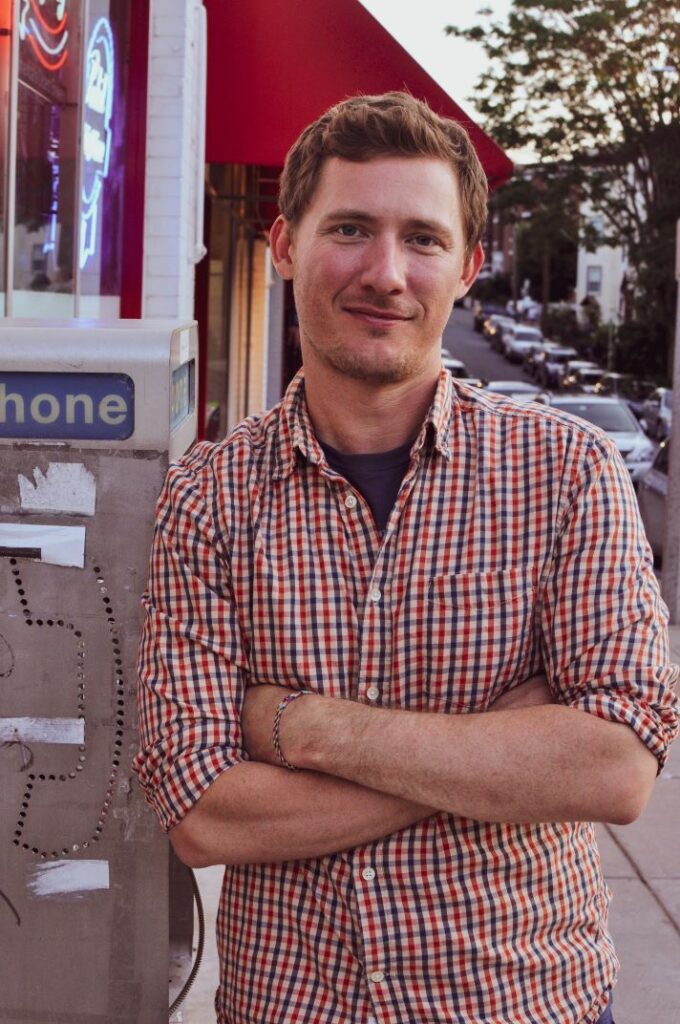
Paul Haney is a writer and educator in the Boston area, where he earned his MFA from Emerson College. His work has appeared in Slate, Fourth Genre, Cincinnati Review, Normal School, Sweet, and elsewhere, and his Bob Dylan writing in The Rumpus, Potomac Review (Best American notable), Hobart, Glide, and the anthologies Multitudes: Teaching Bob Dylan (Bloomsbury 2024) and Bob Dylan in the 1980s: A Reconsideration (LSU Press 2027). Former Editor-in-Chief of Redivider, he now serves as Executive Editor of the Dylan Review while developing his memoir-in-progress, No Secrets to Conceal: Coming Out with Bob Dylan. Follow him @paulhaney.