
Originally published April 21, 2025
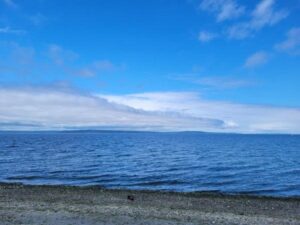
I’m riding the ferry Tacoma between Bainbridge Island and Seattle, crossing the Puget Sound. It’s part of my usual commute between home and the office, aboard a ship bearing an anglicized version of the Puyallup name for Mt. Rainier. It means “the mother of all waters.” Most days the sky is a cloudy white, blurring my view of the mountain, but on days when the sky is blue and the water is blue you get a clear view of her snowy slopes. Sing me the blues of this sky and sea forever. I promise I won’t ever get tired of it.
I’ve written a poetry book on this boat, tasting salt on my lips and smelling the oyster and seaweed stink of the Sound. I can smell fresh popcorn, clam chowder, hot coffee, and hoppy IPAs from the galley. Looking out the window I might see an osprey dive, a heron spearing fish in the shallows, cormorants rocking on the buoys, or seagulls sparring with crows. When it’s nesting season, I glimpse a pair of kingfishers perching on the dock pilings.
I climb the stairs to the sun deck, where I can see Mt. Rainier in the south and Mt. Baker due north. Green foothills rise behind Bainbridge Island in the west, and Seattle’s skyscrapers stab the eastern sky. A seagull struts on the deck.
Puget Sound is sandwiched between the Cascades and the Olympic Mountains. Like the fjords of northern Europe, it was carved out by glaciers. Scandinavian immigrants settled here because it reminded them of home. For the Suquamish and Duwamish people, it was already home, and still is. Many generations of people have lived and died in this place. Other species have been here far longer.
Peering over the railing, I watch as the boat’s wake parts a smack of jellyfish. Their pale moon heads are barely visible below the surface.
Jellyfish don’t have many predators here. They’re actually taking over. The young jellies feed on red algae called noctilucae, which in turn thrive on the nitrogen in the treated sewage we dump into the Sound. The noctilucae is visible in the Sound as floating patches of reddish-brown.
Jellyfish don’t limit their diet to noctilucae. They eat lots of tiny fish that would otherwise feed bigger fish and whales, so there’s less food to go around. There’s less oxygen, too, because the excess nitrogen from our sewage crowds out the oxygen in the water. And when the noctilucae that thrive on the nitrogen die and decompose, this uses up even more oxygen.
Oxygen loss threatens everything that lives in the Sound, including salmon, clams, and crabs. This means less food for birds, marine mammals, and people. Add to that the warming effects of climate change, and the hotter water makes living conditions unbearable for most marine creatures while encouraging yet more noctilucae growth.
Puget Sound functions like an oyster or a lung, constantly filtering whatever we dump into it and exchanging its water with the ocean. But everything has a breaking point. Seattle’s population explosion and inadequate sewage treatment means that humans are responsible for pushing our life-giving water system to the brink. We’re not only destroying our own jobs—fishing, oyster farming, and whale watching tours come to mind—but we’re also bringing the marine life of Puget Sound even closer to extinction.
When our food dies out, so do we.
The first time I saw jellyfish as a child was from a Puget Sound ferry much like the one I take for my daily commute.
My stepdad took me when I was six. Visitors from southwest Washington, we rode the Seattle-Bainbridge ferry, counting jellyfish by the dozens on the way there and back. During that trip my stepdad was kind to me, but I already knew his anger could be like the ghostly jellyfish heads, lurking just under the surface. A set of the jaw, a stare, a clenched fist. Silence before the explosion.
I was four when I saw him beat his dog. He’d married my mother only a few months earlier. We had come back from a family drive, and my mother was in the house when he discovered that his Irish setter had killed one of the pheasant chicks he’d raised.
My stepdad yelled and began to beat her. The dog yelped and curled into a ball, crying as he pummeled her. I was terrified. I’d never seen anyone act like this before.
I ran into the house. My mom was in the bathroom, where I knew I wasn’t supposed to bother her, but there was a poster of a kitten on my bedroom wall that said “Be kind” in large letters. I thought if I brought out the poster, my stepdad would read it and stop hurting the dog.
The beating was still going on when I returned, and the dog’s cries were shrill with pain. I held the poster up to my stepdad, tears blurring my sight.
He lunged, towering over me with clenched fists and a glare of pure rage. “Get that out of here before I rip it in two!” he shouted.
Later, when I told my mom what happened, he downplayed what he’d done. “The dog killed one of the birds. I had to teach her a lesson.” He didn’t lay a hand on me, not then, but I would never forget the terror I felt.
Confusingly, my stepdad alternated abuse with moments of kindness. He took me fishing and let me put the price stickers on groceries at the store where he worked. When I had nightmares, he sometimes brought his guitar into my room and sang lullabies until I fell back asleep. But his kindness was inconsistent, coming and going in waves.
As I grew older, he sometimes grabbed me by the biceps and shook me or pinnedme to the wall, yelling in my face, if he didn’t like something I was doing. I learned to hold still and be quiet until he stopped, and I grew to expect his verbal abuse: shouting, shaming, and putdowns. He also harangued my mother, criticizing her for everything from dinner to laundry to childrearing, and once punched a hole in the wall with his fist. I learned to avoid him whenever I could.
This continued into my adolescence.
But when he shoved me into the wall at the age of seventeen, I finally stood up for myself and ran away. My mom and siblings had gone on a grocery run, and I had stayed home to do some things on the family computer.
I was vaguely aware of my stepdad passing through to the kitchen two rooms away. When the oven timer rang, I assumed that he’d finished whatever he was cooking and was sitting down to eat. I was wrong.
A few minutes later he yelled, “Get in here!” My heart rate spiked as I ran to the kitchen. A pan of over-browned tater tots sizzled on top of the stove as he shouted at me for not taking them out of the oven when the timer rang.
I explained that I’d thought he was there taking care of it. Still shouting, he told me he’d been in the bathroom. I was angry now and raised my voice, too. I said something like, “How is it my fault that you burned your stupid tater tots?”
He reacted instantly, grabbing me by the upper arms and slamming me into the doorjamb so hard my skull smacked the wood. He pinned me there, snarling down at me, a man twice my size and strength. I wondered if my scalp was bleeding, or my brain. I wondered if this was how I would die.
But this time, my instinct to freeze was overwhelmed by a powerful need to live. “Let go of me!” I screamed. “I’ll call CPS.”
Uncertainty flashed across his face. He dropped his hands as I tore out of the room, heading for the front door. “No one will believe you,” he called after me. “They won’t find a mark on you.”
I had no license, no car. I took my dog on an hours-long walk along the winding Cowlitz River. Roaming its sandy banks, with open sky above me and water flowing by my side, I had space to think. From now on, my safety would take priority. If I had to, I would move out with friends or relatives, with families I trusted. I had an escape plan, even if I wasn’t ready to act on it right away. I knew I would do it if need be.
When I came home, my mom was back, imploring me anxiously to never leave again unless I told them where I was going. My stepdad followed up with a threat to call the police and have them take me to juvie if I ever “ran away” like that again.
It was six more years before I moved out, years spent living under the threat of my own extinction. But my stepdad never laid a hand on me in anger again—I’d made it clear that I would no longer tolerate his abuse. For the first time, I saw myself as someone worth saving. And it was up to me to save myself.
The rocking motion of the boat pulls me out of my head and back into my body. The 60% of me that is water remembers this movement from my mother’s womb. The flow of the waves is continuous, a constant relationship of air, water, and the gravitational tension between the earth and the moon.
If we’re going to survive as a species, we have to do two things. First, we must face the truth of our coming extinction. The bare facts of our biological needs outweigh any escapist fantasies of colonizing space—we are creatures of Earth, after all, and dependent on her for our survival.
The second thing we must do to survive is find the will to do so. And for that to happen, we must first see ourselves as someones worth saving. Only then will we be determined to make the changes we so desperately need, making a plan to save ourselves while recognizing that the safety of other people, plants, and animals is vital for our own. Even if we think our lives are too short for our efforts to be meaningful, we must take action if we say we love life. Future generations depend on us.
I gaze out over the sound. The expanse of water and sky calms me. Somewhere, there are orcas, following salmon and singing their whale songs. The orca Tahlequah, who carried her dead calf for seventeen days, was seen with a new calf two years later. We are still here, at least for now—and the planet will endure long after us, recycling our mineral and water components to sustain new lives. I think of the psalmist who wrote of dwelling in the house of the Lord forever. Is this what they meant?
When my time in this body comes to an end, I still won’t be tired of this place. I know I belong here. Maybe the recycled bits of me will swim with the whales, breathing salt air at the top of the sea. I’ll plumb the cool deeps, feel the power of the waves. Evaporate into clouds and fall to the ocean again as rain.
Yet I am already here, now, and I don’t know what the future holds. Now is the time to care for this place, to fight for our common survival. To choose life and treasure it. To dwell in the house of our earth and say, forever, yes.
Sources
Abramo, Allegra. “Outdated sewage treatment is suffocating fish in Puget Sound.” Investigate West. https://www.investigatewest.org/investigatewest-reports/outdated-sewage-treatment-is-suffocating-fish-in-puget-sound-17692821
Sun, Deedee. “Changing the name of Mount Rainier? The new effort from Washington tribes.” KIRO 7 News. https://www.kiro7.com/news/local/changing-name-mount-rainier-new-effort-washington-tribes/RZ7STJVYDNFMLGPNCHZY62CRWI/
“Oxygen & nutrients in Puget Sound.” State of Washington Department of Ecology. ecology.wa.gov/Water-Shorelines/Puget-Sound/Issues-problems/Dissolved-oxygen-nitrogen

Liz Kellebrew is the author of The River People and Water Signs (both from Unsolicited Press). She won The Miracle Monocle Award for Innovative Writing, and she was a finalist for the Calvino Prize. Her work has been published in journals such as Gaia Lit, Catamaran, About Place, and Room. She writes essays, poems, and short fiction from the Pacific Northwest.
