
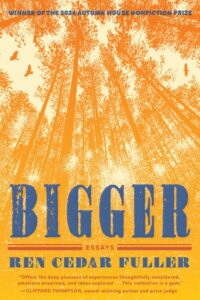
Ren Cedar Fuller’s essay collection Bigger encourages readers not only look at the world they inhabit in a bigger way, but to expand their minds and hearts toward each other – neighbor, friend, family – embracing the nuance, sprinkling the glitter, and finding the treasures hidden beneath the surface. Winner of the 2024 Autumn House Nonfiction Prize, Ren has penned an unforgettable book. I had the opportunity to interview Ren on her collection, and she was gracious to answer my questions about Bigger. Here is our conversation.
Cindy Bradley: Ren, it’s such a delight to talk to you about your incredible essay collection, Bigger, and to congratulate you on winning Autumn House’s Nonfiction Prize! Here at Under the Sun, we were introduced to your writing when you submitted “Naming My Father,” to our 2023 Summer Writing Contest. Sue William Silverman chose your piece as the winning essay, and I’ll delve into that process a little later during our conversation.
“Naming My Father” details what you believe is your father’s autism, during a time when diagnosis was in its early years and not readily available. You note “Our parents show us how people are supposed to be,” so you assumed your father’s behavior was how all fathers behaved, until you were in middle school and decided your father wasn’t normal. When you asked your mother if your father loved you, and she replied of course he loves you, you then interpreted that his aloofness, his explosions, his strangeness, was what it felt like to have a father love you – “it feels like he does not.” This is so powerful – experiencing unloving behavior from a young age and being told it is love could be a recipe for disaster in future relationships.
The ending of this essay is just beautiful. Realizing that your father most likely was autistic and never diagnosed, gave meaning to your experiences growing up, allowed you to see your father in a way previously not available. The fact that this realization came after his death compounded all the losses you experienced along the way, and in all the ways you had never felt loved by your father. Yet your father gave you a gift: “He wanted my world to be Bigger, which is what we want for those we love.” From there, your collection explodes with the notion of Bigger. My question is this: how did you feel when you realized that this was your father’s gift to you, and how did that shape your future relationships and your writing?
Ren Cedar Fuller: Hi Cindy! Thank you for your kind words. During the months when I drafted that essay, I couldn’t figure out how to end it. One day when I reread the draft, I had an epiphany. My father didn’t just happen to know those facts about San Francisco when he drove up to visit me. He had to research them. I remember feeling so excited: He researched the history of San Francisco to connect with me! I already felt compassion for him—I’d worked through the sadness and anger years before—but now I saw the love behind his strange way of communicating.
I’d written a few other essays by then, but that was the first time I experienced the power of creating meaning through crafting an essay. All the facts were the same, but essaying let me see them in a new way.
I learned while writing “Naming My Father” that it’s not enough to try to tell a good story. My essays aren’t complete until they change my view of the world.
CB: Expanding your perspective on the world and on your life by essaying certainly makes writing more meaningful. It’s interesting to me that some of your more experimental craft choices occur in the essays about your mother. We learn that your mother was born to Scandinavian parents, grew up in Ecuador, immigrated to the United States in her late teens, and married your father mere months after her arrival. She attended church and was an obedient wife. You knew your mother always told the truth, until the morning she didn’t. In “Four Words,” you write about your younger sister acting up in the backseat of the car, your father’s brimming anger, complete with flailing hands, and your knowledge your mother would not intervene to whatever punishment heading your sister’s way.
Then your mother shocked you. She uttered four words. Four words = the lie. The lie was BIG and spared your sister from your father’s wrath. From this lie, your mother’s words “taught me I could choose what I believe.” This is a profound essay in so many ways. When your oldest sister decided she no longer liked the sister in the literal hot seat of the car, you followed suit. Yet in the car that morning as your father ordered her to get in the front seat, you grabbed her hand in solidarity and protection and realized “How strange it is that fear can lead to love.” You also discovered that your mother’s lie really meant “white lies are intended to bring people closer.” Is that what your mother’s lie in the car did for her and her daughters? And can you talk a little about your craft choice for this piece?
RCF: My sisters and I have always talked about the lie the way, I suppose, people who think they’ve seen a miracle talk about that. Hushed voices, away from our parents. I started the essay after a Zoom with my sisters when one of them referred to “that time in the car,” and we all knew what she meant.
The lie didn’t bring my mother and me closer: We never talked about it. Her lie gave me a foundation to help me think differently, but she suffered from depression. Much of my independence came from having a mother who lay in bed.
CB: I can certainly understand not talking about the lie, and how, once spoken, everyone kept it tucked away. And what a gift to be permitted to think differently. We see this in so much of your writing. Your essays about Indigo are beautiful and poignant. Two themes that run through all of your essays, particularly your essays about Indigo, are acceptance and living Bigger. You write that when Indigo was young, before you had the language for it, you’d say, “Not a boy, not a girl,” when describing your child. When Indigo announced in middle school, “I’m transgender” – “It was not a bombshell for me, more of a sparkler, a shimmering flame I could hold in my hand.” In your touching essay “Let Us Sit on the Lawn,” you write about how your mother, growing up in Quito, Ecuador, “would pray to God to make me a boy.” You also write that “One of my sisters was gender conforming like me. Two were not.” The last line in the essay is so powerful: “Let us sit on the lawn and imagine a time when a child tells their parent ‘I am trans.’ …Let us sit on the lawn and listen to the parent say, ‘I thought so. How wonderful. Come here, baby.’” This imagining a Bigger world full of love and understanding for everyone is at the heart of your collection, and this essay encapsulates this so well.
In “The TARDIS in Our Living Room” we also see the notion of living Bigger as you deftly use Doctor Who’s TARDIS and its transformative powers as a vehicle for talking about Indigo’s transition. When your husband, Jason, built a replica of the TARDIS for Indigo one Christmas, Indigo told Jason “If I read a book in here, it would be Bigger on the inside.” You write that “The TARDIS entered my living room, and soon a world hidden from me grew big enough for me to see.” You created a colorful booklet for friends and family, hoping to “change the nature of the story” when illustrating Indigo’s and your family’s journey – “I suppose I was inviting them to build their own TARDIS, to remember that as parents we try to enlarge our children’s worlds. We don’t always realize they will do the same for ours.” I love what you’re doing here, highlighting the TARDIS’ size, Bigger on the inside than on the outside, to explain not only what you were experiencing, but your hope for what others could also experience.
Thinking about these essays and the truly BIG ideas they present, and the truly stunning way you present them, how did you approach these essays when you knew you wanted to write about Indigo, and land on the best ways to tell what you wanted and needed to tell?
RCF: During the pandemic, I asked Indigo if I could write about the “golden afternoon,” which is how it felt when our middle schooler came out to Jason and me. Indigo was now an adult and encouraged me to write about it. When I workshopped an early draft, however, the other writers didn’t believe the story. Their questions were about grief and trauma, but that’s not what our family experienced.
I kept trying. How could I share a different kind of story about a child being transgender? Trying to explain to people who didn’t believe me, in lots of drafts, over at least a year, led to the epiphany that the family I grew up in prepared me to have a gender diverse child. I wasn’t starting from zero. That realization helped me write “Let Us Sit on the Lawn.” Later, I wanted to write about the few golden weeks right after Indigo came out, but I couldn’t find the right structure until I was looking at family photos, and there was the TARDIS. I’d forgotten Jason gave it to Indigo the day before our child came out.
CB: The connections you make between your upbringing, and looking through family photos (a fabulous tool, by the way), with constructing these beautiful essays is so inspiring. One of the biggest surprises for me was found in “The Tar Rocks.” This is a wonderful essay that takes place during the summer between high school and college, when you almost joined the Army. Flexing your independence muscles, with salt in the air and lemon juice in your hair, you and your friend Diane spent the summer at Goleta Beach. You craved freedom, were ready to leave your family and town. Those days at the beach brought a sense of autonomy you didn’t expect. Along with bodysurfing and tar sticking to the bottoms of your feet, you learned to navigate the looks and whistles, cat calls from men, and realize, “does anyone know how to keep men from thinking they own the girls they see?”
As someone who grew up in Thousand Oaks and spent time at the beaches in Ventura and Santa Barbara, there was so much written that resonated with me, so many wonderful descriptions and lines I underlined and highlighted, like “Bodysurfing started where the larger waves began to swell. We counted for the seventh one, which everyone knew was the biggest…” and “You can’t bodysurf without sometimes going under.” Ren, you nail the Southern California beach experience, and I love it! “The Tar Rocks” also explores the idea of something gritty and “stuck” that can be cleansed and removed: “Tar was a natural part of the beach, the adults around us said, harmless and easy to wash away,” and “Back then, I didn’t realize there were beaches without tar. I thought the specks and tar balls were a natural part of the world., something to step around and – when I couldn’t avoid them – to scrub off at the end of the day.” This makes me think of what a nuisance and how stubborn that tar could be, how hard you’d have to scrub to remove all the tiny flecks, and how fresh and new your skin would feel when clean. Day after day the same ritual, the same routine. There’s a metaphor here, and I’d love to hear what this all means to you.
RCF: The summer when I was eighteen, I was a child-adult, innocent yet experienced. We weren’t supposed to complain about the tar. We weren’t supposed to talk about sexual harassment. We had to figure out for ourselves how to handle those experiences. I pretended to myself that I had figured out how to deal with the tar, how to deal with the men who grabbed my butt. How to not think about it afterward.
The ending is hopeful, though, that someday there would be beaches without tar. Somewhere, I could walk down the street and not hear catcalls. Someday I would understand the world better than when I stood on the cusp between childhood and adulthood.
CB: In your essay “I Am the Dippy Bird,” you chronicle your diagnosis of Sjögren’s syndrome, and you write “I understand my disability is strange. We call something strange when we cannot explain it.” One of the symptoms of Sjögren’s syndrome is dry eyes and the inability to produce tears. You mention that when you ran your preschool and children, parents, teachers all around you readily showed their emotions, you remained poised: “I must wait to feel big things until I am home. I have learned how to cry without tears.” Then there are the times when “sometimes a thing is so big I cannot hold it in until I reach the shower…” These big things, big emotions, are threaded throughout your collection, and here, their mention embedded in the lack of your tears, strikes me as especially moving. You realize that “I would not trade my happiness for tears. Maybe it is not a loss, my inability to cry. Maybe other people use their tears to keep themselves from feeling.” This is a fascinating essay, both in learning about Sjögren’s syndrome and in your learning to live with it. I started thinking about feeling really big emotions and not having the “expression” that tears often bring, and I wonder if you have found your capacity for “feeling the feelings” is even sharper since your diagnosis and not having the release of tears?
RCF: I should have written, “Maybe some people use their tears to keep themselves from feeling,” and not imply that all people do that. The physical act of crying connects people to their feelings. Tears manifest sadness, anger, fear, confusion.
It’s a strange thing to desperately want to cry yet have to wait until I get home and wait for the shower to warm up. The water dripping down my face becomes my tears, and I need that physical sensation. Having to wait gives me time to think about my feelings—they simmer inside me. Waiting gives me time to process, but it can be painful. I have no quick release.
CB: “The water dripping down my face becomes my tears” is so powerful! I need to let that soak in, no pun intended.
As I mentioned earlier, “Naming Our Father” won Under the Sun’s 2023 Summer Writing Contest. In her comments, judge Sue William Silverman said “Naming My Father” is “a brilliant essay. It’s completely engaging and fully realized.” Our team wholeheartedly agreed! Can you talk about what it was like winning the contest and the revision process? We also must talk about Al the alligator, your father’s pet and best friend when he was a child. We fell in love with Al and wanted more of him!
RCF: Oh, wow! I hadn’t heard that comment from Sue William Silverman. I respect her so much and have studied her craft books, so it means a lot.
Your question embodies the generosity I’ve always experienced with Under the Sun. When I entered a piece in the 2021 Fall Emerging Writers Contest, I received a fantastic rejection email from Martha Highers, which included feedback from the judge, Alison Townsend, and five readers. They gave lots of encouragement as well as the suggestion that my essay lacked narrative flow. I revised it based on the comments, and it became “I Am the Dippy Bird.”
The next year, I submitted “Naming My Father” to Under the Sun’s Summer Writing Contest and hoped for helpful feedback. I didn’t expect to win! It was exciting, and it also felt like an affirmation of the work I was doing to learn the craft of writing essays.
I’d had two essays published in small lit journals by then, but neither piece received any editing. I wanted to work with an editor—I knew my writing could be improved, and I loved working with Nomi Isenberg. The first major revision was to help the reader understand why I didn’t recognize my father’s neurodiversity earlier. We also made a few structural changes to better weave the storylines of the history of autism treatment, my dad’s life, and mine.
Then it was time to address the alligator. The Under the Sun team wondered if I could make the alligator more of a metaphor: Maybe other facts about alligators could help illuminate my father. I researched and rewrote the essay with a few more alligator elements, which were interesting, but in the end, we decided there’s such a thing as too much alligator, and we stuck with the original references.
I’ve told that story to writing groups, and more than one person suggested it must have felt frustrating to do that research and not use it. But I enjoy research. With all my essays, I’ve done huge amounts of research that wasn’t explicitly included in the piece.
CB: I love hearing this and am so glad you continued sending your work to Under the Sun and have had such a positive experience. I tell people we’re a “boutique” literary journal in the way we offer detailed, personal feedback to every essay, something our editor Martha Highers is committed to offering. Most of us are writers ourselves, so she’s wanting to provide our authors with the type of feedback we’d love to receive from sending out our own work. And Nomi Isenberg is so thoughtful, with an uncanny way of pinpointing an essay’s hidden strengths.
We love to hear about a manuscript’s journey. Can you talk a bit about Bigger’strajectory from writing and submitting to publication? Had you sent it out to many contests and presses before winning Autumn House’s Nonfiction Prize?
RCF: When I started taking writing seriously, I hoped I’d get a book published in a decade or two. In the spring of 2023, I saw a notice in Poets & Writers about a book contest for essay collections: The winning manuscript would be published by the small press. The contest mentioned a page count, and my first step toward publication was wondering if I’d written enough essays to make a book.
I put all my finished essays in a single document, and it was twenty pages short. I decided to write one more essay that summer and enter the contest for fun—and maybe I’d get feedback from the readers.
I understood a collection needs an overarching theme, but I’d written my essays as stand-alone pieces, so I created a spreadsheet. Subject, conflict, main characters, theme, opening and closing lines, my favorite line from each essay, etc.
One of my favorite lines was one you mentioned in your first question: “He wanted my world to be Bigger.” I knew the word “big” was in a few other essays, so I reread all of them to see if they shared a feeling of expansion, which they did. I spent the summer writing the final essay (“The Tar Rocks”) and honing and arranging the collection.
I researched a dozen small presses with upcoming book contests or open submission periods and started submitting the manuscript at the end of the summer. Over the next six months, I submitted to two open submissions (where I didn’t need an agent), and six book contests at small presses and university presses. I heard from two publishers that Bigger was on their finalist list but not selected, so when Autumn House Press said I was a finalist, I thought, “Always a bridesmaid. Never a bride.” A few months later, though, I got the call from Autumn House.
CB: Your process is fascinating! I love your spreadsheet idea and want to borrow it. Your collection also includes a generous Acknowledgement page, and we learn you belong to a strong writing community. I’d love for you to share with our readers how you found and forged this community and what it has meant for your writing.
RCF: I started taking online writing classes through Hugo House during the pandemic and studied for two years with Theo Nestor. She built a warm community even though we met in little Zoom boxes. A few of us recognized we worked well with each other’s feedback, and we’ve been meeting once a month for a few years. Another writing group formed from a class with Beth Slattery, when four of us asked to keep working with her.
All the essays in Bigger were workshopped by one or both of my writing groups, and those six writers, plus Beth, will join me on the stage for my book launch at Hugo House. Besides reading from my book, we’ll have a panel discussion about building a writing community.
CB: Theo Nestor is an Under the Sunner! We’ve published a few of Theo’s essays, and she won our inaugural Summer Writing Contest in 2020. She’s such an involved member of the literary community, and I’m sure she’s thrilled with your success. Your book launch with your writing partners sounds like a lot of fun, and your panel sounds informative. In addition to promoting Bigger this fall, are you currently working on any other projects?
RCF: Yes! I have a long checklist for publicizing my book, but I save time each week to work on my current project. I think it’s going to be a narrative memoir, not an essay collection, but right now I’m just drafting vignettes. It’s about my family, and I’m not ready to give more details than that—although I might need to take a research trip to Ecuador.
CB: This sounds intriguing, and definitely something we’ll be on the lookout for! Thank you so much for your generosity and time, Ren. And now, I’d like to finish with a fun lightning round of questions as we close our delightful conversation.
- Describe your happy place.
The beach. Any beach. Especially in winter.
- If Ren was a season, which season would Ren be?
I asked my family, and both Jason and Indigo said, “Spring!” and I said, “I know, right?”
- You’re planning a dinner party for writers and can invite six you admire, living or dead. Who made the invite list?
I’ll choose writers whose books I love to reread—although it’s hard to winnow the list. My favorite book as a child was Charlotte’s Web, so E.B. White. From my teen years: Alice Walker’s The Color Purple. My twenties: Milan Kundera’s The Unbearable Lightness of Being. Thirties: Toni Morrison’s Beloved. Forties: Ann Patchett’s Bel Canto. Current favorite: Ocean Vuong’s On Earth We Were Briefly Gorgeous.
- Current obsession? Could be anything – song, book, film, food, drink, you name it!
I’m writing this in August, in Seattle, and the Himalayan blackberries are ripe. I can pick and eat them while walking through Interlaken Park. Or Jason and I will go out to the peninsula and fill a bucket with berries, come home, and make a cobbler.
- What is the BIGGEST takeaway you hope readers have from Bigger?
A Swedish proverb says, “Every behavior happens for a reason.” I hope Bigger reminds readers that, despite the hurts and difficulties, they can choose to approach their loving-but-complex relationships with open-hearted curiosity.
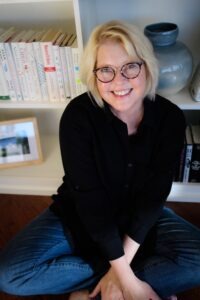
Ren Cedar Fuller’s debut book Bigger: Essays won the Autumn House Press Nonfiction Prize and was a finalist for the Iron Horse Prize and the Santa Fe Writers Project Literary Awards Program. Her essays have appeared in HerStry, Hippocampus, New England Review, North American Review, and Under the Sun, and been nominated for a Pushcart Prize and Best American Essays. Ren is a parent facilitator at TransFamilies, an online hub for families with gender-diverse children. After teaching public school, she founded a nonprofit preschool, where she continues teaching parent education. Ren lives in Seattle and loves to kayak slowly on the Salish Sea.
